
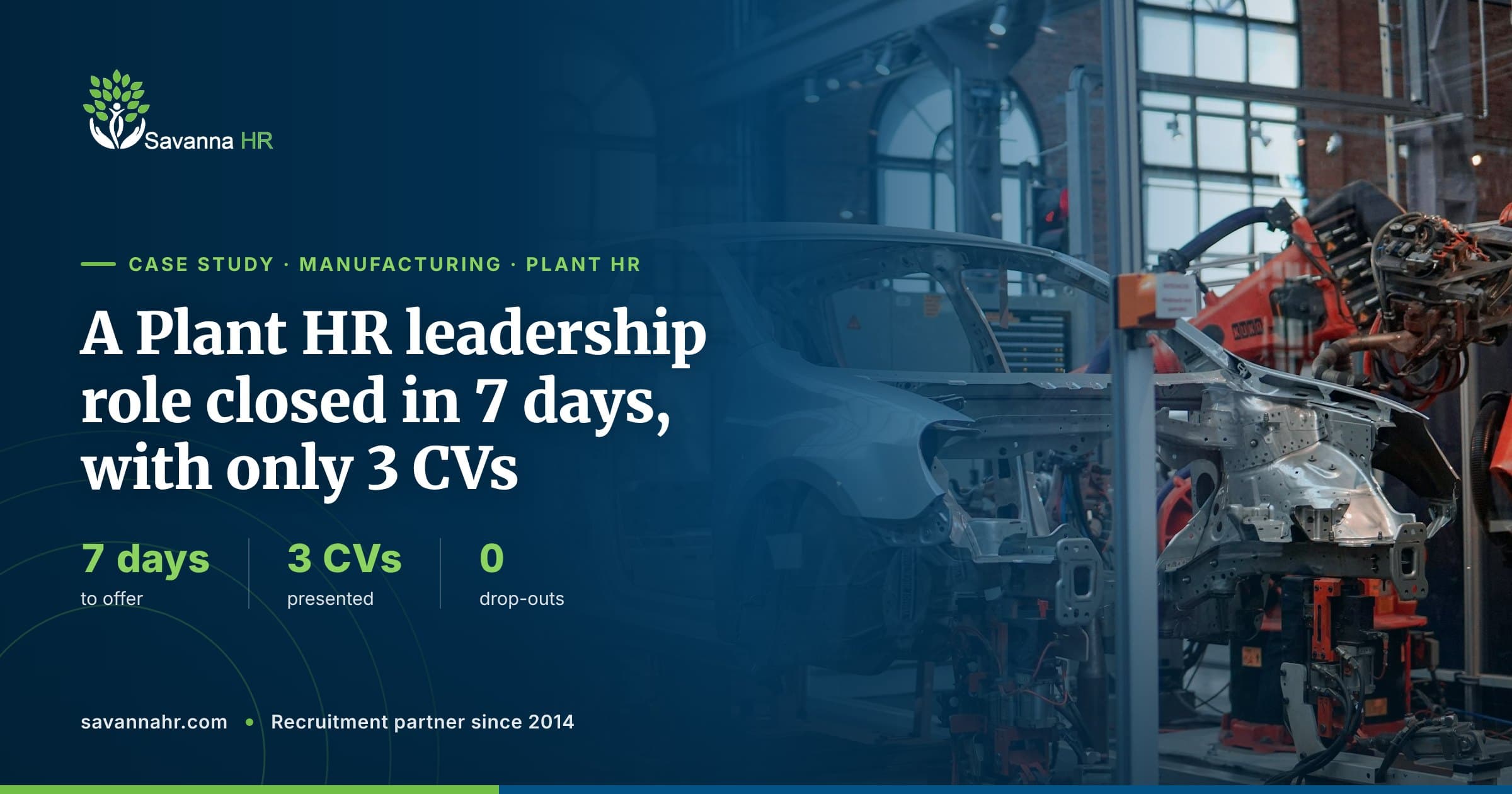
Closing a remote Plant HR leadership role in 7 days, with only 3 CVs
A global manufacturer setting up its first India plant needed a Plant HR leader at a remote site with a large workforce of women from nearby villages. We closed it in a week by screening for intent before skill.
- We decoded what the client did not write down: welfare orientation, rural-workforce credibility and relocation readiness with family on board.
- Six sourcing channels ran in parallel from day one, not one after another.
- A narrow referral ask—one name, not ten—to trusted senior manufacturing HR leaders produced the candidate who was hired.
- Our red-flag-first screen filters out counter-offer hunters in the first 15 minutes.
- HireXL narrowed thousands of profiles to about 40 for human review, so consultants spent their week on conversations, not CVs.
The situation: a first hire that would define a brand
The client is an internationally recognised manufacturer. India was a ground-up setup, and the Plant HR leader would be one of the earliest senior hires on the India payroll, setting the tone for every hire after and representing the brand to the local community and regulators.
The remote, non-metro plant employed many women from surrounding villages, often in their first formal factory job. The client sought a woman leader able to build rapport and steward welfare and discipline credibly with this workforce.
| Dimension | Detail |
|---|---|
| Role | Plant HR Lead, India operations |
| Industry | Manufacturing: global parent, India greenfield |
| Location | Remote plant; relocation mandatory |
| Workforce | Predominantly women from surrounding villages |
| Compensation | Above-market CTC plus company-provided accommodation |
| Process | Four rounds: screening, plant leadership, global HR, final fitment |
Why it was harder than it looked
Plant HR manager sounds like a deep talent pool in India. Every constraint narrowed it further: a small cohort of women with plant-HR experience, relocation to a remote site, a greenfield setup, rural-workforce experience and the rigour required for a globally watched first hire.
The sharpest risk was not sourcing. A candidate who completes multiple rounds only to extract a counter-offer is costly in any senior search, especially for a first India hire.
| Constraint | What it ruled out | What remained |
|---|---|---|
| Preference for a woman leader | Most senior plant HR and IR profiles | Women with factory-floor HR experience |
| Remote plant | Metro-loyal candidates and dual-career couples | People open to relocation |
| Greenfield setup | Candidates who prefer established SOPs | Self-starters who have built systems from zero |
| Rural women workforce | Corporate-office-only HR profiles | People with shop-floor welfare experience |
| Above-market pay plus housing | Offer shoppers | Candidates with a genuine reason to relocate |
Our approach: five phases, run in parallel
- Role decoding on day 0: a 90-minute session with India leadership and global HR surfaced welfare, transport, crèche, safety, location realities and the client’s 24-month outcome.
- Multi-channel sourcing on days 1–2: LinkedIn Recruiter, niche job boards, manufacturing HR communities, Savanna HR alumni, HR-institute alumni networks and targeted paid social all ran at once.
- Referral engine on days 1–3: senior manufacturing HR leaders were asked for one specific name. A referral on day 2 surfaced the eventual hire.
- Red-flag-first screening on days 2–4: test the reason for leaving, current-employer awareness, family alignment, non-pay motivators, CV accuracy and CTC transparency before investing in skill evaluation.
- Alignment and closure on days 5–7: compress four interviews into three days, briefing the candidate and debriefing the client between each step.
| Red-flag signal | What it means | Action |
|---|---|---|
| Vague reason for leaving | Testing the market | Deprioritise |
| Current employer unaware | Higher risk of late withdrawal | Raise it explicitly |
| Family not aligned on relocation | Strongest predictor of remote-role drop-out | Require a family conversation before round 2 |
| Pay is the only motivator | A small outside offer can flip the decision | Probe for other motivators |
| CV and conversation do not match | Will fail global HR review | Reject early |
Outcome
The offer went out on day 7 and was accepted within 24 hours. The candidate received a CTC uplift of more than 25% and joined on schedule. There was no post-offer negotiation, no notice-period fallout and no replacement needed.
What made the difference
- Intent before skill. Skill can be checked on a CV and reference call; intent decides whether an offer closes.
- A narrow ask to a trusted network. One specific request to the right referrer beat every sourcing channel.
- Decoding what was not written down. Surfacing unwritten requirements on day 0 saved days of sourcing in the wrong direction.
- AI for volume, people for judgement. HireXL screened thousands of profiles in the first 48 hours and surfaced the top 40.
Frequently asked questions
How quickly can a Plant HR head be hired in India?
It depends on location and constraints. For this remote greenfield plant, Savanna HR extended an offer on day 7, the candidate accepted within 24 hours and joined on schedule.
Why do senior manufacturing candidates drop out late?
Most late drop-outs are intent failures, not skill failures: candidates may be interviewing for a counter-offer or have family members who have not agreed to relocate.
How do you hire HR leaders for remote manufacturing plants?
Decode unwritten requirements, source in parallel across specialist channels, ask trusted HR peers for focused referrals and require a family conversation about relocation before the second interview.
Does Savanna HR hire for manufacturing companies?
Yes. Savanna HR hires plant leadership, HR and IR, EHS, supply chain and shop-floor management roles across India’s industrial corridors.
More case studies
23 hires in 2 months for a funded EdTech company, while repairing its employer brand
23 · 98% · 96% · 1
A funded company selling degree and certification courses needed to scale fast, but its Google, Glassdoor and AmbitionBox reviews were putting candidates off. We fixed the reasons people were saying no while we hired.
Read case study →HealthTech · CTO · LeadershipHiring a CTO for a Series-B HealthTech startup in 9 weeks
9 weeks · 185 → 1 · 38% → 19% · Daily
The company was little known, had 38% attrition, negative employer reviews and a final interview round that sent candidates away confused. Here is how we placed a CTO anyway, and what changed six months later.
Read case study →Setting up or scaling a plant in India?
We hire plant leadership, HR and IR, EHS, supply chain and shop-floor managers across India's industrial corridors.
Submit a requirementMore case studies


