The client did not have a recruitment problem. They had a roadmap problem that looked like a recruitment problem - an AI product agenda in a retail category consolidating faster than they could staff for it, in the tightest engineering talent market in India.
01Why this was the hardest brief in the market
Before the numbers mean anything, the difficulty has to be established. Three independent datasets say the same thing about AI engineering talent in India.
The pool does not exist yet
Bain & Company projects India will have more than 2.3 million AI job openings by 2027 against a talent pool of roughly 1.2 million - openings running at 1.5 to 2 times available talent, the largest absolute shortfall of any market Bain measured. NASSCOM and Deloitte India independently put projected 2027 supply at 1.25 million, closely corroborating the supply side. Zinnov's 2026 India GCC study puts the current demand-supply gap at 51%, against an India AI talent pool of about 416,000 professionals.
Demand is concentrating, not broadening
In June 2026, Naukri JobSpeak recorded AI/ML role postings up 25% year on year while the IT sector overall fell 3% - same index, same month. This is not a general hiring boom. It is a scramble for one category.
Seniority is the choke point
TeamLease Digital's assessment, reported in Outlook Business, is that for every ten open GenAI roles in India there is one qualified engineer available, with innovation-linked pay compounding at over 18% a year while mainstream skills such as full-stack, API and DevOps taper to 2-3% and legacy systems maintenance stays flat. An analysis of 950 postings across five Indian metros by 1 Finance found AI skills commanding a 38% median salary premium at the 10+ year level - Rs 36 lakh against Rs 26 lakh for comparable IT roles.
And a D2C brand is bidding against everyone
India now hosts 2,117 Global Capability Centres employing 2.36 million people, with 1,200+ running embedded AI/ML mandates and a GCC AI talent pool of 250,000. Zinnov recorded a 21.1% salary increase for AI/ML roles in Indian GCCs in 2026 against 9.8% overall. AI-first Indian startups grew hiring 21% year on year as of May 2026, against 12% for the wider startup ecosystem. Every one of those employers wants the same engineer.
The commercial clock, on the other side of the equation
The client is not hiring engineers for their own sake. India's beauty and personal care market is $23 billion, growing at 12% CAGR toward $40 billion by 2030, with e-commerce penetration moving from roughly 8% five years ago to a projected 34-38% by 2030. Quick-commerce beauty sales are approaching $1 billion annualised and growing around 90% year on year - and the top 75 brands take 75% of the spend. A concentrating, winner-takes-most channel.
Meanwhile the interface itself is moving. In June 2026 Nykaa's Beauty and Fashion storefronts became connected apps inside ChatGPT, alongside a phased, multi-year internal rollout across marketing, support, finance, supply chain and operations. Nykaa's Chief Product and Technology Officer put it plainly: "Traditional search-and-scroll shopping models are likely to evolve as conversational interfaces become more capable."
The commercial payoff is measurable - in Western markets, where results have actually been published. Clarins' AI shade finder reports a 96% match rate against a professional makeup artist and doubled basket sizes in France and UK pilots; e.l.f. Beauty reports a 3x conversion increase with IlluminateAI, sustained nine months post-launch; FitSkin's SkinScanner - over 40 million scans a year across its deployments - doubled average basket size at Sephora when used by store staff. Gorgias reports that brands using its AI shopping agent nearly doubled conversion rates against those using AI for support only - a vendor figure, but directionally consistent with the branded results above.
Where the evidence stops
No Indian beauty company has yet published quantified AI performance results. Every AI-performance number in the paragraph above comes from a Western deployment - Clarins, e.l.f., FitSkin or Sephora. Indian players have shipped the features; the published ROI evidence sits with global peers. What is not in doubt is the direction of travel - or that the market leader has already started the clock.
So the brief was: build an AI engineering capability, in the tightest talent market in the country, before the category consolidates.
02What "normal" would have cost the client
The value of speed only reads if you know what slow looks like. Four figures define the counterfactual.
- Technical roles take 75 days to first fill, against 60 for business roles - Ashby's benchmark across 54 million applications and 93,000 jobs. Recruitment-industry estimates for senior AI/ML roles in India run 50 to 90 days, though sources vary widely and none is survey-grade.
- Then the notice period starts. Mid-level and senior notice periods in Indian IT are conventionally 60 to 90 days. Requisition to a productive engineer at a desk is therefore realistically four and a half to five and a half months - our calculation from the two figures above, not a published benchmark.
- Offers do not all hold. Ashby puts technical offer acceptance at 73%, eleven points below business roles. At a 70% acceptance rate, five hires need roughly seven offers - each preceded by its own search.
- Run as staggered, partly overlapping searches, a five-person AI team is six to nine months away - run strictly one after another, far longer. For a brand competing in a channel growing 90% a year, that is not a hiring delay. It is a missed season.
03The operating system: five layers, two recruiters
What follows is the actual process, described in full. The differentiator is not that we used AI - iCIMS and Aptitude Research find 69% of companies now use AI in hiring somewhere, though only 18% use it broadly. The differentiator is where the AI sits, and where the recruiter sits.
Agentic market mapping
Before a single CV moved, agents mapped the market: who is building comparable AI systems in D2C and consumer internet, what stacks they run, where compensation bands actually sit for this seniority in this category, and which teams were in a position to move.
The output was not a longlist. It was a calibrated brief - client and recruiters working from a shared, evidenced picture of what was buyable at what price. This is the step most agencies skip, and it is why most mandates re-scope in week three.
Distribution that reaches active talent
3 of 6 closures came from these direct applications - all three immediate joinersRoles were published to social channels and Google job distribution, deliberately targeting active talent pools rather than only passive outbound.
That runs against recruiting orthodoxy, so it is worth grounding. Inbound is a volume channel: Ashby's data shows inbound converts to interview at about 3% against 25% for sourced candidates. But inbound is also 94% of all applications, and still produces roughly half of all hires - 52% in Q2 2025, the highest in four years.
Inbound is not lower quality. It is lower precision and higher velocity - and when the constraint is time to a joined engineer, velocity is what you want. An active applicant who can start in fifteen days beats a marginally better-fit passive candidate serving ninety days' notice. In India that arithmetic is brutal. foundit's Employer Hiring Urgency Index finds 27% of roles now need a joiner inside 15 days, while only 14% of candidates can join that fast - a gap that widened as employer demand for immediate joiners rose 58% since 2022 against a 12% rise in availability. Distribution, done properly, is how you find the 14%.
Talent-pool rediscovery in 15-20 minutes
2 of 6 closures came from our existing databaseIn parallel, AI agents searched Savanna HR's own talent pool on HireXL - years of parsed, structured, relationship-mapped candidate data - and returned exactly-matching profiles in 15 to 20 minutes.
This is the most under-used asset in most recruiting functions. Gem's benchmark data - 165 million applications, 1.2 million hires - shows rediscovered candidates rising from roughly a quarter of all sourced hires in 2021 to 46% in 2025. The database has quietly become the primary sourcing channel. The obstacle was never the data; it was that searching it properly took a recruiter a day. Semantic agent search collapses that to the length of a coffee break - which changes what a recruiter can afford to do before lunch.
AI screening that finds gaps, not just matches
Profiles were screened by AI agents against the calibrated brief. The output was deliberately two-sided: where the candidate matches, and where the candidate does not. Named gaps. Specific ones.
The efficiency evidence is strong. In Bullhorn's 2026 survey of around 2,300 recruitment professionals, 46% of firms report AI has cut screening time in half or better, and 55% report AI screening alone improved KPIs by more than 25%.
But we build screening to characterise rather than to filter because of the failure mode on the other side. Harvard Business School and Accenture's Hidden Workers research found that more than 90% of employers use a recruitment management system to filter or rank candidates before a human sees them - 94% for middle-skills roles, 92% for high-skills. And 88% of employers agree that qualified high-skills candidates are vetted out of the process because they do not match the exact criteria in the job description, rising to 94% for middle-skills workers. A screening agent tuned to reject is an efficient way to lose the person you needed. A screening agent tuned to characterise hands the recruiter a hypothesis to test.
The recruiter call - where the decision is actually made
Every shortlisted candidate got a recruiter on the phone. Skills probed. Tech stack verified. The AI-identified gaps put directly to the candidate and either validated or dismissed.
This is not a courtesy step. It is the step the evidence most strongly supports. The largest field experiment yet conducted in this area - run by researchers at Chicago Booth and Erasmus Rotterdam, published July 2026 - 70,000 job applicants randomly assigned to AI or human interviews, with human recruiters making every final decision in both arms - found AI-conducted interviews produced 12% more offers, 18% more job starts and 18% better 30-day retention, with no decline in the productivity of hires. The mechanism the authors identify is controlled variance: AI produced more consistent, more decision-relevant information for humans to judge. It is evidence that AI improves what humans decide on - not evidence that AI should decide.
Practice agrees. In the same iCIMS research, recruiter judgement overrides AI in 58% of organisations, and 80% report recruiters now spend more time on candidate engagement than before. And candidates know the difference. Dice's 2025 survey of US tech professionals found 80% trust human-led hiring, 46% trust hybrid AI-plus-human, and only 14% trust fully AI-driven hiring.
Our position
Not that AI screens and humans rubber-stamp. Agents compress the search space; the recruiter makes the call. Every metric below is a product of that division of labour, not of automation.
04The numbers
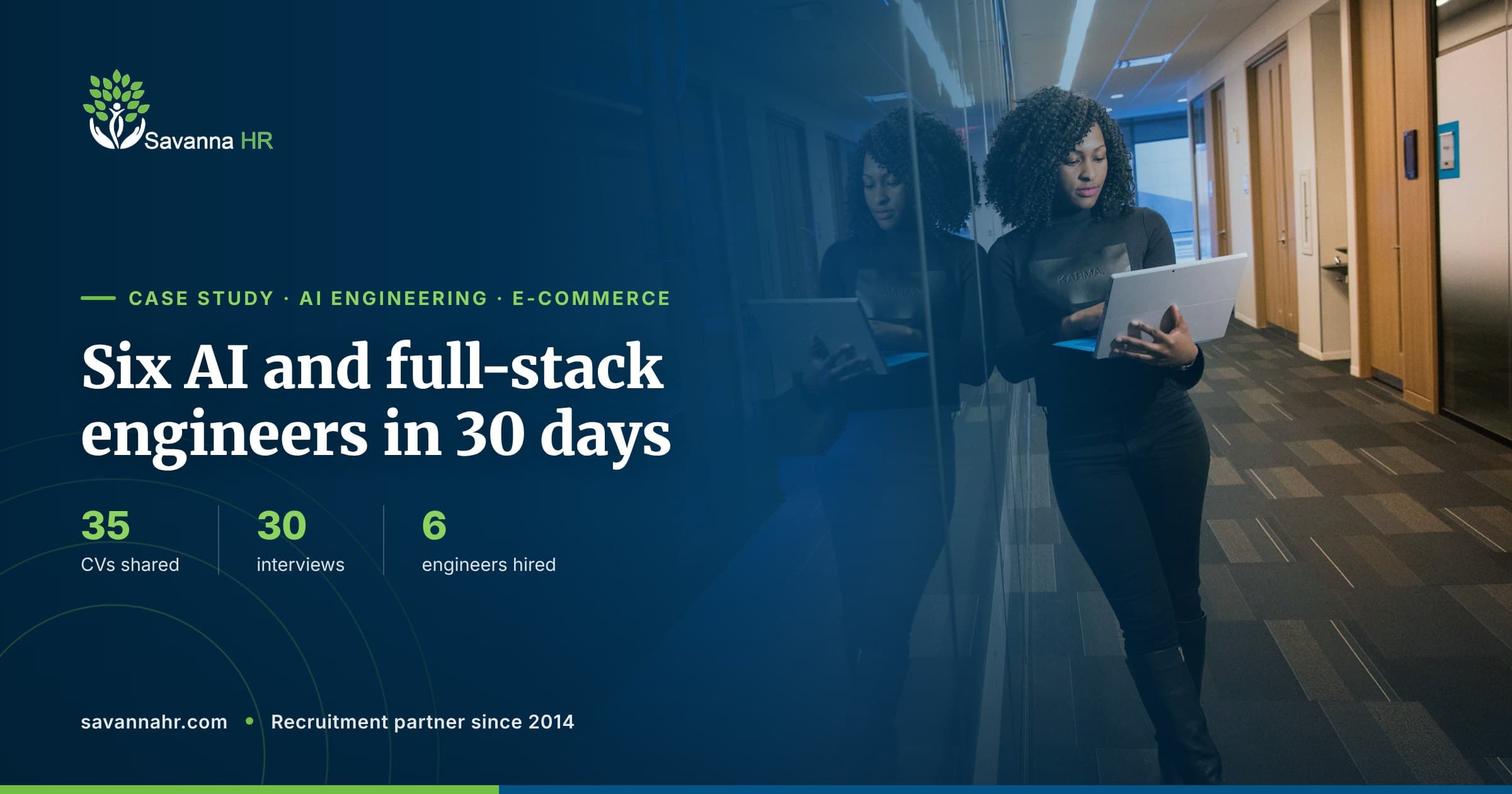
One month. Two recruiters. One client.
| Stage | Volume | Conversion |
|---|---|---|
| CVs shared | 35 | - |
| Candidates interviewed | 30 | 85.7% of CVs shared |
| Offers generated | 8 | 26.7% of interviews |
| Offers accepted | 6 | 75.0% of offers |
| Joined | 4 | 67% of acceptances, within the cycle |
| Joining within 15 days | 2 | 100% of acceptances accounted for |
Against benchmark
| Metric | This mandate | Benchmark | Source |
|---|---|---|---|
| CVs shared per hire | 5.8 | 27 qualified candidates per hire (engineering, Asia) | Workable |
| CV-to-interview rate | 85.7% | 35% recruiter-screen passthrough | Ashby |
| Interview-to-offer rate | 26.7% | 6% sourced; 16% referral | Ashby |
| Offer acceptance | 75.0% | 73% technical, 78% all roles (Ashby); 82% all roles (Gem) | Ashby / Gem |
| Time to fill | ~30 days for six acceptances | 75 days to first technical fill | Ashby |
| Acceptance-to-joining | 100% committed | No credible India benchmark published | - |
Three of those rows deserve honest reading rather than a victory lap.
The CV-to-interview rate is the headline - and the one we would defend hardest
At 85.7%, nearly every profile shared was worth the hiring manager's hour. Against a 35% screen-passthrough benchmark, that is roughly 2.4x the industry norm - with one honest caveat: Ashby measures passthrough at an employer's own recruiter screen, while our figure measures what survives our screen and reaches the client's calendar. Comparable in its effect on hiring-manager hours; not identical in funnel position. At 5.8 CVs per hire against a benchmark of 27 qualified candidates per hire, it represents around 4.6x less screening load placed on the client's engineering team. For a company whose engineers are the scarce resource, the hours not spent interviewing are worth as much as the hires.
The offer acceptance rate is good, not extraordinary - and the speed is what makes it interesting
75% sits marginally above Ashby's 73% technical benchmark. We are not going to claim a breakthrough on a two-point margin. The claim we will make is that benchmark-level acceptance was sustained in 30 days against a 75-day median to first technical fill - under half the benchmark timeline, for six acceptances rather than one, in the scarcest talent category in the country. Speed usually costs you acceptance. Here it did not.
The joining ratio is the number we are proudest of and can prove least
Six offers accepted, four joined, two with confirmed start dates inside fifteen days. Candidate reneging is a long-documented problem in Indian technology hiring - but no credible organisation has published a quantified renege rate for the Indian market, so we cannot show you a benchmark to beat. What we can show you is our own number: 100% of accepted offers held. Judge it against your own experience of the last five senior offers you made.
Where the hires came from
| Channel | Closures | What it tells you |
|---|---|---|
| Direct applications via social + Google distribution | 3 | All immediate joiners. Distribution reaches the 14% who can start inside 15 days. |
| Agent-led rediscovery from the HireXL talent pool | 2 | 15-20 minutes from search to matched shortlist. |
| Agent-led market mapping and targeted outreach | 1 | The hardest role. Precision, not volume. |
Three channels doing three different jobs. No single-channel strategy would have closed this mandate in thirty days - and that is the actual finding.
05What AI did not do, and what we watch for
A case study that only reports the wins is marketing. Here is the other side, because any serious talent leader will ask.
Bias in automated screening is measurable, not hypothetical
A 2024 University of Washington study - 550+ real resumes, 500+ job listings, over three million resume-to-job comparisons across three production language models - found white-associated names favoured 85% of the time against 9% for Black-associated names, and male-associated names preferred 52% against 11% for female-associated names. It is why our agents characterise and rank rather than reject, why every shortlist passes a human, and why the recruiter call is non-negotiable.
Candidates are gaming AI screening
A May 2026 study of 196,682 de-identified resumes found roughly 1% contained hidden prompt injections, over 90% of them fabricated skills planted for the machine to read - a rate that spiked in 2024. Separately, in Greenhouse's 2025 study 41% of job seekers admit to using prompt injection to bypass filters. The measured rate and the admitted rate differ by a factor of forty, which tells you something about both. Either way, a skills conversation with a human recruiter is the control that catches it.
Candidate trust in AI hiring is low and falling
Greenhouse's November 2025 study of 4,136 job seekers and hiring managers found 46% of job seekers reporting decreased trust in hiring over the past year, with 42% attributing the decline directly to AI. 87% say employer transparency about AI use matters to them. We tell candidates how the process works.
Regulation is moving
Recruitment AI is classified high-risk under Annex III of the EU AI Act; the compliance timetable for stand-alone Annex III obligations has been subject to amendment - postponed from 2 August 2026 to 2 December 2027 under the omnibus agreement - and should be checked against the current position before any cross-border deployment. For clients hiring into Europe, this is a live design constraint, not a footnote.
06The replicable model
For talent acquisition leaders who want the operating system rather than the story, this is the sequence. It works at two recruiters or twenty.
- Calibrate before you search. Agent-led market mapping produces a shared, evidenced brief. Most re-scoping happens because this step was skipped.
- Run three channels in parallel, not in sequence. Distribution for velocity and immediate joiners. Database rediscovery for precision at speed. Targeted outreach for the roles the market will not hand you.
- Search your own data first - and make it take minutes. Rediscovered candidates are now 46% of sourced hires industry-wide. If searching your ATS takes a recruiter a day, it will not happen.
- Tune screening to characterise, not to filter. Output the gaps, not just the match. Over-filtering is a well-documented failure mode of automated screening.
- Put a recruiter on every shortlisted candidate. Validate skills, stack and machine-identified gaps by voice. This is where the decision is made.
- Measure CV-to-interview, not CVs sent. It is the only funnel metric that tells you whether you are respecting your hiring manager's time.
And for founders and CTOs
The translation is simpler. On a five-to-six person AI and full-stack build, the difference between a thirty-day cycle and a sequential six-to-nine-month one is roughly two to three quarters of shipped roadmap - in a category where quick commerce is growing 90% a year, the market leader has already integrated with a frontier AI platform, and BCG's survey of 1,250 senior executives finds AI leaders expecting twice the revenue increase and 40% greater cost reductions than laggards in the areas where they apply AI.
Work with us
Get your first set of relevant profiles within 5-6 hours of opening a role.
Savanna HR has been hiring for fast-growing Indian and global companies since 2014 - 100+ clients, 3,500+ joinings, and a technology stack we build ourselves. HireXL is our AI-enabled recruiting platform: a continuously enriched talent pool, semantic matching, agent-led screening, and analytics that show you the funnel while it is running, not after.
Frequently asked questions
How quickly did Savanna HR hire the AI engineering team?
Six AI and full-stack engineers accepted offers in 30 days. Four joined in the cycle and two had confirmed start dates within 15 days.
Which AI engineering roles were included?
The mandate covered full-stack developers, AI engineers and a founding AI engineer for a D2C beauty e-commerce company.
How did AI support the hiring process?
HireXL supported market mapping, talent-pool rediscovery and screening. Recruiters validated skills, technical stack and AI-identified gaps with every shortlisted candidate.
Does Savanna HR provide technology hiring services in India?
Yes. Savanna HR hires technology, product, data and AI talent for high-growth companies across India.
Notes on this case study
Client anonymised at the client's discretion. All funnel figures are Savanna HR internal data for a single mandate over a one-month period, reported as at 18 August 2026; the two pending joiners have confirmed start dates within 15 days of that date. Single-mandate results are not a guarantee of comparable outcomes. Every external benchmark quoted is attributed in the text to the organisation that published it; where no credible published benchmark exists we have said so rather than substitute an estimate.


