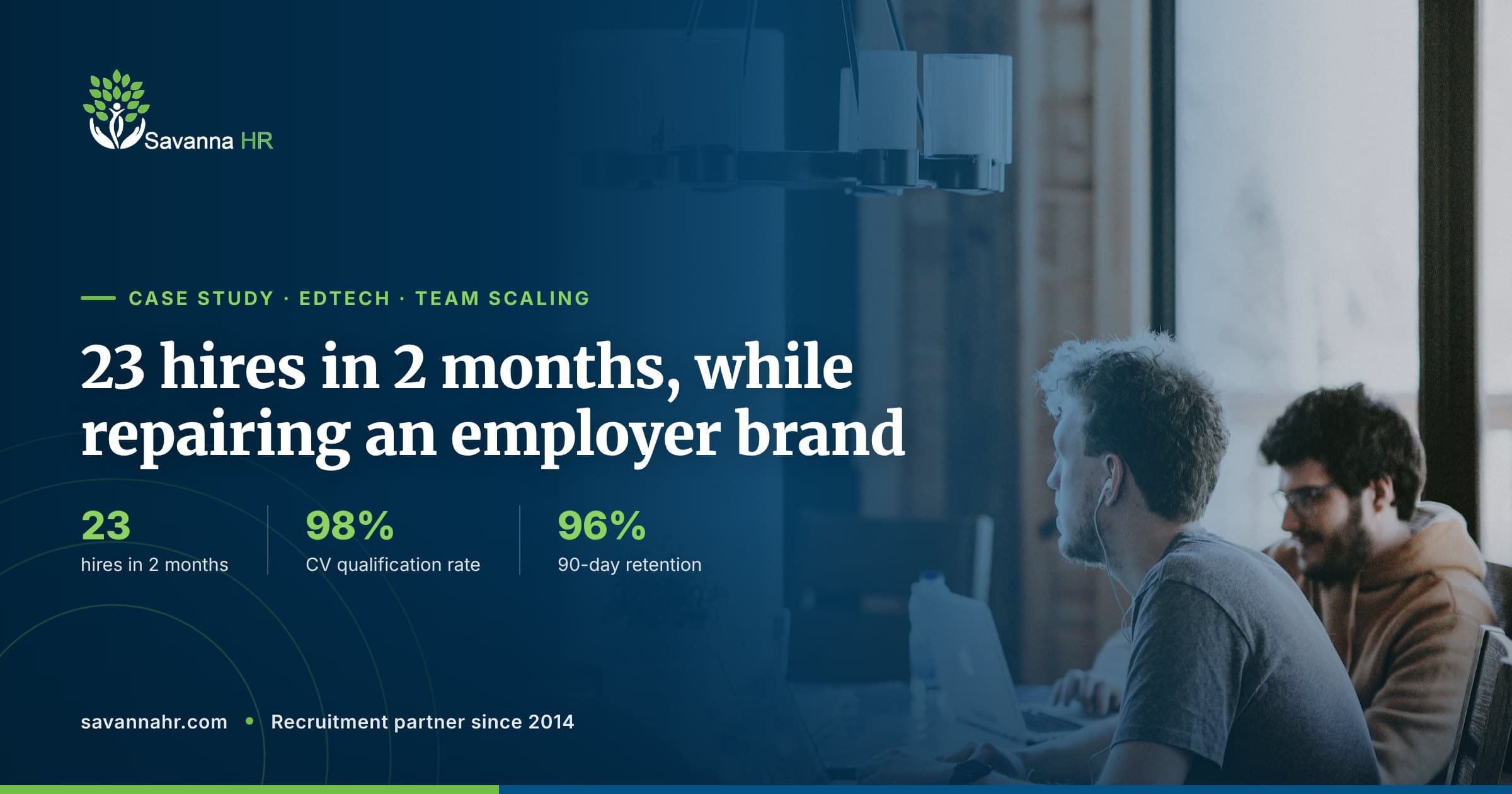
23 hires in 2 months for a funded EdTech company, while repairing its employer brand
A funded company selling degree and certification courses needed to scale fast, but its Google, Glassdoor and AmbitionBox reviews were putting candidates off. We fixed the reasons people were saying no while we hired.
- Reputation is a hiring problem. Unanswered reviews about refunds, job guarantees and long hours were costing the client candidates before the first call.
- We worked on reviews, exits and working hours in parallel with hiring, not after it.
- Every candidate heard about targets, peak periods and working hours before their CV was submitted. That is why 98% of CVs qualified and 96% of hires were still there after 90 days.
- AI handled sourcing, screening and interview summaries. A recruiter reviewed every output.
The client and the mandate
Most agencies would have treated this as volume hiring. We saw an employer-brand and operations problem that would keep undoing any hiring we did.
| Dimension | Detail |
|---|---|
| Industry | EdTech: degree courses and certification programmes |
| Stage | Funded, relatively new entrant with strong investor backing |
| Revenue model | Course sales, concentrated on weekends and before appraisal seasons |
| Team situation | Understaffed, high attrition, burnout during peak sales periods |
| Online reputation | Average Glassdoor and AmbitionBox ratings, negative Google reviews, zero public responses |
| Mandate | 23 roles, plus reputation management and process improvement |
| Timeline | 2 months |
| Competition | Several agencies working the same roles at the same time |
The challenge: two problems feeding each other
A reputation that spoke before the company did. Customer reviews on Google centred on a money-back policy that was not being honoured and a job-guarantee programme that left subscribers unhappy. Employee reviews on Glassdoor and AmbitionBox described long hours, unrealistic targets and difficult managers. The company had not replied to a single review.
When we spoke to the CRM team, we found they had already resolved many complaints over the phone, and some customers had removed their reviews. None of that was visible publicly, so the unanswered reviews defined the brand.
Leadership knew the teams were short-staffed but had no hiring plan. Existing staff were burning out over weekends and pre-appraisal peaks. Exits were messy: delayed Full & Final settlements and terminations without a performance improvement plan turned leavers into new negative reviewers. And other agencies were pitching the same candidates.
Our approach
- Google reviews: respond publicly to resolved complaints, flag reviews that break platform policy, invite satisfied learners to share their experience and map sentiment by theme.
- Glassdoor and AmbitionBox: set expectations about targets, hours and peak demands before candidates accept; trade peak-period overtime for flexibility on lighter days; announce predictable workload peaks in advance.
- Culture and retention: acknowledge the manpower gap, track burnout and exit reasons, document PIPs and process Full & Final settlements on time.
- AI-enabled workflow: use HireXL for matching, skill-fit scoring, duplicate detection and structured interview summaries, with recruiter review at every step and live client pipeline visibility.
- Candidate experience: give rejected candidates specific feedback and collect declarations on availability, notice period and exclusivity.
- Onboarding: provide every hire with a documentation pack and a 90-day plan with milestones.
Every exit is either a brand ambassador or a brand detractor. The choice is in how you handle the last 30 days.
Results
| Metric | Result | Context |
|---|---|---|
| Total hires | 23 in 2 months | While other agencies worked the same roles |
| CV qualification | 98% | Very few duplicates; candidate declarations on file |
| Early attrition | 1 of 23 | One person left within a month; everyone else stayed |
| 90-day retention | 96% | Pre-submission due diligence removed mismatches |
| Hiring cycle time | About 40% faster | AI-assisted workflow compared with traditional methods |
| Onboarding | 90-day plan | For every hire |
Savanna HR's approach was fundamentally different from any other agency we worked with. They didn't just send us CVs; they partnered with us to fix the underlying issues that were making hiring difficult in the first place. — Client leadership team, funded EdTech company
Lessons for EdTech founders and HR heads
- Reputation management is a hiring strategy. Fix reviews and their root causes before expecting strong candidates to say yes.
- Document resolutions publicly. If you do not write the narrative, your critics will.
- Set expectations during hiring, not after. People who know about targets and peak hours before joining stay longer.
- Handle exits with dignity. A documented PIP and on-time Full & Final settlement turn leavers into neutral or positive alumni.
- Use AI for volume, humans for judgement. That combination gave both speed and a 98% qualification rate.
- EdTech needs specialist recruiters. The mix of teaching empathy, commercial drive and comfort with technology is easy to miss with generic filters.
Frequently asked questions
How did Savanna HR hire 23 people in 2 months for an EdTech company?
By fixing the reasons candidates were saying no at the same time as sourcing. Savanna HR repaired the company's Google, Glassdoor and AmbitionBox narrative, recommended structural fixes to working hours and exits, and ran sourcing, screening and interview summaries through HireXL, with a recruiter reviewing every step.
What results did the EdTech hiring engagement deliver?
23 hires in two months, a 98% CV qualification rate, 96% 90-day retention and only one early exit out of 23, while other agencies were working the same mandates.
Can negative Glassdoor and Google reviews hurt EdTech hiring?
Yes. Candidates read them before they reply. Publicly documenting resolutions, flagging reviews that break platform policy and asking satisfied learners and employees to share their experience rebalanced the picture.
How do you reduce early attrition in EdTech sales teams?
Tell candidates about targets, weekend peaks and working hours before they accept, compensate peak-period overtime with flexibility on lighter days, run documented PIPs before any exit, and settle Full & Final dues on time.
More case studies
Hiring a CTO for a Series-B HealthTech startup in 9 weeks
9 weeks · 185 → 1 · 38% → 19% · Daily
The company was little known, had 38% attrition, negative employer reviews and a final interview round that sent candidates away confused. Here is how we placed a CTO anyway, and what changed six months later.
Read case study →Manufacturing · Plant HR · GreenfieldClosing a remote Plant HR leadership role in 7 days, with only 3 CVs
7 days · 3 CVs · 24 hours · 0
A global manufacturer setting up its first India plant needed a Plant HR leader at a remote site with a large workforce of women from nearby villages. We closed it in a week by screening for intent before skill.
Read case study →Scaling an EdTech team?
Share one critical role. We will show you profiles that match the mandate before we talk about an engagement.
Submit a requirementMore case studies


