
The 55% of university hiring nobody talks about
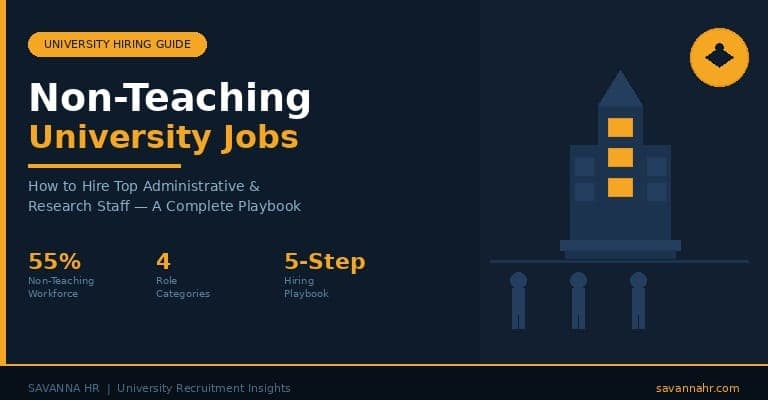
Roughly 55% of the typical university workforce is non-teaching: registrars, deans of operations, financial controllers, research grants managers, lab managers, student affairs professionals, communications leads, IT staff, and a long tail of specialist roles. These people run the university. And yet, while faculty hiring attracts boards, committees, and branded campaigns, non-teaching hiring is often treated as a clerical exercise — posted on generic job boards, screened by overworked HR generalists, and filled with whoever happens to be available.
Quick answer
Non-teaching staff make up over half of a typical university workforce. Hire them in four groups, each with its own playbook: senior leaders such as Registrar, CFO and CIO through executive search; research administrators through deliberate sourcing; student affairs professionals for judgement and empathy; and technical staff with market-aligned pay.
The cost of this neglect is significant. A weak director of research administration can cost a university ₹5–10 crore in lost grant capture over three years. A mediocre chief communications officer can reduce applications by 8–12%. A poor IT leader can delay digital transformation by 24 months. Non-teaching roles are high-leverage, and they deserve recruitment strategies as rigorous as faculty hiring.
The four categories of non-teaching hiring — each needs a different playbook
| Category | Examples | What makes hiring hard |
|---|---|---|
| Senior leadership | Registrar, CFO, CIO, Dean of Operations | Rare profile combining higher-ed + corporate experience |
| Research administration | Grants manager, research operations, compliance | Specialist niche; weak pipeline; low visibility |
| Student affairs & operations | Dean of students, counseling, career services | High emotional intelligence needed; often undervalued |
| Technical & research staff | Lab managers, data engineers, instrument specialists | Compete directly with industry on comp |
Category 1: Senior leadership — the registrar and beyond
The modern university registrar, CFO, or CIO is a C-suite equivalent. The best candidates sit at the intersection of corporate operational experience and higher-education sector fluency. Hiring them looks more like executive search than HR recruitment: a disciplined search process, executive interview panels, and negotiation on total compensation structured with corporate-like variable components.
Common mistakes: promoting an excellent operational middle manager internally without external benchmark; hiring a corporate CFO with no higher-ed exposure and no transition support; under-budgeting the role 25–40% below market, then wondering why the search stalls at 9 months.
Category 2: Research administration — the hidden lever
Research administrators — grants officers, research operations directors, compliance leads — are the single highest-ROI non-teaching roles in research-intensive universities. A top research administrator can increase grant capture by 20–35% over 3 years by improving proposal quality, compliance readiness, and post-award management.
The pipeline is thin. Most research administrators are trained on the job, not through a formal programme. Sourcing has to be deliberate: industry sponsored-research managers, former CROs, pharma R&D ops leaders, and senior PhD graduates who do not want a faculty career path but love the research ecosystem. Savanna HR maintains a dedicated research admin sub-pipeline for exactly this reason.
Category 3: Student affairs and operations
Roles like Dean of Students, Director of Counseling, and Head of Career Services are often the face of the student experience. They require a specific blend: empathy, operational rigour, and the ability to navigate complex multi-stakeholder environments (students, parents, faculty, regulators). Our data shows that universities that invest in senior student affairs leadership see 3–5 point improvements in NSS-equivalent student satisfaction scores and reduced mental health crises.
Hiring tip: treat the interview process itself as a demonstration. Have candidates meet students informally. The candidate who genuinely connects is almost always the right hire; the one who treats it as a transaction almost never is.
Category 4: Technical and research staff — competing with industry
Lab managers, data engineers, bioinformaticians, instrument specialists, and similar roles are where universities lose the hardest battle: they compete directly with industry on compensation and often lose by 40–80%. The answer is not to match industry comp (mostly impossible) but to reframe the value proposition:
- Work stability and benefits (pension, tenure-track for senior technical roles, sabbaticals).
- Intellectual freedom — opportunity to co-author, present at conferences, pursue their own projects.
- Cutting-edge equipment and collaboration networks unavailable in most industry contexts.
- Part-time or consulting arrangements that allow industry moonlighting within policy bounds.
Universities that articulate this well can hire top 25% technical talent at 50–65% of industry comp. Universities that try to compete on base salary alone rarely hire at all.
A unified hiring playbook for non-teaching roles
Across all four categories, the same 5-step playbook works:
- Build a scorecard. Not a JD dump. A 4-factor scorecard: capability, track record, cultural fit, growth trajectory.
- Source specialised. Don’t rely on generic job boards. Use industry associations (SCUP, NACUBO, NACAC, AACRAO for higher-ed ops) and role-specific communities.
- Structured interviews. Same rigor as faculty — behavioural questions tied to competencies, multi-evaluator, independent scoring.
- Reference depth. At least one off-list reference. Ask specifically about operational track record, not personality.
- Onboarding that respects seniority. 30/60/90 with clear deliverables, access to senior leadership, and explicit decision authority.
The compensation question
Non-teaching comp benchmarks in India vary widely. Indicative 2026 ranges for leading private universities:
| Role | Indian private university range (₹ LPA) | US equivalent range (USD, R1 private) |
|---|---|---|
| Registrar | 28–55 | $145K–$220K |
| CFO / Director of Finance | 45–90 | $180K–$320K |
| CIO / Head of IT | 35–75 | $170K–$290K |
| Director, Research Admin | 22–42 | $120K–$200K |
| Dean of Students | 20–38 | $110K–$175K |
| Senior Lab Manager | 14–28 | $85K–$130K |
We used to hire non-teaching roles the way we hire vendors. Now we hire them the way we hire faculty — and the quality of our operations has changed entirely.” — Vice-Chancellor, research-intensive Indian university
The bottom line
Non-teaching hiring is where universities either compound their faculty investments or quietly undermine them. The institutions that treat administrative and research staff hiring with the same discipline they apply to faculty searches build durable operational advantage. Those that continue to treat it as paperwork pay for it in grant capture, student experience, and institutional reputation — for years.
University hiring guides
Frequently asked questions
Which non-teaching university roles are hardest to fill?
Registrars, CFOs and CIOs with both corporate and higher-education experience, research grants and compliance managers, and technical staff who are also courted by industry.
How should a university hire a Registrar?
Treat it as executive search: define the mandate, benchmark pay externally, use a senior interview panel and plan the transition into the university.
Does Savanna HR hire non-teaching university staff?
Yes. Savanna HR hires registrars, finance, IT, admissions, research administration and operations leaders for universities across India.
University and faculty hiring
Hiring faculty, deans or university leaders?
Savanna HR is a university and faculty recruitment agency in India. We hire Vice Chancellors, Registrars, Deans, Professors and non-teaching leaders for private and deemed universities, with screened profiles and a 90-day replacement guarantee.
Share a university role →See our university hiring practiceRelated reading: Savanna HR university and faculty hiring · University Hiring Metrics That Matter: KPIs Every Academic HR Team Should Track · Employer Branding for Universities: How to Attract Top Academic Talent


