
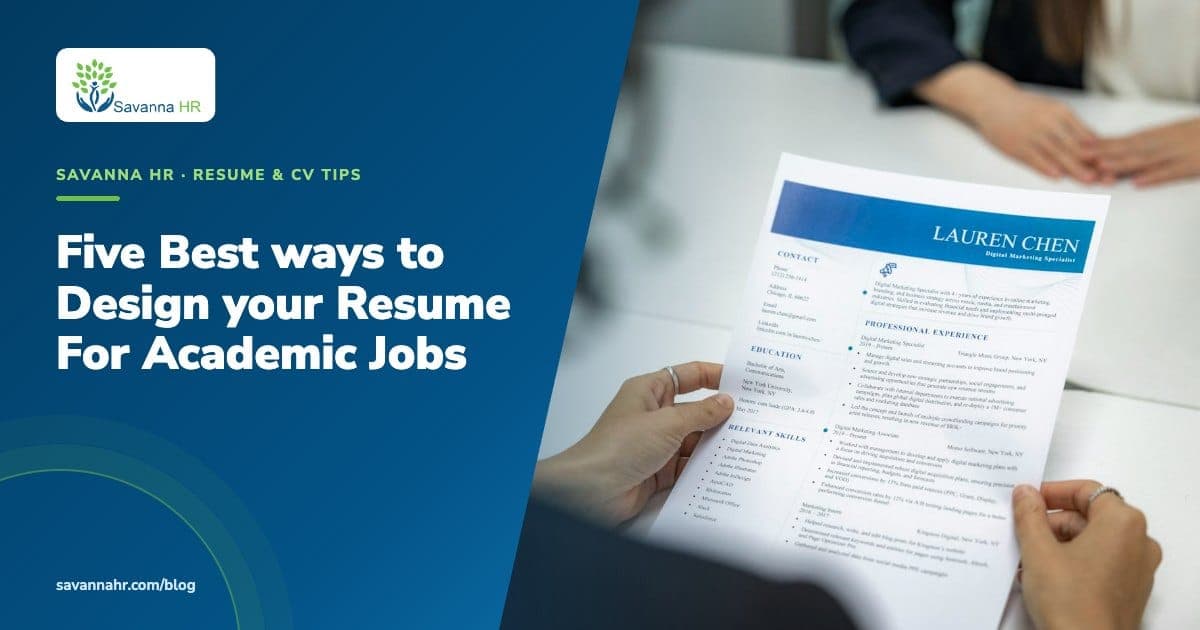
Quick answer: To design a resume for academic jobs, list your degrees from most recent with grades, describe each teaching role's duties in detail, link a portfolio of lesson plans or training videos, and add honours, memberships, conferences and publications. Use clean formatting with no more than 2 fonts, bullet points and a clear structure starting with education and research.
Building a resume is an art. Your resume is the sum total of your experiences, a screenshot of your personality, and overall insight into your professional journey. HireXL is a pioneer in streamlining recruitment for Academic Industry and that gives me access to hundreds of Resumes on a daily basis who are seeking good opportunities in their respective fields. My experience over all these years has given me an understanding that Jobs in the Education industry require a different kind of Resume. We all know that we need our curriculum vitae to showcase our skills and experiences in an effective way to our employers. Again few silly mistakes here and there, drastically reduce our chances of finding a good job. I have tried to encapsulate a few vital things which we should necessarily capture in our resume if we are on the lookout for Academic jobs.
My resume should have your Educational Qualification
While writing your resume, list down your academic achievements. Start with the recent degree you have achieved and go on mentioning all the degrees awarded to you. Do not forget to mention your grades or any other remarkable detail which can be significant in your job search.
Always add Professional Qualification
While describing your professional degree , write in detail about your every experience . Mention the major responsibilites assigned to you on job . At times you don’t have a job offer mentioning your roles and responsibilities . But you can always recall your major responsibilities at job and put in on your resume . Ex – If you are a teacher , do mention following things in your resume . That Apart from teaching , you also develop assessment for students , Involved in development of parent community . Also that you Design lesson plans and organise cultural events at school or any other responsibility . Your resume should present you in positive way and that attracts a employer towards your candidature .
Create a Portfolio of your work and add it in your resume .
I remember a teacher preparing to apply in some school in China , had an awesome scrapbook , depicting her work . It had pictures of her in classroom . Sample lesson plans , assessment and teaching aids created by her . Like She had also copy pasted few testimonials given by her co-teachers .
If you are a teacher trainer , make few video links of training sessions . If you are an instructional designer , Curriculum designer or Editor , create a sample of your work and share the link on CV . Also you can also give a demo if applicable in form of a short video . This link can be shared on your CV or social networking sites . You can use your imagination to create your portfolio in some amazing way .
Must Mention while searching Academic Jobs
Honours or recognition , Membership to any professional group , Conference attended , Publication or journals , Any leadership experience .
Basic Hygiene of A CV
Formatting : Biggest spoiler in resume writing is poor formatting . And never use more than 2 types of font in a resume . Normal font size in basic colour is appreciated . Use bullent points to effectively present important items and avoid playing with colours in your CV , except if you are an artist and know the work . Be careful with spelling and grammar . Also make your CV smart but avoid use of bold, underlining or italics .
Structure : Choose a structure for your CV with the main headings and sub-headings you will use. There are several sources and CV samples available and links are provided to these sources at the end of this document. At the same time, you should start with providing some brief personal details, then a brief career summary. Your education, publications and research should follow and be the focus for the first section of your CV. Other important categories to address include: funding, awards and prizes, teaching roles, administrative experience, technical and professional skills and qualifications, any professional affiliations or memberships, conference and seminar attendances and a list of references.
Hope these Tips are helpful and you create a wonderful resume for yourself . Incase you are on lookout for some academic jobs reach our team at hello@hirexl.in . We at HireXl are solely focussed on connecting right talent with Education Industry .
Looking for your next role? Browse current jobs at Savanna HR or submit your CV.
Related reading: Browse current jobs at Savanna HR · How to Ace Your First 90 Days at a Startup: A Practical Roadmap · The Gig Economy and Freelancers for Startups: Building Flexible Teams in India
Frequently asked questions
How is an academic CV different from a corporate resume?
An academic CV puts education, research and publications first, and usually runs longer. It lists teaching roles, funding, awards, conferences, professional memberships and references. A corporate resume is shorter and focuses on work achievements and skills for one specific job.
What should a teacher include in a portfolio?
Include sample lesson plans, assessments and teaching aids you created, photos or short videos of you teaching and testimonials from colleagues. Trainers can add recordings of sessions, and curriculum designers or editors can share work samples. Put the portfolio link on your CV.
How should I list publications on an academic CV?
Give publications their own section near the top, after education. List each one in a consistent citation format with authors, title, journal or publisher and year, starting with the most recent. Separate peer-reviewed papers from other publications if you have many.
What formatting mistakes should I avoid on a CV?
Avoid more than 2 fonts, bright colours, heavy bold, underlining or italics, and dense paragraphs. Use a normal font size, clear headings and bullet points, and check spelling and grammar carefully. Poor formatting is one of the quickest ways to lose a recruiter's attention.


