From gatekeeper to strategic advisor: rewriting the recruiter in the AI era
AI has taken a scythe to the volume work that defined recruiting for decades. That doesn't shrink the recruiter's importance — it relocates it, from processing candidates to advising the business. For CHROs, it's a chance to redesign the talent function.
Ask a CHRO what's on the 2026 agenda and, according to Gartner, the answer starts with artificial intelligence. In its survey of 222 chief HR officers, Gartner named harnessing AI to revolutionise HR — and preparing the organisation for a human-machine model of work — among the top priorities for the year. Nowhere is that transformation more visible, or more misunderstood, than in recruiting. Because the popular narrative — "AI will replace recruiters" — gets the story almost exactly backwards.
AI is not making recruiters redundant. It is making one kind of recruiter redundant — the gatekeeper who processed volume — while making another kind, the strategic advisor, more valuable than ever. Understanding that distinction is how CHROs turn an anxious moment into an operating-model upgrade.
In this article
What AI actually took over
For most of its history, recruiting was a volume game. Read hundreds of CVs. Run Boolean searches across job boards. Screen, schedule, chase references, send status updates. The best recruiters were the ones who could push the most candidates through the funnel without dropping the ball. Those tasks — sourcing, résumé parsing, ranking against a job description, scheduling, first-pass screening — are precisely the ones AI now does in minutes, at a scale no human can match and without fatigue setting in on the four-hundredth application. Industry analysts describe this as the arrival of agentic AI in hiring: systems that don't merely assist but execute whole steps of the process autonomously.
It would be easy to read that as a threat. It's better read as a liberation. The parts of recruiting AI is absorbing were never the parts that created the most value — they were the administrative cost of getting to the valuable parts. Automating them frees the recruiter to do the work that actually moves outcomes.
Where the human value moves
When a machine can build a ranked, criteria-matched shortlist almost instantly, human value migrates upstream and downstream of that step. Upstream, the recruiter becomes a diagnostician and advisor: helping the business articulate what it actually needs versus what the job description says; challenging unrealistic "unicorn" specs before they waste a quarter; advising on the market, the realistic timeline and the compensation required to win. Downstream, the recruiter becomes a judge and a guide: reading motivation, intent and culture-fit in conversation; managing the human dynamics of an offer and a counter-offer; and helping hiring managers make the judgment calls no algorithm should make alone.
In short, the recruiter stops being the person who finds candidates and becomes the advisor who helps the business choose and win them. That is a more strategic, more consultative and frankly more valuable role than the one automation replaced — and it's why the best talent professionals are thriving in the AI era, not fearing it.
AI didn't replace the recruiter. It replaced the parts of recruiting that were never the point — and freed the human to do the parts that always were.
The trust problem AI can't solve alone
There's a further reason the human can't be automated away, and it's one CHROs should sit with. Gartner's 2026 research found that only 26% of job applicants trust that AI will evaluate them fairly. That's a remarkable number: three-quarters of the people you want to hire are wary of a purely algorithmic process. In a candidate-driven market, that scepticism is a real risk — an over-automated funnel can quietly repel exactly the talent you're trying to attract.
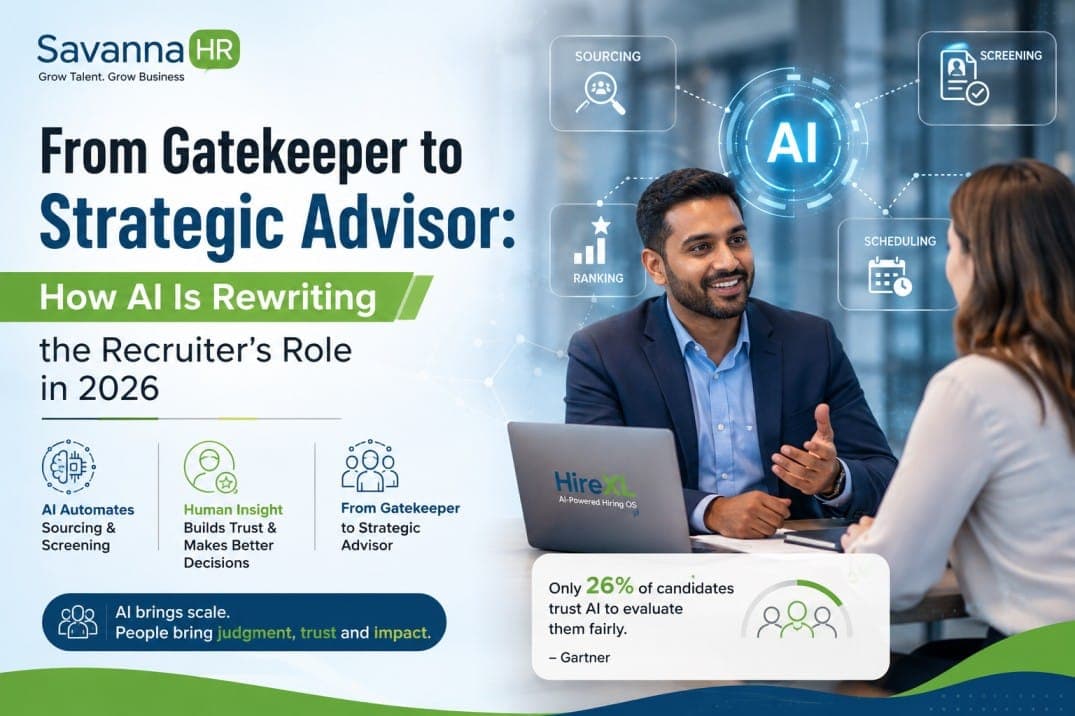
Only 26% of candidates trust AI to evaluate them fairly, and just 47% of CHROs say their culture drives performance today. Both point to the same conclusion: the human layer of hiring — trust, judgment, culture — is where competitive advantage now lives.
The answer isn't to abandon AI; it's to keep a human visibly in the loop. Candidates accept — even appreciate — AI handling the mechanical steps, provided a real person owns the judgment and the relationship. The recruiter, in other words, is not just an efficiency story; they're a trust story. They're how you use powerful automation without making candidates feel processed by a machine.
The operating model that wins: AI plus human
The organisations getting this right in 2026 aren't choosing between technology and people — they're combining them deliberately, and designing the handoffs. The machine does what machines are brilliant at: reading and ranking talent at scale, surfacing matches in minutes, and flagging on day one when a required profile is genuinely rare. The recruiter does what people are brilliant at: bringing evidence-based judgment, market context, candidate trust and human care to the decision. Speed and quality stop being a trade-off and become a single motion.
This is exactly the model behind Savanna HR. Our HireXL Hiring OS handles sourcing and ranking with speed and consistency; our recruiters operate as advisors — partnering with clients to define the real need, protect quality, and guide the decision, while owning the human relationship that keeps candidates engaged and trusting. It's not AI versus the recruiter. It's AI amplifying a better recruiter.
How CHROs should redesign the talent function
For CHROs, this is a rare chance to re-architect talent acquisition rather than just re-tool it. That means three moves. Automate the mechanical ruthlessly — sourcing, screening, scheduling, updates — so your people aren't spending scarce judgment on administrative work. Re-skill recruiters as advisors, investing in the consulting, market-intelligence and stakeholder-influence capabilities that the elevated role demands. And keep the human visible in the candidate journey, so that efficiency never comes at the cost of the trust and experience that win offers. Done well, you get a talent function that is both dramatically faster and distinctly more human — which is precisely the combination the 2026 market rewards.
Before and after: a recruiter's week
To see how profound the shift is, picture a recruiter's week in 2020 versus 2026. In 2020, the bulk of it went to mechanical throughput: crafting Boolean strings, combing job boards, manually reading hundreds of CVs, copying notes between systems, coordinating calendars, and sending the same status updates over and over. Judgment work — the conversations that actually determined a hire — got whatever hours were left over. In 2026, that ratio inverts. The Hiring OS produces a ranked, criteria-matched shortlist in minutes; scheduling and updates largely run themselves. What now fills the recruiter's week is the high-value work: diagnosing the real need with a hiring manager, having the nuanced conversations that reveal motivation and fit, advising on market realities, and shepherding offers to a close.
That isn't a smaller job — it's a more demanding one, and a more strategic one. It rewards market knowledge, business acumen, emotional intelligence and influence far more than administrative stamina. The recruiters who struggle in this transition are the ones who defined their value by throughput; the ones who thrive are those who lean fully into advisory work.
What it means for cost and quality of hire
For CHROs, the operating-model shift also reshapes the metrics. When AI compresses sourcing and screening, time-to-shortlist collapses and the mechanical component of cost-per-hire falls. But the metric that should rise in importance is quality-of-hire — because with the administrative burden lifted, the human judgment that most determines whether a hire succeeds can finally get more attention, not less. The trap to avoid is optimising only for the metrics AI makes easy — speed, volume, cost — while neglecting the one that matters most: whether the person is actually right. The best talent functions spend the efficiency dividend on better judgment, not merely on doing the same hiring faster.
Don't automate away your employer brand
There's a strategic prize in getting this balance right that goes well beyond efficiency: your employer brand. In a market where candidates talk publicly and compare notes, the experience of your hiring process is a marketing channel — for better or worse. An over-automated funnel that leaves candidates feeling processed by a machine quietly repels talent and generates the negative reviews that deter the next applicant. A process that pairs fast, frictionless automation with genuine human contact does the opposite: it leaves even rejected candidates with a positive impression, turning your hiring process into a reputation asset. The recruiter, as the human face of that process, is central to it. Automation handles the volume; the recruiter ensures the people on the other side feel like people — which, in a candidate-driven market, is an advantage most companies leave on the table.
Key takeaways for CHROs
- AI automates the mechanical layer of recruiting — not the strategic one. The gatekeeper role fades; the advisor role grows.
- Human value moves upstream (defining the real need) and downstream (judgment, offers, culture-fit).
- Only 26% of candidates trust AI to evaluate them fairly — keep a human visibly in the loop to protect trust.
- The winning model is AI plus human: automation for scale and speed, recruiters for judgment and relationships.
- Treat this as a chance to redesign TA: automate the mechanical, re-skill recruiters as advisors, keep the journey human.
A better recruiter, amplified
For anyone worried that AI will hollow out the talent function, the truth is the opposite: it raises the bar on what a great recruiter is for. The administrative recruiter is being automated; the advisory recruiter is becoming indispensable. CHROs who redesign around that shift — pairing a capable Hiring OS with recruiters elevated into advisors — will build talent functions that are faster, more strategic and more trusted at once. That's the model Savanna HR was built to deliver.
The organisations that get ahead won't be the ones that adopted AI the fastest or resisted it the longest. They'll be the ones that redrew the line between machine and human deliberately — letting software carry the load it carries best, and freeing their people to do the judgment, advocacy and relationship work that only people can. In recruiting, that line has moved. The CHROs who move with it will find they haven't lost recruiters to automation at all; they've gained advisors.
Rethinking your talent function for the AI era?
Savanna HR combines the HireXL Hiring OS with specialist recruiters who act as advisors — fast where it should be automated, human where it must be. Let's talk.
Talk to Savanna HRFrequently asked questions
Will AI replace recruiters?
No. AI replaces the mechanical parts of recruiting — sourcing, screening, scheduling — but not the strategic ones. Defining the real need, reading intent and culture-fit, protecting candidate trust and guiding decisions are becoming more valuable, not less.
What are CHROs' top priorities for AI in 2026?
Gartner's 2026 survey of 222 CHROs names harnessing AI to revolutionise HR and preparing for a human-machine model of work among the top priorities — while cautioning that culture and trust remain human challenges AI can't solve alone.
Do candidates trust AI in hiring?
Largely not yet. Gartner found only 26% of applicants trust AI to evaluate them fairly. That's why keeping a human visibly in the loop — owning judgment and relationships — is essential to attracting talent in an automated process.
What is a Hiring OS?
A Hiring OS pairs AI-powered sourcing and ranking with human recruiters in one system. The AI delivers scale and speed; the recruiters bring judgment, candidate trust and care. HireXL is Savanna HR's Hiring OS.


