Human skills are the new hard skills
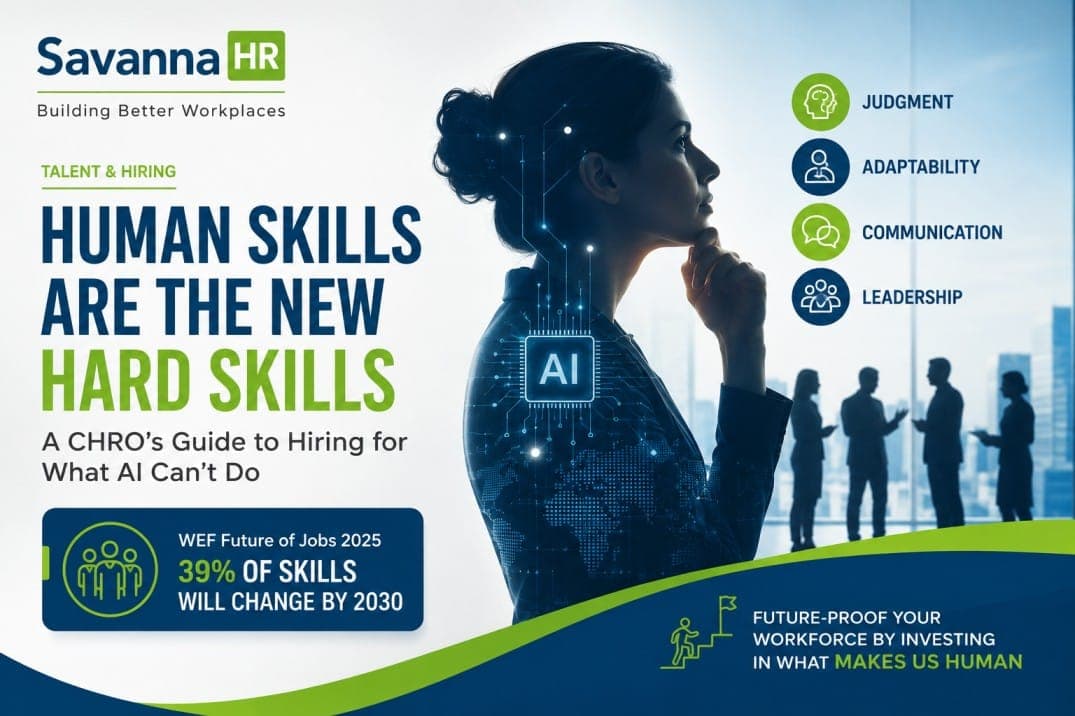
As AI absorbs the technical and repeatable work, the capabilities it can't replicate — judgment, adaptability, communication, leadership — are becoming the scarcest assets on the market. For CHROs, that changes what you hire for, and how.
For a generation, we sorted workplace skills into a clear hierarchy. "Hard skills" — coding, accounting, engineering — were the real currency, the things that got people hired and promoted. "Soft skills" were the pleasant extras: nice if present, rarely decisive. In 2026, that hierarchy has quietly inverted. The technical skills are being automated or commoditised at speed, while the human ones have become the genuine differentiators. And the CHROs who understand this are rebuilding how they hire, assess and develop talent around it.
This isn't a feel-good HR sentiment. It's a hard-nosed response to what artificial intelligence is doing to work — and the data behind it is some of the most important any people leader will read this year.
In this article
The AI paradox: why human skills are rising
Here is the counter-intuitive truth at the centre of the 2026 talent market: the more that AI can do, the more your distinctly human skills are worth. As AI absorbs the routine, technical and repeatable — drafting code, summarising documents, generating analysis, answering tier-one queries — the economic value shifts to what it cannot do. Deciding whether the AI's plausible answer is actually right. Persuading a sceptical stakeholder. Reading what a client needs versus what they asked for. Holding a team together through a reorganisation. These don't automate, and so they appreciate.
The paradox catches many organisations off guard because they assumed AI would make people less important. In practice it hollows out the middle — the routine technical tasks — and raises the premium on both deep expertise and, crucially, the human capabilities that surround and direct that expertise. A brilliant model is only as useful as the judgment of the person deploying it.
What the WEF data actually says
The World Economic Forum's Future of Jobs Report 2025 is the most-cited evidence base here, and its numbers are stark. By 2030, the report projects 170 million new roles created and 92 million displaced — a net gain, but with churn equivalent to 22% of all jobs. Most important for hiring: nearly 40% of the core skills required on the job will change by 2030, and 59% of the global workforce will need reskilling or upskilling. A striking 63% of employers name skills gaps as the single biggest barrier to transforming their business.
~40% of required skills will change by 2030; 59% of workers will need reskilling; 63% of employers cite skills gaps as their #1 barrier. Alongside technical skills like AI and big data, the fastest-rising capabilities are analytical thinking, resilience and flexibility, leadership, and curiosity for lifelong learning.
What's telling is which skills the WEF identifies as rising fastest. Yes, technology skills — AI, big data, cybersecurity — top the demand curve. But sitting right alongside them are the human ones: analytical and creative thinking, resilience, flexibility and agility, leadership and social influence, curiosity and lifelong learning. The future-ready worker isn't the pure technologist or the pure "people person." It's the person who blends both — and that blend is exactly what's hardest to source.
The winning profile in 2026 isn't the person who knows the most tools today. It's the one who can learn the next ten — and carry a team along while doing it.
Which human skills matter most
Not all human skills are equal, and the ones compounding fastest cluster into a few families that every CHRO should be building into hiring criteria.
Adaptability and learning agility top almost every list, because change is now the only constant. When the tools, models and processes shift every quarter, the ability to absorb the new quickly is worth more than mastery of the current. Communication and influence rise as work becomes more distributed, cross-functional and AI-mediated — someone has to translate, align and persuade across boundaries. Critical thinking and judgment matter more, not less, precisely because AI can now produce a confident-sounding answer in seconds and a human must decide whether to trust it. And emotional intelligence and leadership — motivating people, navigating conflict, building trust — remain stubbornly, valuably human. Gartner's 2026 research underlines why this last one is urgent: only 47% of CHROs say their culture currently drives employee performance, and culture is built by exactly these human capabilities.
Why your hiring process measures the wrong things
Here's the uncomfortable part. If human skills are the real differentiators, most hiring processes are built to miss them. A CV is excellent at capturing credentials, tools and tenure, and almost useless at capturing adaptability, judgment or influence. Keyword-matching and degree filters compound the problem, screening for exactly the proxies that matter least while ignoring the capabilities that matter most.
That mismatch explains a frustration many hiring managers know well: the technically "qualified" hire who underperforms. They had the keywords but not the capabilities — the credentials but not the adaptability to grow as the role changed underneath them. In a market where 40% of skills will turn over by 2030, hiring purely for today's technical checklist is hiring for obsolescence.
How to actually hire for human skills
The fix is to make human skills explicit and measurable, rather than hoping they surface by accident. In practice that means three shifts. First, define the human competencies each role needs and put them on the scorecard alongside the technical ones — adaptability, communication, judgment, collaboration — so they're evaluated deliberately, not left to gut feel. Second, use structured, behavioural interviews that probe real past situations ("tell me about a time the plan fell apart"), because how someone handled ambiguity, conflict or failure predicts far more than how they describe themselves. Third, use work samples and scenarios that reveal thinking rather than recall — a short real-world problem tells you more about judgment than any credential.
Crucially, these signals live in conversations, not in a résumé scan — which is exactly why the human dimension of recruiting is becoming more important as the mechanical dimension gets automated. The most effective model pairs AI, which screens technical fit at scale in minutes, with skilled recruiters and interviewers who surface the human capabilities no algorithm can score. That is the balance we've built Savanna HR around: HireXL handles the technical matching; our recruiters run the structured conversations that reveal adaptability, intent and judgment.
The reskilling imperative
Hiring is only half the answer. With 59% of the workforce needing reskilling by 2030, the CHROs getting ahead are treating skills as a living portfolio to be continually refreshed, not a fixed inventory bought once at the point of hire. That means mapping the human and technical skills you already have, identifying the gaps against where the business is going, and closing them through development as a first resort — not only through the external market. It also reframes what "hireable" means: increasingly, the most valuable candidates are the ones with the learning agility to be reskilled repeatedly over a career, because the specific skills will keep changing but the capacity to learn endures.
The human-skills premium is showing up in the market
This isn't only a theoretical shift; it's visible in how the market now prices talent. Analyses of millions of job postings show that roles demanding AI skills command clear wage premiums — but so, increasingly, do roles that require the human skills AI can't provide, because those are the capabilities that make AI investments actually pay off. Employers are learning, sometimes expensively, that buying the best tools without the people who can wield them judiciously produces disappointing returns. The differentiated organisation is the one whose people can genuinely partner with AI — directing it, sense-checking its output, and applying it to problems it can't frame on its own.
For CHROs, the strategic implication is to stop treating human skills as an afterthought in workforce planning and start treating them as a distinct, scarce and investable asset class. That means measuring them, hiring for them explicitly, developing them deliberately, and building an employee value proposition that attracts people strong in exactly the capabilities becoming decisive. In a labour market where technical skills have a shortening half-life, human skills are the closest thing to a durable competitive moat a workforce can have.
Key takeaways for CHROs
- AI raises the premium on human skills — judgment, adaptability, communication, leadership — because it can't replicate them.
- The WEF projects ~40% of skills changing by 2030 and 59% of workers needing reskilling; skills gaps are employers' #1 barrier.
- Traditional CV-and-keyword screening measures credentials, not the capabilities that now decide success.
- Put human competencies on the scorecard; assess them with structured, behavioural interviews and work samples.
- Pair AI screening at scale with human interviewers — and treat reskilling as a continuous, first-resort strategy.
Hiring for capability, not just credentials
The organisations that thrive over the next five years will be the ones that stop hiring for a static checklist of today's tools and start hiring for durable human capability — the adaptability, judgment and influence that hold their value as everything technical churns beneath them. That's a harder thing to assess than a keyword match, which is precisely why it's becoming a competitive advantage. Savanna HR combines the HireXL Hiring OS with specialist recruiters who evaluate both the hard and the human, so the people you hire can do the job today and grow into what it becomes tomorrow.
None of this is a reason to devalue technical expertise — deep skills still matter enormously. The shift is one of emphasis: from hiring people for a fixed snapshot of what they know, to hiring people for the range of what they can become. In a decade defined by AI, that range is set less by credentials than by character — the curiosity to keep learning, the judgment to apply it well, and the humanity to lead others through constant change. Build your hiring around those, and you build a workforce that stays valuable no matter how fast the tools move.
Hiring for durable capability, not just today's checklist?
Savanna HR pairs the HireXL Hiring OS with recruiters who assess both technical and human skills — so your hires can grow with the role. Let's talk.
Talk to Savanna HRFrequently asked questions
Are human skills more important than technical skills in 2026?
They're increasingly complementary. Technical skills get candidates considered, but human skills — adaptability, judgment, communication, leadership — increasingly decide who succeeds, especially as AI automates routine technical work. The WEF's fastest-rising skills list includes both.
What does the WEF Future of Jobs Report 2025 say about skills?
It projects that nearly 40% of required job skills will change by 2030, that 59% of workers will need reskilling or upskilling, and that 63% of employers cite skills gaps as their biggest barrier to transformation — with analytical thinking, resilience and leadership among the fastest-growing skills.
How do you assess human skills when hiring?
Define the human competencies each role needs and score them explicitly; use structured, behavioural interviews that probe real past situations; and use work samples that reveal thinking rather than recall — rather than relying on CV keywords or gut feel.
Should we reskill existing staff or hire externally?
Both — but with 59% of the workforce needing reskilling by 2030, development should be a first resort. The most valuable hires are those with the learning agility to be reskilled repeatedly, since specific skills will keep changing while the capacity to learn endures.


