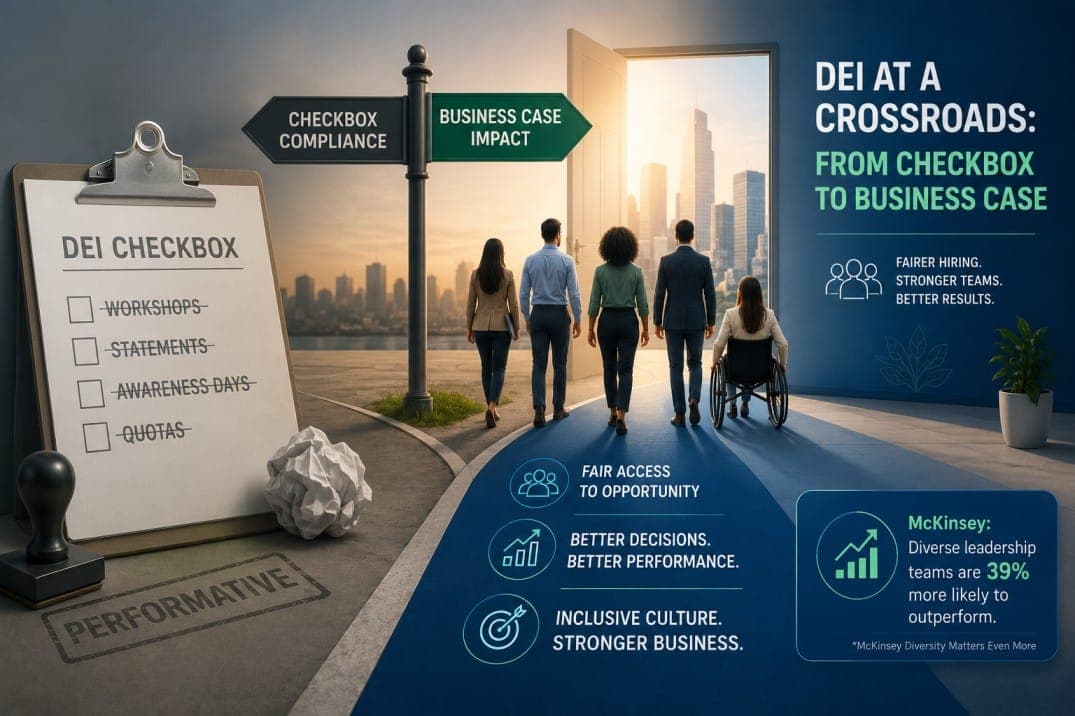
DEI at a crossroads: from checkbox to business case
Few topics have swung as sharply as diversity, equity and inclusion. After years of rapid growth came a visible backlash. But read past the noise and what's really happening is a maturing — one that, done right, makes fairness and performance the same thing.
If you judged the state of diversity, equity and inclusion by headlines alone, you'd conclude it had peaked and gone into retreat. Several high-profile companies have scaled back formal DEI programmes; the language has grown cautious; the political temperature has risen. For a CHRO, it's tempting to read all this as a signal to quietly step back and wait out the storm. That would be a strategic mistake — because it misreads what's actually happening. This isn't a collapse. It's a correction, and a maturing, and the organisations that understand the difference will pull ahead of the ones that simply retreat.
In this article
What's really changing
The version of DEI losing ground is the performative one: the checkbox initiative, the statement without substance, the representation target chased for optics rather than tied to any business outcome. That version was always fragile, precisely because it floated free of how the organisation actually performed. When budgets tighten and scrutiny rises, programmes that can't demonstrate value are the first to be cut — and much of what's being rolled back falls into exactly that category.
What's not disappearing is the underlying goal: building organisations where the best talent, from the widest possible range of backgrounds, can be found, hired and developed fairly. That goal isn't a political fashion; it's a talent-strategy fundamental. In a market defined by skills shortages — where the WEF reports 63% of employers blocked by skills gaps — deliberately narrowing the pool of people you'll seriously consider is a self-inflicted wound. The maturing of DEI is really a move from symbolism back to that fundamental.
The business case hasn't gone away
The evidence linking genuine diversity to performance remains robust, whatever the political weather. McKinsey's long-running research — most recently its "Diversity Matters Even More" analysis — has repeatedly found that companies in the top quartile for leadership diversity are meaningfully more likely to outperform their peers financially, with the most diverse executive teams showing up to 39% higher odds of outperformance than the least diverse. The mechanism is not mysterious: diverse teams bring a wider range of perspectives to decisions, which matters most in exactly the complex, ambiguous problems that define modern business. Homogeneous teams are faster to agree and slower to spot what they're missing.
Companies in the top quartile for executive-team diversity are up to 39% more likely to financially outperform those in the bottom quartile. The business case was never about optics — it's about better decisions, and better decisions show up in results.
This is the point CHROs can hold onto amid the noise: the case for diversity was never fundamentally a moral-versus-commercial trade-off. It's a performance argument that happens also to be a fair one. Retreating from it wholesale doesn't make an organisation more hard-nosed; it makes it less likely to make good decisions.
Where DEI and skills-based hiring converge
The most interesting development in 2026 is that the smartest path to diversity increasingly runs through something that looks, on the surface, like a completely different trend: skills-based hiring. When you evaluate candidates on demonstrated capability — what they can actually do — rather than on pedigree, alma mater, or who they know, you naturally widen the aperture of who gets considered. Talented people from non-traditional backgrounds, who'd never survive a credential filter, get a genuine look.
That's the quiet power of it: fairness and rigour turn out to be the same discipline. Structured, evidence-based, capability-focused evaluation reduces the influence of unconscious bias and improves the quality of your hiring decisions at the same time. Diversity stops being a separate initiative bolted onto the process and becomes a byproduct of simply hiring well. You don't have to choose between "the best candidate" and "a fair process" — done properly, the fair process is exactly what surfaces the best candidate, from a broader field than a pedigree filter would ever have shown you.
The performative version of DEI is fading. The business case for genuine diversity is not — because diverse teams make better decisions, and better decisions show up in the numbers.
A measured way forward
Our take is deliberately un-tribal, because the topic badly needs it. Ignore the noise at both extremes — the performative activism that promises more than it delivers, and the reactive backlash that throws out a proven performance driver — and focus instead on building a hiring process that is rigorous, structured and evidence-based. Define the real requirements of each role. Evaluate every candidate against the same clear criteria. Use work samples and structured interviews that measure capability rather than polish or pedigree. Widen your sourcing so more kinds of people are considered, then let a fair, consistent process do the deciding.
That's not a political posture; it's simply good hiring. And it happens to produce fairer and stronger outcomes at the same time. The CHROs who frame diversity this way — as a byproduct of hiring excellence rather than a separate, contestable initiative — are the ones whose approach will survive the political weather, because it's anchored in performance rather than fashion.
What this looks like in practice
Concretely, the mature approach shows up in a few habits. Job requirements are written around genuine capabilities, not proxy credentials that quietly screen out capable people. Evaluation is structured and consistent, so every candidate is judged against the same yardstick rather than an interviewer's gut. Sourcing deliberately reaches beyond the usual channels and networks, because you can't hire from a pool you never look at. And technology is used to bring consistency — scoring candidates against defined, role-specific criteria — while humans provide the judgment and the accountability. Each of these improves fairness and hiring quality together; none requires a slogan.
This is how we approach every search at Savanna HR. Our HireXL Hiring OS evaluates candidates against defined, role-specific criteria, which brings consistency and reduces the drift and bias that creep into ad-hoc processes; our recruiters run structured, capability-focused conversations. The result is a process built to find the best person for the role — and one that, by its very design, considers a broader and fairer field to get there.
Reading the backlash correctly
It's worth being precise about what the backlash is and isn't, because overreacting to it is as risky as ignoring it. Much of the retreat is a response to the performative and legally exposed edges of DEI — rigid quotas, initiatives that promised transformation and delivered slogans, programmes vulnerable to shifting regulation. What is not being seriously contested by anyone focused on results is the underlying commercial logic: that a wider, fairer talent funnel produces better hires and better decisions. CHROs who conflate the two — who abandon fair, capability-based hiring because a particular programme became controversial — risk throwing out a performance advantage to dodge a political one. The disciplined move is to shed the symbolism and keep the substance.
The skills-shortage angle the backlash overlooks
There's also a hard-nosed argument that the political noise tends to drown out. With the WEF reporting that skills gaps are the single biggest barrier to transformation for 63% of employers, no organisation can afford to systematically overlook large pools of capable people. Filters that screen on pedigree, unbroken career history, or a narrow set of networks don't just risk unfairness — they shrink your access to exactly the scarce talent you're competing hardest for. Widening the funnel isn't charity in a skills-short market; it's supply. The companies that quietly keep doing this while others retreat will have a broader talent base to draw on precisely when talent is hardest to find.
Measure outcomes, not activity
The mature version of this work is also a measured one — literally. Instead of tracking activity (training hours logged, statements published), the organisations getting it right track outcomes: the diversity of their actual hiring funnels, whether structured evaluation is applied consistently, whether capable candidates from non-traditional backgrounds progress at similar rates, and whether the resulting teams perform. Data does two useful things here. It replaces ideology with evidence, which lowers the temperature of a heated topic. And it lets you demonstrate — to a sceptical board or a wary line manager — that a fairer process is producing better hires, not softer ones. In a climate where these budgets are under scrutiny, the ability to show results rather than intentions is what keeps good practice funded.
Key takeaways for CHROs
- The performative version of DEI is being cut; the underlying talent-strategy fundamental is not.
- McKinsey finds top-quartile diverse leadership up to 39% more likely to outperform — the business case is a performance case.
- Skills-based hiring is the pragmatic route to diversity: capability over pedigree widens the field and improves decisions.
- Fairness and rigour are the same discipline — a structured, evidence-based process surfaces the best candidate.
- Anchor diversity in hiring excellence, not slogans, and it will outlast the political weather.
Fairness and performance, not fairness versus performance
The organisations that navigate this moment well won't be the loudest on either side. They'll be the ones that quietly build rigorous, capability-based hiring processes that happen to be fair — and that therefore keep delivering both the performance benefits of diverse teams and the trust of a market that increasingly notices how companies hire. Fairness and performance were never really in tension. Done properly, they are the same thing. Savanna HR builds structured, evidence-based hiring that surfaces the best candidate from the widest field — which is, in the end, simply what good hiring looks like.
For CHROs, that reframing is also the most durable form of protection. A diversity effort justified by slogans rises and falls with the political mood; one justified by better hiring and better results is simply good management — and good management doesn't go out of fashion. Build it into how you hire rather than bolting it on beside how you hire, and it becomes resilient to whichever way the wind is blowing.
Want a hiring process that's rigorous and fair by design?
Savanna HR builds structured, evidence-based hiring that surfaces the best candidate from the widest field. Let's talk about your roles.
Talk to Savanna HRFrequently asked questions
Is DEI still relevant in 2026?
Yes, though it's changing. The performative, checkbox version of DEI is losing ground, but the underlying goal — hiring the best talent from the widest range of backgrounds, fairly — remains a talent-strategy fundamental, and the business case for genuine diversity is intact.
What does McKinsey say about diversity and performance?
McKinsey's research, including its 'Diversity Matters Even More' analysis, finds that companies in the top quartile for executive-team diversity are up to 39% more likely to financially outperform those in the bottom quartile — because diverse teams make better decisions on complex problems.
How does skills-based hiring support diversity?
Evaluating candidates on demonstrated capability rather than pedigree, alma mater or network widens who gets considered, giving talented people from non-traditional backgrounds a fair look — while structured, evidence-based evaluation improves both fairness and decision quality.
Do you have to choose between the best candidate and a fair process?
No. A rigorous, structured process that evaluates everyone against the same clear, role-specific criteria is precisely what surfaces the best candidate — from a broader field than a pedigree filter would show. Fairness and quality reinforce each other.


