AI layoffs don't mean an AI talent surplus
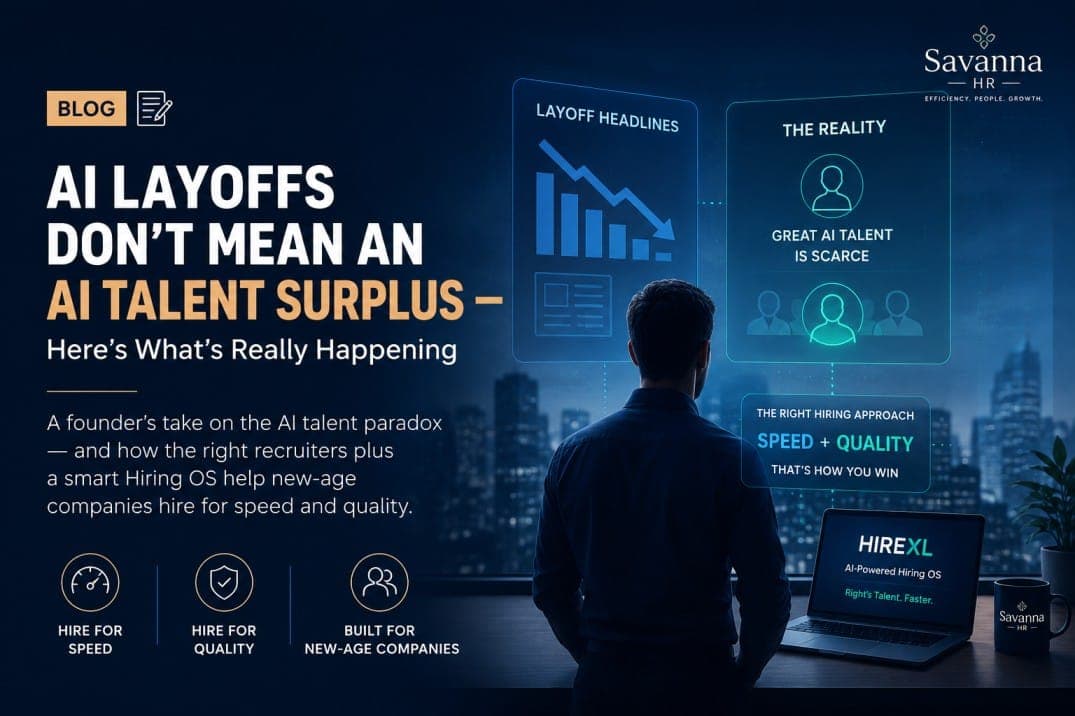
Every week there's another headline about an AI company cutting its team. And every week, I watch brilliant new-age companies struggle to hire the exact people they need. Both things are true at once — and understanding why is the whole game.
A headline crossed my feed this week — another well-funded AI company trimming its team as it "restructures." It's becoming a familiar story. And almost on cue, someone asked me: "Swati, with all these AI layoffs, hiring good AI talent must be easy right now, no?"
I understand why it sounds that way. But after more than a decade of doing this, I can tell you it's one of the biggest misreadings of the market I keep running into. Layoffs and a hiring crisis are happening in the same season — and if you run a new-age or AI-first company, the gap between those two realities is exactly where your next great hire is won or lost.
The paradox nobody's saying out loud
Here's the uncomfortable truth. A layoff headline tells you a company changed its strategy, ran out of runway for a particular bet, or pivoted away from a product. What it does not tell you is that there's suddenly a warehouse full of the exact talent you need, sitting around waiting.
The numbers back this up hard. In 2026, 82% of employers in India reported difficulty filling roles — well above the global average of 72%. And for the first time, AI skills top the list of the hardest roles to fill: AI model and application development, and AI literacy, have overtaken traditional engineering and IT as the scarcest capabilities in the market. This isn't a temporary blip that a few layoff rounds will fix. Analysts are calling it a structural shift in the labour market, not a cyclical one.
Layoffs release people. They don't release the specific, proven, production-ready AI talent that fast-moving companies are fighting over. Those two things get confused constantly — and it costs founders dearly.
So what actually happens when a high-profile AI company restructures? A small number of genuinely excellent engineers, researchers and data people do become available. But here's the part most companies miss: that window is tiny. The best of them are gone in days — quietly picked up through networks and warm intros before they ever "hit the market." By the time a role is posted and a pile of applications rolls in, the people you actually wanted have already said yes to someone else.
Speed, in other words, isn't a nice-to-have in this market. It's the difference between hiring the person and reading about them joining your competitor.
But speed alone is a trap
Now, the easy takeaway would be "move fast, hire fast." I want to push back on my own point here, because speed without judgement is how companies make their most expensive mistakes.
A wrong senior AI hire doesn't just cost a salary. It costs months of lost momentum, a team that has to clean up after a bad architectural call, and the morale hit of getting it wrong on a high-visibility role. In a small, ambitious company, one mis-hire in a key seat can set you back two quarters. Filling a seat quickly is worthless if it's the wrong seat-filler.
So the real challenge isn't speed or quality. It's refusing to trade one for the other. And that, honestly, is the problem I built Savanna HR to solve.
The goal was never to hire fast or hire well. It was to make "fast" and "right" the same motion.
How we hire for speed AND quality
People sometimes assume that "AI in recruitment" means you replace recruiters with software and call it a day. We think that's exactly backwards. The magic isn't the machine or the human — it's the two working as one system. Internally, we call it our Hiring OS: HireXL, our AI-powered sourcing and ranking engine, running alongside recruiters who actually understand the roles they're filling.
A Hiring OS built for speed
HireXL scans and ranks talent against your exact requirements in minutes, not weeks — so when a window opens, we're already reaching out to the right people while everyone else is still writing the job post.
Recruiters who protect quality
Our recruiters aren't form-fillers. They know the difference between a résumé that looks right and a person who is right — and they bring logical, evidence-based judgement to every shortlist.
Honesty about the talent gap
If a profile is genuinely rare, our system flags it on day one. We'd rather tell you the truth early — and realign on scope, timing or comp — than waste your weeks chasing a unicorn that doesn't exist.
That combination is the whole point. The AI does what software is brilliant at: reading and ranking thousands of profiles against a precise spec, instantly, without fatigue or bias creeping in on the 400th CV. Our recruiters do what people are brilliant at: reading between the lines, understanding a founder's actual need versus the written brief, and making the judgement calls that no algorithm should make alone.
The result is a shortlist that's both fast and genuinely good — a small set of people who fit, delivered while the opportunity is still live. We've used exactly this approach to crack mandates other agencies called impossible, from ultra-niche technical roles to high-velocity scaling pushes.
Why AI hiring is only getting harder
A word to the people behind the headlines
I don't want to write a single word that treats layoffs as an opportunity to be exploited. Behind every "restructuring" headline are real people — engineers, researchers, linguists, PMs — who took a bet on an ambitious company and now find themselves job-hunting through no fault of their own. Many of them are exceptional.
If that's you: the demand for what you can do is real, and it's growing. The market doesn't have too much AI talent — it has too little of the right kind, and you may well be it. We're always glad to talk, whether or not there's an immediate role, and to point good people toward companies that will value them.
The takeaway for founders
So, back to the question I get asked. No — AI layoffs have not made hiring easy. If anything, they've made the market noisier and more confusing, which means the companies that hire with both speed and discernment will quietly win the talent war while everyone else waits for a surplus that isn't coming.
That's the bet we make every day at Savanna HR: great recruiters, a Hiring OS that fuels both pace and precision, and the honesty to tell you the truth about your search. If you're building something in AI or in the new economy and you need the right people — fast — that's exactly the problem we love to solve.
Hiring for an AI or new-age team?
Let's find your next great hire before the market does. Tell us about the role — we'll tell you honestly how findable it is, and then go find them.
Talk to Savanna HRFrequently asked
Do AI layoffs mean there's a surplus of AI talent to hire?
No. Layoffs make headlines, but the people companies actually need — proven AI, ML and data engineers who can build in production — remain scarce. In India, 82% of employers reported difficulty filling roles in 2026, with AI development and AI literacy now the hardest skills to find. When a restructuring does release strong talent, that window closes fast, because the best people are hired within days.
How can new-age and AI companies hire great talent quickly?
By pairing specialist recruiters with an AI-powered Hiring OS. At Savanna HR, HireXL scans and ranks talent against exact requirements in minutes and flags where the pool is thin, while experienced recruiters bring judgement, market context and logical decision-making. That's how you get speed and quality instead of trading one for the other.
Why does quality matter as much as speed when hiring AI talent?
A wrong senior AI hire is expensive — in salary, lost momentum and team morale. Speed without quality just fills a seat; quality without speed loses the candidate. A good Hiring OS plus strong recruiters delivers a fast shortlist of genuinely right-fit people, so you move quickly without lowering the bar.
Job seeker
Jobs by location
Jobs by industry
GCC hirings


registered office: Savanna HR India, 90B, Delhi – Jaipur Expy, Sector 18, Gurugram, Haryana 122008. email: hello@savannahr.com
© 2015–2026 Savanna HR. All rights reserved.
Designed & Developed by Technocube(India)