
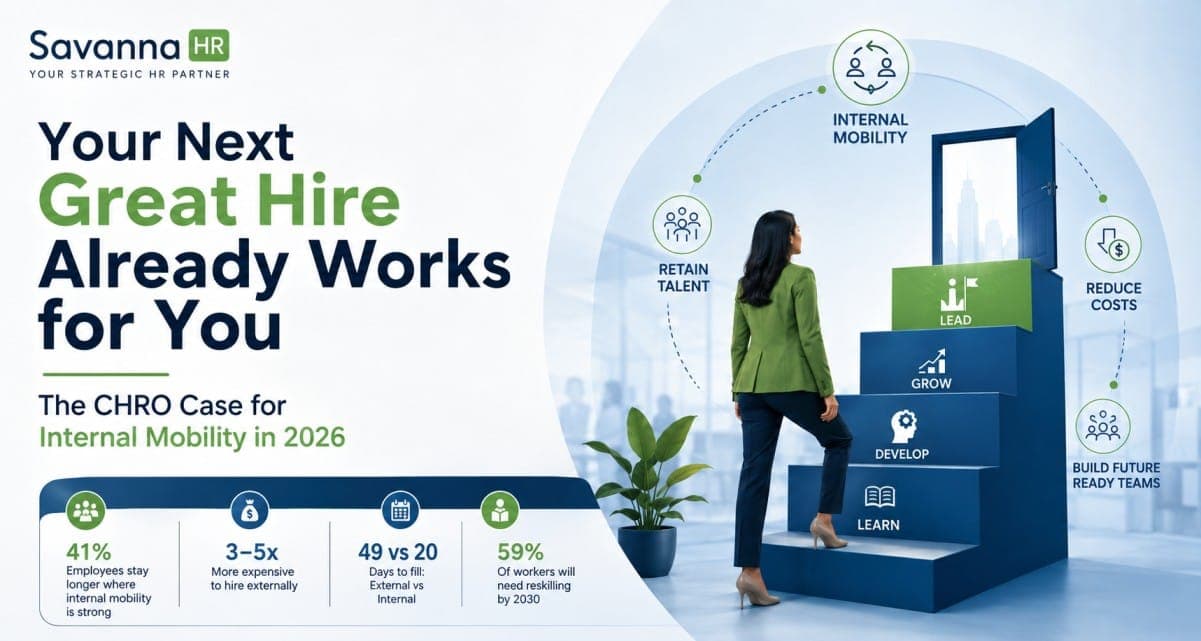
Your next great hire already works for you
In the rush to source externally, most organisations overlook the fastest, cheapest, lowest-risk talent pool they have: their own people. For CHROs facing a reskilling wave and relentless external competition, internal mobility is the most under-used lever on the board.
When a role opens up, the corporate reflex is almost automatic: write a job description, post it externally, and start sourcing from the outside. It feels like progress — like action. But for a large share of roles, the best-qualified, lowest-risk candidate is already on the payroll, one growth conversation away from being exactly who you need. And the cost of overlooking them — in money, in time, and in the people who leave because they couldn't grow — is enormous.
For CHROs navigating a tight, expensive external market and a historic reskilling wave, internal mobility isn't a soft "employee experience" initiative. It's one of the highest-ROI moves in the entire talent playbook, and the data makes the case almost embarrassingly clearly.
In this article
The numbers that make the case
Internal mobility touches every metric a CHRO is measured on — retention, cost, speed, performance — and it moves all of them in the right direction. Employees stay up to 41% longer at companies with high internal mobility, according to LinkedIn data, and roughly 94% of workers say they'd stay longer at an employer that invests in their development. On cost and speed, the gap is dramatic: external hires cost 3–5x more than internal moves once recruitment, onboarding and ramp-up are counted, and internal roles fill in around 20 days versus 49 for external hires. Wharton research adds a performance dimension — external hires take two to three years to match the performance of someone promoted from within, while commanding a pay premium for the privilege.
Internal vs external hiring
Put simply: internal moves are cheaper, faster, lower-risk and better for retention than external hires — on average and across the board. For a lever that strong, you'd expect it to be maximised. It isn't.
So why do companies still over-hire externally?
Despite the evidence, only about 25% of organisations fill more than half their roles with internal candidates. The gap is rarely a conscious choice — it's structural, and each cause is fixable. Managers hoard talent, reluctant to let good people move to another team. There's no visibility into who internally has which skills, so leaders default to the external market they can at least see. Career paths are vague, so ambitious employees conclude the only way up is out. And it often simply feels easier to import a finished candidate than to develop one — a bias toward the external "sure thing" that the data shows is neither surer nor cheaper.
The irony is sharp: by overlooking internal candidates, organisations create the very attrition that forces more external hiring. The employee who couldn't get the internal move takes an external offer — and now you're backfilling two roles instead of promoting into one.
Before you open a role to the market, ask a sharper question: who inside the business is one growth opportunity away from being exactly the person you need?
The reskilling wave makes this urgent
Internal mobility used to be a nice-to-have. The scale of the coming skills shift makes it a strategic necessity. The WEF's Future of Jobs Report 2025 projects that 59% of the global workforce will need reskilling or upskilling by 2030, and that nearly 40% of required skills will change. You cannot buy your way out of a shift that large — there simply isn't enough external talent, and the market for it is fiercely contested and expensive.
59% of the global workforce will need reskilling by 2030, and skills gaps are employers' #1 barrier to transformation. At that scale, developing and redeploying existing talent isn't optional — it's the only mathematically viable way to close the gap.
This reframes internal mobility as the operational face of reskilling. The organisations that map the skills they have, identify where they're heading, and move and develop people to close the gap will be resilient. The ones that treat every skills gap as a fresh external search will be perpetually behind, and perpetually overpaying.
How to build a real internal mobility engine
Intent isn't enough; internal mobility only works when it's engineered. Three components matter most. Visibility comes first: a live, honest map of the skills your people already have, so you know who could step up before you look outside. A genuine internal marketplace comes next — posting roles internally first, making internal moves easy rather than politically fraught, and protecting managers from being penalised for developing talent that moves on. And reskilling closes the loop: treating the gap between what someone can do today and what a role needs as something to develop, not only to recruit. Underpinning all three is a cultural shift — leaders who are measured on developing and exporting talent, not just hoarding it.
When to build and when to buy
None of this means external hiring disappears. There will always be roles — genuinely new capabilities, senior specialists, moments of rapid scale, skills that don't exist internally — where you need to buy talent rather than build it. The strategic skill is knowing which is which, and being honest about it. Reaching externally for a capability you already have wastes money and demoralises the people you passed over; trying to build internally for a capability that truly isn't there wastes time you don't have.
A good talent partner helps you make that call honestly rather than defaulting to a search. At Savanna HR, we'd always rather help you hire the right way than simply sell you a req — championing internal moves where they fit, and bringing fast, precise, specialist external sourcing when the market genuinely is the answer. Sometimes the best candidate for the role is two desks away. Sometimes they're one of the rare specialists only a focused external search will find. Knowing the difference is the whole game.
The compounding cost of ignoring internal talent
It's worth dwelling on what the internal-mobility gap actually costs, because the damage compounds in ways that never show up on a single requisition. Every time a capable employee is passed over for an external hire, three things happen at once. You pay the 3–5x premium of buying rather than building. You signal to that employee — and to everyone watching — that growth here means leaving. And you often lose that person within a year, triggering a backfill that restarts the expensive external cycle. One overlooked internal candidate, in other words, can quietly generate two external searches.
Multiply that across an organisation and the numbers turn serious. Attrition driven by a lack of internal opportunity is among the most preventable — and most expensive — forms of turnover, because it walks out the door with institutional knowledge, relationships and trained capability that a new external hire will take two to three years to rebuild. The CHROs who quantify this hidden cost, rather than treating it as invisible, are usually the ones who move fastest to fix it.
Technology is finally making internal mobility workable
One reason internal mobility stayed aspirational for so long is that the enabling technology simply wasn't there. You can't move people into roles you can't see them fit, and for decades organisations had no reliable, live picture of the skills sitting inside them — only job titles and org charts. That is changing fast. Skills-inference technology and internal talent marketplaces can now map what employees actually can do, not merely what their title says, and match them to open roles and projects much as external sourcing tools match candidates to jobs. The same AI capabilities transforming external hiring are, in other words, making the internal option finally practical at scale.
For CHROs, this removes the oldest excuse for defaulting to the external market: you can now see your internal talent nearly as clearly as the outside pool. That means the choice between building and buying can finally be made on merit rather than on visibility — and it puts real weight behind the discipline of checking inside before you look out. The organisations investing in this infrastructure now are the ones that will convert the internal-mobility opportunity from a slide in a strategy deck into a measurable shift in how roles actually get filled.
Key takeaways for CHROs
- Internal moves are cheaper (3–5x), faster (20 vs 49 days), lower-risk and better for retention (up to 41% longer tenure).
- Only ~25% of organisations fill most roles internally — the gap is structural and fixable.
- With 59% of workers needing reskilling by 2030, internal mobility is the operational face of a viable skills strategy.
- Build the engine: skills visibility, a real internal marketplace, reskilling, and leaders rewarded for developing talent.
- Know when to build vs buy — and use external hiring precisely, for the roles that genuinely require it.
Build talent, buy talent — but choose deliberately
The CHROs who win the next few years won't be the ones who hire the most externally or the least — they'll be the ones who choose deliberately between building and buying, role by role, with the data in front of them. Internal mobility is the lever most organisations are under-using, and closing that gap is one of the highest-return moves in talent today. When the market genuinely is the answer, Savanna HR brings the specialist, AI-powered sourcing to fill it fast — but we'll always help you check the desk next door first.
In a market this competitive and a skills landscape shifting this fast, no organisation can afford to overlook its single most under-used talent pool. Building a real internal-mobility engine won't happen by accident — it takes visibility, a genuine marketplace, reskilling, and a culture that rewards developing people. But the return, measured in retention, cost, speed and resilience, is among the highest in all of talent strategy. The desk next door is where a lot of your future hires are already sitting. The only question is whether you'll see them before someone else does.
Deciding whether to build or buy your next hire?
Savanna HR helps you weigh internal moves against external sourcing honestly — and brings fast, specialist hiring when the market is the right answer. Let's talk.
Talk to Savanna HRFrequently asked questions
What is internal mobility?
Internal mobility is filling open roles by moving or promoting existing employees — through internal job markets, career pathing and reskilling — rather than always hiring externally. It's a core lever for retention, cost and speed.
Is internal hiring cheaper than external hiring?
Yes. External hires cost 3–5x more than internal moves once recruitment, onboarding and ramp-up are counted, take around 49 days to fill versus 20 internally, and need two to three years to match the performance of internal promotions.
Does internal mobility improve retention?
Significantly. Employees stay up to 41% longer at companies with strong internal mobility, and around 94% say they'd stay longer with an employer that invests in their development.
How does internal mobility relate to reskilling?
They're two sides of the same strategy. With the WEF projecting 59% of workers needing reskilling by 2030, developing and redeploying existing talent through internal mobility is the only viable way to close skills gaps at that scale.


