
The GCC talent war: what India's capability-centre boom means for every CHRO in 2026
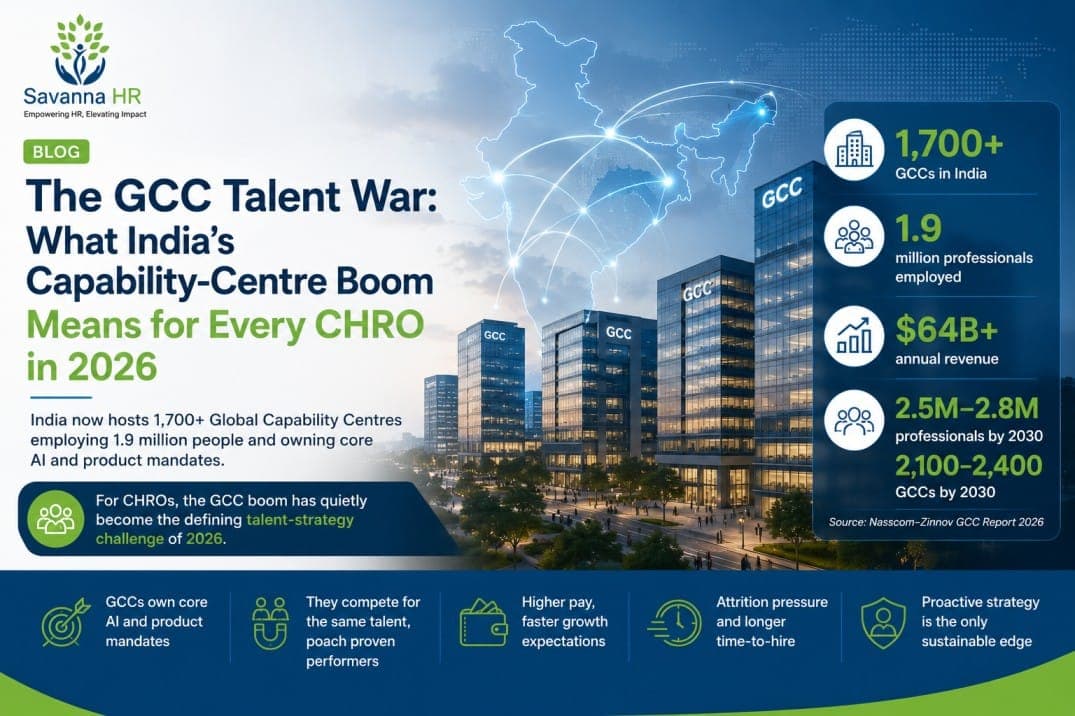
India's Global Capability Centres have crossed from cost-saving back offices into owners of core AI, product and engineering mandates. For CHROs, that shift has rewritten the rules of the talent market. Here's the data, the pressure it creates, and how to respond.
There's a moment many CHROs have had in the last eighteen months. A req that used to close in six weeks is still open at week twelve. A high performer resigns — not for a competitor, but for a global brand's newly opened India centre offering 40% more and a "global mandate." A compensation band you benchmarked a year ago is suddenly, embarrassingly, below market. Individually these feel like isolated hiring headaches. Together, they're the symptoms of one structural force: the Global Capability Centre boom, and the talent war it has unleashed.
For years, GCCs were a story for the operations and real-estate functions — a location decision, a cost line. In 2026, they are squarely a CHRO story, because they are reshaping the price, availability and expectations of skilled talent across India. If you employ engineers, data scientists, product managers or technology leaders anywhere in the country, the GCC surge is already shaping your attrition, your comp philosophy and your time-to-hire — whether you run a GCC yourself or compete against one for the same people.
In this article
From cost centre to capability centre
To understand the talent pressure, you have to understand what changed about the GCC itself. The first wave, two decades ago, was about labour arbitrage: do the same work for less. The current wave is about something entirely different — capability. Multinationals now stand up centres in India not to save money on routine tasks, but to own product roadmaps, run applied AI research, and build the technology their global business depends on.
That framing isn't marketing spin; it's the explicit theme of the industry itself. At the Nasscom GCC Summit 2026, the headline shift was described as moving "from scale to ownership" — Indian centres are no longer measured by headcount alone, but by the strategic mandates they own. Nasscom and Zinnov's landscape research now positions India's GCCs as increasingly leading the AI agenda for their global parents, not merely supporting it.
India's GCC story has shifted "from scale to ownership," with centres increasingly leading global AI mandates rather than executing them — a change that pulls demand towards senior, specialised and hard-to-find talent.
Why does this matter for hiring? Because ownership requires a very different kind of person than execution did. Owning a product line or an AI capability calls for senior engineers, applied researchers, principal-level architects and technology leaders — precisely the profiles that are scarcest, most expensive and most aggressively courted. The GCC boom hasn't just added demand to the talent market; it has concentrated that demand at the top of the skill and seniority curve, exactly where supply is thinnest.
The scale, in numbers
The magnitude is what makes this impossible to ignore. India is now home to more than 1,700 Global Capability Centres, employing around 1.9 million professionals and generating over $64 billion in annual revenue — roughly 45% of the entire world's GCC talent base. The sector has compounded at close to 10% a year, and the trajectory is steep: Nasscom–Zinnov research projects it will reach 2,100–2,400 centres and 2.5–2.8 million professionals by 2030, pushing towards $100 billion in value.
India's GCC sector at a glance
The AI concentration is especially striking. More than 120,000 AI and ML professionals already work across 185+ dedicated AI centres of excellence in India, and around 70% of GCCs now run defined AI adoption roadmaps. And the footprint is spreading beyond the traditional hubs of Bengaluru, Hyderabad and Pune. State governments have noticed the economic prize: Karnataka has announced incentives aimed at doubling its global centres to 1,000 by 2029, and tier-2 cities are actively courting new centres. For CHROs, that geographic spread is a double-edged sword — new talent pools opening up, but also new fronts in the competition for them.
Why this is a CHRO problem, not an ops one
It's tempting to file the GCC boom under someone else's remit — real estate, finance, the country GM. That would be a mistake. Every dynamic the boom creates lands on the CHRO's desk. When a dozen new centres open in your city, they don't bring their own talent; they hire from the same pool you do. When they set aggressive compensation to fill senior roles fast, they reset the market rate you must match to retain your own people. When they market "global mandates" and world-class engineering cultures, they raise the bar on the employee value proposition you need to compete.
In other words, the GCC boom is a talent-market event, and the talent market is the CHRO's domain. The leaders who treat it strategically — factoring it into workforce planning, compensation philosophy, retention strategy and employer brand — will protect their organisations. The ones who treat it as background noise will keep being surprised by the resignation letters.
The GCC boom didn't just create new jobs. It reset the price, the pace and the expectations of talent across India — and that makes it a board-level people issue, not a facilities one.
The four pressures on your talent strategy
Concretely, the boom shows up as four distinct pressures. Naming them is the first step to managing them.
1. Compensation inflation
When well-funded global centres compete for a finite pool of senior engineers and AI specialists, they bid up the price. Compensation benchmarks that felt generous a year ago erode quickly, and the gap is sharpest exactly where talent is scarcest. CHROs are being forced to re-benchmark far more frequently, and to think beyond base pay — because in a bidding war, the organisation that wins on total experience, not just total cash, is the one that keeps its people.
2. Attrition and active poaching
New centres need to staff up fast, and the quickest way to do that is to hire people who are already trained and productive — often from you. Targeted poaching of proven talent is now a standard GCC ramp-up tactic. This turns retention from a background concern into a frontline priority, and it rewards organisations that know who their flight risks are before a recruiter's InMail arrives.
3. The speed problem
In a market this hot, the best candidates are gone in days. A slow, multi-round, indecisive hiring process doesn't protect quality — it simply hands your preferred candidate to a faster competitor. GCCs that hire well move decisively, with clear criteria and short cycles. If your process still takes weeks to produce a first shortlist, you are losing people you never even got to meet.
4. Employer brand and leadership talent
GCCs compete not just on money but on story — global impact, cutting-edge work, strong engineering cultures. That raises the stakes on your employer value proposition, especially for the senior and leadership hires everyone is chasing. In a market where candidates have options, a weak or invisible employer brand is a silent tax on every offer you make.
The skills crunch underneath it all
The GCC talent war doesn't exist in a vacuum — it sits on top of a structural skills shortage that global research has been flagging loudly. The World Economic Forum's Future of Jobs Report 2025 found that 63% of employers cite skills gaps as the single biggest barrier to business transformation, and that nearly 40% of the skills required on the job will change by 2030. ManpowerGroup's 2026 data puts India's talent shortage at 82% — well above the global average — with AI skills now the hardest of all to find.
63% of employers name skills gaps as their top barrier to transformation; ~40% of required job skills will change by 2030; and 59% of the global workforce will need reskilling. The scarcity the GCC boom is competing over is structural, not temporary.
Layer a booming, AI-hungry GCC sector on top of an already-tight skills market, and you get the defining talent condition of 2026: not enough of the right people, and everyone bidding for the same ones. This is why generic, high-volume recruiting struggles here. When the profiles you need are rare, senior and specialised, you don't need more résumés — you need a sharper way to find the few people who genuinely fit, and the speed to reach them before someone else does.
What smart CHROs are doing differently
The organisations winning this war aren't simply paying more — although comp realism matters. They're changing how they operate across four dimensions.
First, they plan talent like a strategist, not a firefighter: building proactive pipelines of the roles they know they'll need, so a critical opening doesn't start a scramble from zero. Second, they protect their own people deliberately — knowing their flight risks, investing in internal mobility and development, and competing on growth and experience, not just cash. Third, they compress their hiring cycles, using AI-powered sourcing to build shortlists in minutes and empowering decisive, low-round processes so they don't lose candidates to speed. Fourth, they partner with specialists who understand niche technical mandates and the GCC market specifically, rather than treating a rare senior search like a volume play.
Key takeaways for CHROs
- The GCC boom is a talent-market event — treat it as a core input to workforce planning, comp and retention, not a facilities footnote.
- Demand has concentrated at the top of the skill curve; senior, specialised and AI roles are where the war is hottest.
- Compensation realism plus a strong employee experience beats cash alone in a bidding war.
- Speed is a competitive weapon: slow, indecisive processes lose the best people to faster rivals.
- Proactive pipelines, internal mobility and specialist hiring partners are the durable advantages.
How Savanna HR helps you win the GCC talent war
Whether you're standing up a new capability centre, scaling an existing one, or simply defending your talent against the centres opening around you, the challenge is the same: find rare, senior, specialised people — fast — and keep the ones you have. That is precisely what Savanna HR is built for. Our HireXL Hiring OS combines AI-powered sourcing that identifies and ranks scarce profiles in minutes and flags scarcity on day one, with specialist recruiters who understand technical and leadership mandates and the GCC market itself. Since 2014, that approach has delivered more than 3,500 placements, from ultra-niche technical roles to leadership hires for fast-scaling, AI-first organisations.
The GCC boom is the biggest talent story in the world right now, and it isn't slowing down. The CHROs who treat it as the strategic force it is — and hire with clarity, speed and specialist support — will be the ones who staff their ambitions instead of watching talent walk to the centre next door.
Competing for talent in the GCC market?
From standing up a capability centre to defending your best people, Savanna HR pairs specialist recruiters with the HireXL Hiring OS to help you hire rare talent fast. Let's talk.
Talk to Savanna HRFrequently asked questions
What is a Global Capability Centre (GCC)?
A GCC is an in-house centre a multinational establishes — most often in India — to deliver engineering, technology, R&D, analytics, AI and business functions for its global operations. Increasingly, GCCs own core product and innovation mandates rather than just support work.
Why is the GCC boom a challenge for CHROs?
GCCs hire from the same talent pool as everyone else, set aggressive compensation to fill senior roles quickly, actively poach proven talent, and raise employer-brand expectations. That reshapes attrition, compensation and time-to-hire for every organisation competing in the same market.
How big is India's GCC sector in 2026?
India hosts more than 1,700 GCCs employing around 1.9 million professionals and generating over $64 billion in annual revenue — roughly 45% of the world's GCC talent. Nasscom–Zinnov research projects 2,100–2,400 centres and 2.5–2.8 million professionals by 2030.
How can employers compete for GCC talent?
By planning talent proactively rather than reactively, protecting existing people through internal mobility and strong experience, compressing hiring cycles with AI-powered sourcing, and partnering with specialists who understand niche technical and leadership mandates in the GCC market.


