
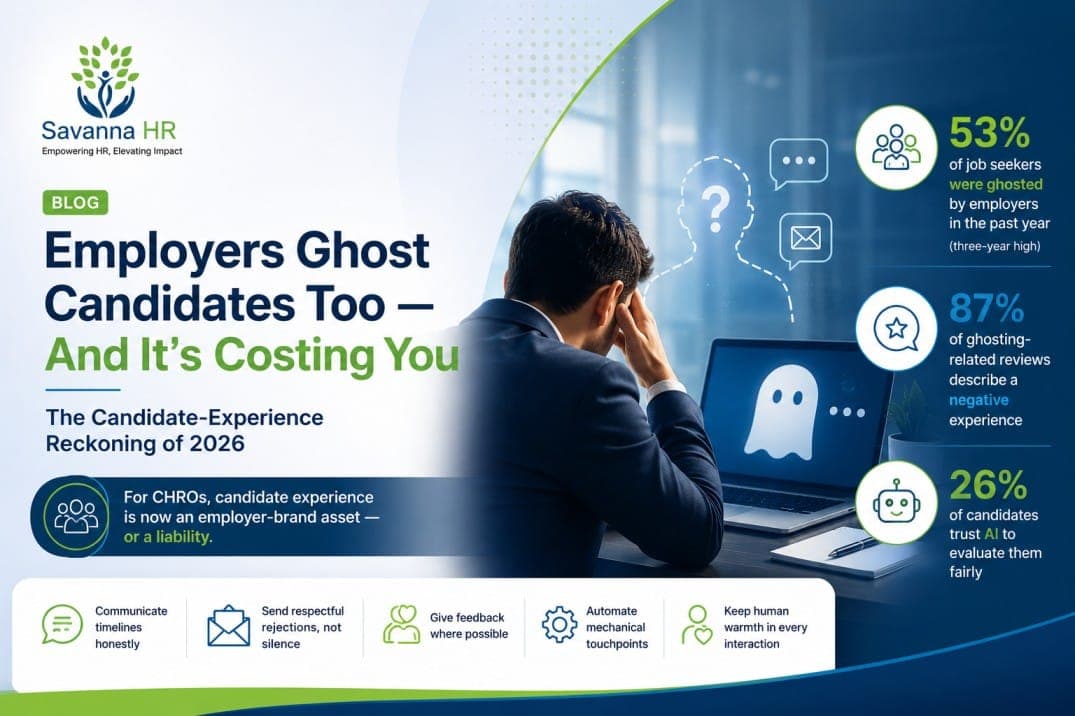
Employers ghost candidates too — and it’s costing you
We talk endlessly about candidates who ghost us. We rarely admit how often we ghost them. In 2026, with candidates comparing notes publicly and trust in hiring at a low, that silence has become a measurable business cost — and a CHRO-level issue.
Every hiring manager has a story about the candidate who vanished — stopped replying, no-showed the interview, accepted the offer and never appeared. It's real, it's maddening, and we tell these stories often. What we discuss far less is the uncomfortable mirror image: employers ghost candidates constantly, at scale, and the reputational bill for it is now coming due. In a market where candidates talk publicly and trust in hiring is fragile, candidate experience has quietly become one of the most consequential — and most neglected — levers a CHRO controls.
In this article
The data nobody wants to see
The numbers are blunt. According to Criteria Corp's 2026 research, 53% of job seekers report being ghosted by an employer in the past year — a three-year high. Greenhouse data puts post-interview ghosting rates as high as 61%, and it happens at every stage: after the recruiter screen, after the hiring-manager interview, even after final rounds and completed skills assignments. Platform analyses of hundreds of thousands of hiring conversations find candidates routinely left in silence for 30, 60, even 75 days after their last real contact.
The most damning figure is about reputation. Glassdoor analysis finds that 87% of online reviews mentioning ghosting describe a negative overall experience with that company. In other words, ghosting doesn't just annoy an individual — it converts, reliably, into public reputational damage that the next candidate reads before they ever apply.
53% of job seekers ghosted by employers in the past year (Criteria Corp); up to 61% post-interview ghosting (Greenhouse); 87% of ghosting-related reviews report a negative experience (Glassdoor). Silence is not neutral — it is remembered, and increasingly, it is published.
Why employers ghost — and why it's a false economy
Employers rarely ghost out of malice. It's almost always the by-product of a broken or overloaded process: too many candidates and too little time; decisions stuck in limbo waiting on a hiring manager; a fear that delivering a "no" invites an awkward conversation; or simply no clear owner of the final, unglamorous step of closing the loop. So the message never gets sent — and a person who invested hours, sometimes days, in your process is left staring at silence.
The logic feels like time saved. It's actually time borrowed against your reputation at a punishing rate of interest. Because the candidate you ghost today isn't only a candidate. They're a potential customer, a referral source, a professional who talks to peers, and possibly a future hire in a role you can't yet imagine. Every silent rejection is a small, compounding withdrawal from your employer brand.
Every candidate you ghost becomes a data point about what it's like to deal with your company. Enough of them, and your reputation starts doing your hiring for you — in the wrong direction.
Where ghosting hurts most
Ghosting isn't spread evenly across the hiring journey — and the later it happens, the more it costs. Analyses of the funnel find that silence lands hardest after the points of greatest candidate investment: a meaningful share of ghosting occurs after the recruiter screen, but comparable shares happen after the hiring-manager interview, after skills assignments, and even after final rounds and completed assessments. The pattern matters because effort creates expectation. A candidate who spent an evening on a take-home task or cleared four rounds has invested real time and hope; meeting that investment with silence doesn't merely disappoint them — it converts them into an active detractor. The stages where you can least afford to ghost are precisely the ones where overloaded processes most often do.
It's a two-way street — and you set the tone
There's an uncomfortable feedback loop worth naming. Employers frequently complain that candidates ghost them — accepting interviews and vanishing, or going dark after an offer. But candidate behaviour is partly a mirror of how they've been treated across a market that has normalised silence. When ghosting is the industry default, candidates disengage defensively, hedging across many processes and quietly dropping the ones that go quiet. No employer controls the whole market, but every employer controls the tone of its own process — and organisations that communicate consistently find candidates reciprocate. Respect, it turns out, is contagious; so is indifference. The company that treats people well through the process earns more of the very commitment it's asking for in return.
The wider trust problem
Ghosting sits inside a broader erosion of trust between candidates and employers — one that automation, used carelessly, can worsen. Gartner's 2026 research found that only 26% of job applicants trust that AI will evaluate them fairly. As companies rush to automate their funnels, that scepticism becomes a real risk: a process that feels like a black box — application in, silence out, no human anywhere — confirms candidates' worst assumptions and repels exactly the talent you're trying to attract.
Only 26% of candidates trust AI to evaluate them fairly. Automation without a visible human touch amplifies distrust — which means candidate experience and communication matter more, not less, as hiring gets more automated.
The lesson isn't to abandon automation — it's to pair it with visible humanity. Candidates accept, and even appreciate, AI handling mechanical steps, provided a real person owns the communication and the judgment. Efficiency and empathy aren't opposites here; the organisations that combine them are precisely the ones candidates trust.
What poor candidate experience actually costs
For a CHRO, it helps to make the cost concrete, because "be nicer to candidates" rarely wins a budget argument on its own. Poor candidate experience shows up in hard places. It shrinks your applicant pool, as negative reviews and word-of-mouth deter future candidates. It raises your cost and time to hire, because a soured reputation means fewer and warier applicants for each role. It costs referrals — ghosted candidates don't send you their talented friends. And in consumer-facing businesses, it can cost literal revenue, as candidates who felt disrespected take their custom elsewhere. Each of these is a quiet tax, invisible on any single requisition but real in aggregate.
Contrast that with the compounding upside of getting it right. A candidate who had a respectful experience — even one you rejected — becomes an advocate, a re-applicant, a referral source, a customer who thinks well of you. In tight talent markets, and 2026 is a very tight one, that goodwill is a genuine pipeline advantage. Reputation is a hiring asset or a hiring liability. There is no neutral.
Closing the loop is a competitive advantage
The best news is that this is one of the easiest advantages to build, precisely because so few companies bother. The fixes aren't expensive or complicated — they're a matter of discipline and ownership. Communicate timelines honestly, and update candidates when those timelines slip; people forgive delay far more readily than silence. Send a real, respectful "no" rather than nothing — a short, human message closes the loop and costs almost nothing. Give feedback where you reasonably can; candidates remember the companies that helped them, even in rejection. And automate the mechanical touchpoints so no one falls through the cracks, while keeping genuine human warmth at the moments that matter.
Do this consistently and you build something rare and valuable: a talent pool that wants to hear from you next time. This is also part of what a good recruiting partner protects on your behalf. At Savanna HR, managing candidate communication and experience is core to how we work — because every interaction, including every rejection, either strengthens your employer brand or erodes it. Our HireXL Hiring OS handles the mechanical touchpoints so nothing slips, while our recruiters keep the human relationship intact, so candidates feel respected rather than processed.
Make someone own the last step
If ghosting is usually a process failure rather than a values failure, the fix is often organisational rather than motivational: give the final step an owner. In most companies, ghosting happens in the gap between "we've decided" and "we've told them" — a gap no one is explicitly responsible for closing. Assign that responsibility, build the closing message into the workflow so it can't be skipped, and use automation to guarantee that no candidate exits the process without hearing from you. It's a small operational change with an outsized reputational return — exactly the kind of unglamorous discipline that separates employers with strong candidate experience from those quietly accumulating one-star reviews.
Key takeaways for CHROs
- Ghosting runs both ways: 53% of job seekers were ghosted by employers last year, and 87% of ghosting reviews are negative.
- Employers ghost from broken process, not malice — but the "saved" time is borrowed against your reputation.
- Only 26% of candidates trust AI to judge them fairly; automate with a visible human in the loop.
- Poor experience shrinks your applicant pool and raises cost and time to hire — a quiet, compounding tax.
- Closing the loop — honest timelines, respectful rejections, human touch — is a cheap, rare competitive edge.
Candidate experience is employer brand
In a connected market, your hiring process is a public performance of your values — and candidates are the reviewers. Treating every candidate, including the ones you reject, with honesty and respect isn't just decent; it's one of the highest-return, lowest-cost investments a talent function can make. The companies that understand this in 2026 are quietly compounding an advantage while their competitors ghost their way to a worse reputation and a smaller pool. Savanna HR helps you build a hiring process that strengthens your brand with every interaction — because how you treat people, especially when you're saying no, is exactly what the market remembers.
The shift required is less about budget than about mindset: seeing candidates not as applicants to be processed, but as people whose experience of you outlasts any single hire. Most of your applicants won't get the job — but all of them form an impression, and all of them talk. In a market where your reputation reaches candidates before your job post does, that impression is one of the most valuable assets your talent function owns, and candidate experience is how you protect it.
Want a hiring process that builds your brand, not erodes it?
Savanna HR manages candidate experience with the care it deserves — automated where it should be, human where it must be. Let's talk about your hiring.
Talk to Savanna HRFrequently asked questions
What is employer ghosting?
Employer ghosting is when a company goes silent on a candidate during the hiring process — after an application, screen or interview — without communication or a decision. Criteria Corp research found 53% of job seekers experienced it in the past year, a three-year high.
Does ghosting candidates really hurt a company?
Yes. With 87% of ghosting-related reviews describing a negative experience, ghosting damages employer brand, reduces referrals, and shrinks and sours future applicant pools — a compounding cost that raises time and cost to hire in tight markets.
How does AI affect candidate experience?
It can help or hurt. Only 26% of candidates trust AI to evaluate them fairly, so an over-automated, faceless process erodes trust. Automation works best for mechanical touchpoints when a visible human owns communication and judgment.
How can employers stop ghosting candidates?
Communicate timelines honestly and update candidates when they change, send respectful rejections rather than silence, give feedback where possible, and automate mechanical touchpoints while keeping human warmth. Closing the loop builds a talent pool that wants to return.


