
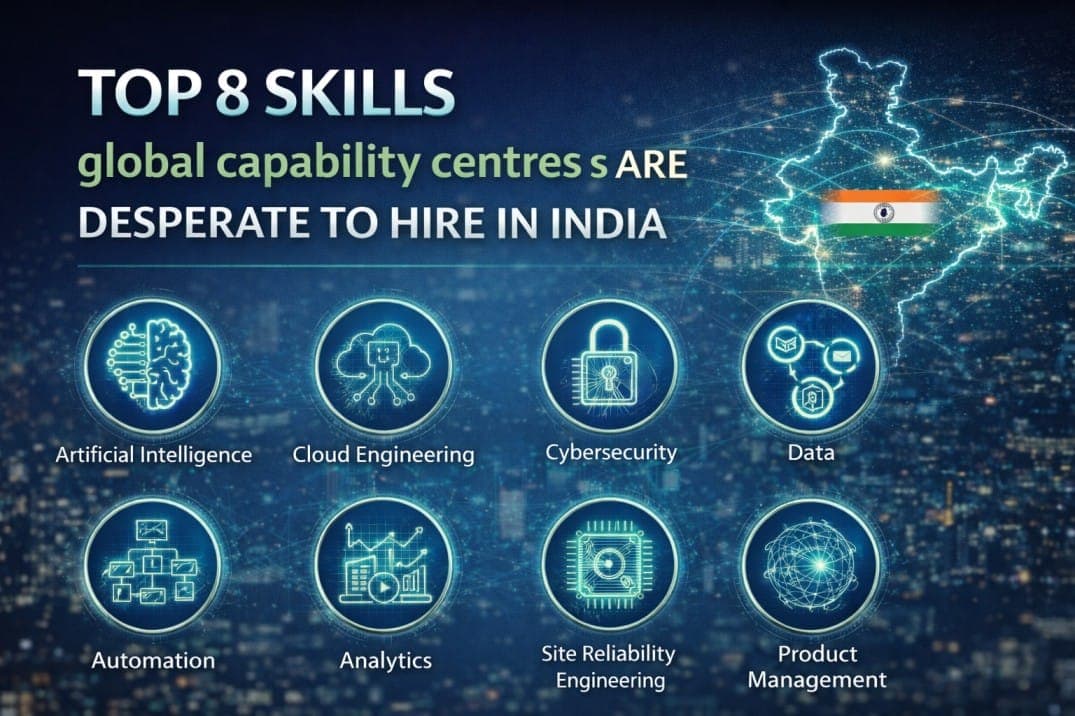
in India
Surge
Deficit
in 2026
The Talent Paradox Nobody's Talking About
Here's a number that should make every GCC leader in India lose sleep: for every 10 open GenAI roles, there's exactly one qualified engineer available.
Let that sink in.
India's Global Capability Centers are on an extraordinary tear. Over 2,100 centers are now operational, generating $64.6 billion in revenue and employing 2.4 million professionals. The Union Budget 2026-27 has sweetened the pot with R&D tax incentives and 'Safe Harbour' rules. GCCs are expected to create 4.25 to 4.5 lakh new jobs this year alone — and a million by 2030.
But here's the paradox nobody's talking about at NASSCOM panels and Zinnov summits: the jobs are being created faster than the talent to fill them. India now reports a 90% shortage in GenAI-ready talent, a 55-60% deficit in cloud-native expertise, and a 25-30% shortfall of mid-to-senior cybersecurity specialists. These aren't marginal gaps. They're canyons.
I've spent the last year embedded in GCC hiring — placing engineers, advising talent acquisition leaders, and tracking skills demand across sectors. This article is the distillation of that experience, combined with data from NASSCOM, Zinnov, EY, AIM Research, Taggd, and dozens of hiring conversations that never make it into public reports.
These are the 8 skills that GCCs are genuinely desperate to hire for — not the LinkedIn-friendly 'hot skills' lists, but the capabilities where supply is so thin that hiring timelines stretch to 90 days, salary premiums touch 60%, and TA leaders are quietly admitting they don't know where to find the next hire.
Let's get into it.
Skill #1: GenAI & LLM Engineering
If there's one skill that defines the GCC hiring crisis of 2026, it's this one. Generative AI hasn't just created a new job category — it's created a new talent economy with its own rules, its own salary physics, and its own desperate arithmetic.
The numbers are staggering. Demand for GenAI specialists has surged 300% compared to 2024. India needs at least 1 million skilled AI professionals by end of 2026, but faces a 53% skill deficit. For senior roles — think RAG architects and LLM fine-tuning engineers — realistic hiring timelines run 60 to 90 days on a well-resourced search. And here's the kicker: roughly 70% of qualified senior GenAI engineers aren't even looking. They're employed, well-compensated, and not scrolling job boards.
What GCCs are actually hiring for within this space tells you how far the field has matured:
▸ LLM Fine-Tuning Engineers: Professionals who can take foundation models (GPT, Claude, Llama, Gemini) and adapt them for enterprise-specific use cases — healthcare diagnostics, financial risk modeling, legal document analysis.
▸ RAG (Retrieval-Augmented Generation) Developers: Engineers who build systems that ground LLM responses in real enterprise data, reducing hallucinations and making AI actually reliable for business decisions.
▸ Prompt Engineers & AI Product Managers: The bridge between raw AI capability and business value. These professionals design the interaction layer — how humans and AI systems work together productively.
▸ MLOps & LLMOps Engineers: The plumbers of the AI world. They build the pipelines, monitoring, and deployment infrastructure that take a model from Jupyter notebook to production at scale.
The salary premium tells the story. Senior GenAI Engineers command ₹40.5 LPA and above. GenAI Research Scientists earn similarly. Synthetic Data Engineers — a role that barely existed 18 months ago — command ₹40.2 LPA. That's a 40-60% premium over traditional ML roles at equivalent experience levels.
The bottom line: 75% of GCCs plan to embed generative AI into daily operations within 12 months. But with only 1 qualified engineer for every 10 open roles, many of those plans will stall — unless hiring strategies fundamentally change.
Skill #2: Cybersecurity & Cloud Security
The 4.8 million professional gap that keeps CISOs awake at night.
Here's a truth that's uncomfortable for global enterprises with India GCCs: you can't build a world-class innovation hub if you can't protect it. And right now, you probably can't hire enough people to protect it.
The global cybersecurity workforce gap stands at 4.8 million professionals. In India specifically, there's a 25-30% shortage of mid-to-senior cybersecurity specialists — the people who can architect zero-trust frameworks, build cloud-native security programs, and respond to sophisticated threats in real time. And this gap could persist well into 2030.
What's driving the urgency isn't just the threat landscape (though ransomware attacks on Indian enterprises rose significantly in 2025). It's the regulatory tsunami. The EU's Digital Operational Resilience Act (DORA) is now in effect for financial services. India's Digital Personal Data Protection Act is tightening enforcement. Every BFSI GCC — and there are hundreds of them — needs compliance-aware security teams.
The specific sub-skills GCCs are scrambling to find:
▸ Cloud Security (CSPM, CNAPP, Zero-Trust): As GCCs move infrastructure to AWS, Azure, and GCP, securing cloud-native environments has become critical. This is the single most in-demand cybersecurity specialization, with 40% YoY demand growth.
▸ DevSecOps / Application Security: Shifting security left into the development pipeline. GCCs building their own products need engineers who understand secure SDLC, SAST/DAST tools, and can embed security into CI/CD without slowing delivery.
▸ Threat Intelligence & SOC Operations: With companies like Deepwatch opening GCCs specifically for AI-driven threat detection, India is becoming a global hub for security operations centers.
▸ GRC & Compliance: SOX, GDPR, HIPAA, DPDPA — the alphabet soup of regulatory frameworks requires specialists who understand both technology and governance.
BFSI GCCs are driving double-digit demand growth in cybersecurity hiring. MetLife's expanded India GCCs, BNY Mellon's Pune technology hub, and ArcelorMittal's AMGBT division all list cybersecurity as a core hiring priority. The challenge? These same companies are competing against each other — and against every other GCC — for the same finite talent pool.
The bottom line: AI, data, and cybersecurity roles have shifted from experimental to core organizational needs, with demand growing 51% year-on-year. If you can break into cloud security today, you're virtually recession-proof for the next decade.
Skill #3: Data Engineering
The invisible backbone of every AI initiative — and the skill nobody remembers to hire for first.
Every GCC leader wants to talk about AI. Nobody wants to talk about the data pipelines that make AI possible. And that's exactly why data engineering has become one of the most quietly desperate hiring needs in the ecosystem.
Here's the uncomfortable reality: you can hire the most brilliant GenAI engineer on the planet, and they'll be useless if your data is scattered across 47 legacy systems with no unified pipeline, no quality governance, and no real-time ingestion capability. Data engineers are the people who fix that. They're the ones who make AI actually work.
India is expected to face a shortage of over 230,000 data science professionals by 2026. Within that, data engineering — the specific discipline of building, maintaining, and optimizing data pipelines — is experiencing particularly acute demand. The global data engineering market is projected to grow from $29.1 billion in 2023 to $175 billion by 2030, a nearly 6x expansion.
What GCCs need isn't the traditional ETL developer of five years ago. The modern data engineering stack has evolved dramatically:
▸ Real-Time Pipeline Builders: Apache Kafka, Apache Flink, and streaming architectures that process millions of events per second. Financial GCCs need real-time fraud detection. Healthcare GCCs need real-time patient data. Batch processing is no longer enough.
▸ Modern Data Stack Experts: dbt (data build tool) for transformation, Snowflake or Databricks for warehousing, Airflow or Dagster for orchestration. This modern stack has created a new generation of data engineers who think in terms of data products, not just data tables.
▸ Data Mesh Architects: As GCCs scale, monolithic data teams can't serve every business unit. Data mesh — a decentralized approach where domain teams own their data products — requires engineers who understand both architecture and organizational design.
▸ DataOps & Data Quality Engineers: The growing realization that bad data kills AI projects has created demand for engineers focused on data observability, lineage tracking, and quality automation.
The salary trajectory reflects the demand. Mid-level data engineers with 5-8 years of experience command ₹22-38 LPA in GCCs. Senior data architects with real-time pipeline expertise push past ₹55 LPA. And unlike some AI roles where hype inflates salaries, data engineering compensation is directly tied to measurable business impact — these professionals keep the entire data infrastructure running.
The bottom line: If AI is the car, data engineering is the road. GCCs are building increasingly powerful cars — but many of them are still driving on dirt tracks. The engineers who can build the highway will be in demand for years.
Skill #4: Platform Engineering
The discipline Gartner says 80% of organizations will adopt by 2026 — but almost nobody can hire for yet.
latform engineering might be the most important skill on this list that most people still can't clearly define. And that ambiguity is exactly what makes it so hard to hire for.
Here's what it is in plain language: platform engineers build the internal tools and infrastructure that make other developers more productive. Think of them as the people who build the factory floor, so that product engineers can focus on building the actual products without worrying about infrastructure, deployment, monitoring, or compliance.
The concept has exploded because GCCs have hit a scaling wall. When you have 500+ engineers across multiple teams, you can't have each team managing its own Kubernetes clusters, CI/CD pipelines, and cloud infrastructure. That's where platform teams come in — they abstract away the complexity and create self-service developer platforms.
Gartner predicted that 80% of software engineering organizations would establish platform teams by 2026. India's GCCs are racing to meet that timeline, but the talent pool is still nascent. PlatformEngineering.org recently highlighted India as one of the fastest-growing markets for this discipline, calling it 'India's next big engineering career shift.
What makes platform engineering hiring uniquely challenging:
▸ Hybrid Skill Set Required: Platform engineers need deep infrastructure knowledge (Kubernetes, Terraform, cloud providers) combined with software engineering skills (building internal tools, APIs, developer portals) and empathy for developer experience. This combination is rare.
▸ No Formal Education Pipeline: Unlike data science or even DevOps, there's no established university curriculum for platform engineering. Talent is almost entirely self-taught or trained on the job.
▸ Confused with DevOps: Many companies (and recruiters) conflate platform engineering with DevOps. They're related but distinct — DevOps is about processes and culture; platform engineering is about building products for internal developers.
The demand is growing at 35% year-on-year, with salaries for experienced platform engineers (8+ years) reaching ₹42-60 LPA in top GCCs. Companies like Ferguson and NTT DATA, who recently opened India GCCs, have platform engineering as a core hiring mandate.
The bottom line: Platform engineering is transitioning from 'nice to have' to 'existential need' as GCCs scale. The professionals who can build internal developer platforms that genuinely improve engineering productivity will be among the highest-paid and most sought-after engineers in the ecosystem.
Skill #5: AI Agents & Agentic AI
The newest skill category — and the one that's already showing 383% projected adoption growth.
If GenAI was the earthquake, agentic AI is the tsunami that follows. And it's arriving faster than anyone anticipated.
Here's what's happening: we've moved from AI that responds to prompts (ChatGPT-style) to AI that takes autonomous action. AI agents can browse the web, execute code, call APIs, manage workflows, and make decisions with minimal human oversight. This isn't science fiction — it's what enterprises are deploying right now.
The numbers are striking. Salesforce's 2026 research shows Indian HR leaders expect agentic AI adoption to jump 383% by 2027, delivering 41.7% productivity gains. Gartner reports that 40% of enterprise applications will have embedded agents by December 2026. EY's 'AIdea of India 2026' report confirms that 24% of Indian leaders are already deploying agentic AI, with the rest racing to catch up.
For GCCs, this isn't a future consideration — it's a present-tense hiring crisis. The professionals who can build, orchestrate, and govern AI agent systems are some of the rarest in the market:
▸ Multi-Agent System Architects: Engineers who can design systems where multiple AI agents collaborate — one agent researches, another writes, a third reviews, a fourth publishes. This requires understanding of agent frameworks (AutoGen, CrewAI, LangGraph) and complex system design.
▸ Tool-Use & Integration Specialists: AI agents are only as useful as the tools they can access. These engineers build the connectors between agents and enterprise systems — CRMs, ERPs, databases, APIs — and handle the security and reliability challenges that come with autonomous access.
▸ Agent Evaluation & Safety Engineers: How do you test an AI system that behaves differently every time? How do you ensure an autonomous agent doesn't take harmful actions? This emerging sub-discipline sits at the intersection of ML engineering, QA, and AI safety.
The compensation for agentic AI specialists reflects the scarcity. Mid-level practitioners with demonstrated agent-building experience command ₹25-50 LPA. Senior architects who can design enterprise-grade agent systems are negotiating packages that rival director-level compensation.
India has a head start here. The IndiaAI Mission has committed to 40,000+ GPUs for sovereign AI compute. IIT Madras, IIMs, and NASSCOM are flooding the market with AI certification programs. But the gap between 'completed a certification' and 'can build production agent systems' remains vast.
The bottom line: Agentic AI is where GenAI was 18 months ago — early but accelerating ferociously. Professionals who build expertise here now will ride the biggest wave in enterprise AI. GCCs that start hiring for this capability today will have a decisive advantage by 2027.
Skill #6: Product Management (Tech)
The clearest signal that a GCC has graduated from 'offshore center' to 'global product hub.
When a GCC hires its first product manager, it's making a statement. It's saying: we're not here to execute someone else's roadmap. We're here to own the product.
That shift — from service delivery to product ownership — is the defining transformation of GCC 4.0. And it's creating a hiring need that India's talent ecosystem is still catching up to.
The Institute of Product Leadership reports a 42% year-on-year increase in product management hiring, driven mainly by demand at senior and leadership levels. This isn't about entry-level associate PMs. GCCs need seasoned product leaders who can define strategy, work with global stakeholders, manage P&L, and translate business outcomes into engineering priorities.
Why is this so hard to hire for? Because India's product management talent pool was historically thin. For two decades, the dominant model was IT services — where someone else defined the product and Indian teams delivered it. The muscle memory of 'product thinking' — user empathy, hypothesis-driven development, outcome orientation — was never systematically built.
That's changing rapidly, but the gap at the experienced level persists:
▸ Strategic Product Leaders (VP/Director): GCCs need product leaders who can present to a C-suite in New York, negotiate priorities with business units in London, and manage distributed engineering teams across time zones. Salary: ₹55-85 LPA+.
▸ Technical Product Managers: PMs who can go deep on AI, data platforms, or infrastructure products. They need to speak engineering fluently while keeping the business case front and center.
▸ Product Design & UX Research: As GCCs own full product lifecycles, the need for user researchers, service designers, and design system architects has surged. This talent barely existed in the GCC context three years ago.
The compensation trajectory tells the story of a maturing market. Junior PMs earn ₹10-15 LPA. Senior professionals start at ₹40 LPA. Leadership positions cross ₹75 LPA. These are packages that compete with Big Tech and startups — a sign that GCCs are dead serious about product ownership.
The bottom line: If a GCC is hiring product managers, it means the parent company trusts its India center to make strategic decisions, not just write code. Every GCC aspires to this. Not enough have the talent to make it real.
Skill #7: Responsible AI & AI Governance
The compliance imperative that went from 'nice to have' to 'existential risk' in 12 months.
n February 2025, the EU AI Act entered into force. In one stroke, it transformed AI governance from an academic exercise into a compliance mandate affecting every GCC that serves European markets — which is to say, almost all of them.
Then came the ripple effects. India's Digital India Act is on the horizon. The US executive orders on AI safety are reshaping procurement requirements. Singapore, Japan, and Australia are all developing AI governance frameworks. Suddenly, every GCC that deploys AI needs someone who can answer the question: 'Is this legal, ethical, and safe?'
The demand for Responsible AI specialists has grown 60% year-on-year, and it's accelerating. But the talent pool is almost comically thin. This is a discipline that sits at the intersection of machine learning, ethics, law, and public policy — and almost no educational institution produces graduates with that combination.
What GCCs are looking for:
▸ AI Ethics & Bias Detection: Engineers and researchers who can audit AI models for discriminatory outcomes, design fairness metrics, and build debiasing pipelines. Critical for BFSI GCCs (credit scoring, insurance underwriting) and healthcare GCCs (clinical decision support).
▸ Model Explainability Specialists: The EU AI Act requires that high-risk AI systems be explainable. These professionals build the tooling and methodologies that make 'black box' models transparent — using techniques like SHAP, LIME, and attention visualization.
▸ AI Risk & Compliance Managers: Non-engineering roles that bridge AI teams and legal/compliance functions. They translate regulatory requirements into technical specifications and build governance frameworks.
▸ AI Red Team Engineers: Specialists who systematically attack AI systems to find vulnerabilities — prompt injection, data poisoning, adversarial examples. A growing sub-discipline inspired by cybersecurity red teaming.
The compensation is strong and rising: ₹18-35 LPA for mid-level practitioners, with senior AI governance leaders commanding ₹50-70 LPA. But more importantly, this is one of the few AI-adjacent roles where demand will only grow as regulation tightens globally.
The bottom line: Every GCC deploying AI will need AI governance professionals. The EU AI Act isn't optional, the DPDPA isn't optional, and the reputational risk of biased AI isn't optional. This is one of the smartest career bets in the ecosystem right now.
Skill #8: FinOps & Cloud Economics
The skill that saves companies millions — and that nobody thought to hire for until the cloud bill arrived.
Here's a story I hear surprisingly often: a GCC migrates to the cloud, celebrates the 'digital transformation,' and then six months later receives a cloud bill that makes the CFO's eyes water. Nobody budgeted for it. Nobody optimized for it. And nobody on the team knows how to fix it.
That's the FinOps problem — and it's creating one of the most unusual skill demands in the GCC ecosystem.
FinOps (Financial Operations for cloud) is the practice of bringing financial accountability to cloud spending. It sits at the intersection of engineering, finance, and business strategy. And it's gone from an obscure discipline to a board-level priority in the space of two years.
The numbers tell the story. 70% of large enterprises now have dedicated FinOps teams. FinOps adoption grew 46% in 2025. The global cloud FinOps market is projected to grow from $13.5 billion in 2024 to $23.3 billion by 2029. Leading GCCs in Bengaluru, Hyderabad, and Pune report that effective FinOps programs reduce cloud costs by 20-30% while actually improving service quality.
Why is this so hard to hire for? Because FinOps requires a genuinely unusual skill combination:
▸ Cloud Infrastructure Knowledge: You need to understand AWS/Azure/GCP pricing models, reserved instances, spot instances, savings plans, and the labyrinthine discount structures that cloud providers use.
▸ Financial Analysis: You need to build forecasting models, chargeback systems, and ROI analyses that translate cloud spending into business language the CFO understands.
▸ Engineering Influence: You need to work with development teams to optimize architecture — right-sizing instances, eliminating waste, implementing auto-scaling — without being seen as the 'cost police.
FinOps professionals command salary premiums of 10-40% over equivalent engineering roles. The demand growth is at 55% year-on-year, and it's concentrated in GCCs where cloud spending runs into hundreds of crores annually.
The bottom line: FinOps is the rare discipline where you can quantify your value in exact rupees saved. A good FinOps engineer pays for themselves many times over. That makes it one of the most defensible, valuable, and undersupplied skills in the GCC talent market.
The Elephant in the Room: The Mid-Level Vacuum
Before we talk about solutions, we need to name the structural problem that cuts across all eight skills: India's mid-level talent vacuum.
The 8-15 year experience band is where the real crisis lives. These are the professionals who possess both technical depth and cross-functional leadership — the architects, principal engineers, senior product managers, and technical directors who mentor junior talent, make system-level decisions, and bridge the gap between strategy and execution.
Entry-level talent? India produces 1.5 million engineering graduates annually. Abundant, if not always job-ready. Senior leadership? It can be recruited globally or developed through multi-year programs. But the mid-level cohort — the people who actually build and run things — faces the fiercest three-way competition: GCCs vs. IT services companies vs. funded startups.
This isn't a problem that salary alone can solve. It's a structural supply constraint that will take 3-5 years of deliberate talent development to address. And it affects every single skill on this list.
How GCCs Can Bridge the Gap: 5 Strategies That Actually Work
Acknowledging the talent crisis is the easy part. Here's what the smartest GCCs are doing about it:
1. Build Talent Factories, Not Just Hiring Pipelines
The GCCs winning the talent war aren't just recruiting — they're manufacturing capability internally. This means structured AI/GenAI academies with 40+ hours of annual training per engineer, rotational programs across global offices, and mentorship pipelines where senior leaders actively coach mid-level professionals. When you can't buy talent fast enough, you build it.
2. Adopt Skills-Based Hiring — For Real
Over 40% of qualified candidates come through non-traditional pathways — bootcamps, self-taught learning, career transitions from adjacent fields. Yet most GCCs still screen for pedigree first. The companies that are filling roles fastest have replaced generic 'Software Engineer' postings with micro-specializations ('RAG Systems Developer', 'Platform Engineer — Internal Developer Experience') and evaluate candidates through project portfolios and live assessments, not resume keywords.
3. Tap the IT Services Goldmine
India's IT services sector — TCS, Infosys, Wipro, HCL — employs over 5 million professionals. That's the largest single talent reservoir for GCC hiring. The sweet spot? The 5-10 year band — professionals who've built technical depth but are hungry for product-oriented roles with direct business impact. The key is addressing the 'services to product' transition gap through structured onboarding that builds product thinking and ownership mindset.
4. Win Tier 2 Before Everyone Else Does
Ahmedabad has 35+ GCCs. Kochi's Infopark hosts 580+ tech companies. Mohali offers 30-35% cost advantage over NCR. Coimbatore is witnessing 40% IT recruitment growth. The Tier 2 opportunity is real — but it requires a fundamentally different playbook: heavy employer branding (candidates don't know your GCC brand), campus partnerships (build the pipeline from source), and community building (tech meetups, hackathons, knowledge-sharing events that position your GCC as a local tech anchor).
5. Partner with Government — The Incentives Are Real
The Union Budget 2026-27 introduced tangible incentives for GCCs: R&D tax benefits, 'Safe Harbour' rules for mid-sized centers, and state-level frameworks (Kerala's GCC Framework, Gujarat's GIFT City incentives, Telangana's IT policy) that offer real operational advantages. GCCs that engage proactively with these programs — co-designing curriculum with universities, participating in NASSCOM's 'Education to Employment' initiatives — get a structural advantage that pure salary competition can't match.
The Complete Picture: Skills Gap Scorecard
Here's our proprietary assessment of each skill's supply-demand dynamics, compensation range, and hiring difficulty:
| Skill | Demand Growth | Supply Status | Time to Hire | Mid CTC (LPA) | Senior CTC (LPA) |
|---|---|---|---|---|---|
| GenAI / LLM Engineering | +300% YoY | Critical Shortage | 60-90 days | ₹30-55L | ₹60-90L+ |
| Cybersecurity / Cloud Security | +40% YoY | Severe Shortage | 45-75 days | ₹25-42L | ₹50-75L |
| Data Engineering | +85% YoY | Moderate Shortage | 30-50 days | ₹22-38L | ₹45-65L |
| Platform Engineering | +35% YoY | Moderate Shortage | 35-55 days | ₹22-36L | ₹42-60L |
| Agentic AI | +180% YoY | Extreme Shortage | 75-100 days | ₹25-50L | ₹55-80L+ |
| Product Management | +42% YoY | Moderate Shortage | 40-60 days | ₹28-48L | ₹55-85L |
| Responsible AI | +60% YoY | Severe Shortage | 50-80 days | ₹18-35L | ₹50-70L |
| FinOps / Cloud Economics | +55% YoY | Significant Shortage | 40-65 days | ₹20-35L | ₹40-60L |
The Window Is Open — But It Won't Stay Open Forever
India's GCC ecosystem is at an inflection point. The $64.6 billion industry is on a trajectory to $100 billion by 2030. The jobs are being created. The investment is flowing. The government support is real.
But the talent crisis is equally real. A 53% AI skill deficit, a 25-30% cybersecurity shortfall, and a structural mid-level vacuum aren't problems that solve themselves. They require deliberate, sustained investment in talent development, hiring innovation, and ecosystem building.
For professionals, the opportunity is extraordinary. Every skill on this list represents a career path where demand dramatically outstrips supply, salaries are premium, and job security is high. The professionals who invest in these capabilities now — genuinely invest, not just collect certifications — will have leverage in the talent market for years to come.
For GCC leaders, the message is urgent: the war for talent in these eight skills will only intensify. The companies that build talent factories, adopt skills-based hiring, tap non-obvious talent pools, and invest in Tier 2 cities will win. The ones waiting for the 'perfect candidate' will wait a very long time.
At Savanna HR, we're deeply embedded in this ecosystem. We don't just fill roles — we help GCCs build talent strategies that account for the skills crisis, the city dynamics, and the compensation landscape. If you're building a GCC team in India and struggling with any of the eight skills above, we should talk.
The window is open. But it won't stay open forever.
Sources & References
○ NASSCOM — GCC Summit & Awards 2025; Quarterly GCC Landscape Reports; Technology Sector Strategic Review
○ NASSCOM-Zinnov — India GCC Landscape Report; Mid-Market GCCs Report 2025
○ EY — Future of Pay 2026 Report; 'AIdea of India 2026: Agents and Digital Workforce' Report
○ Salesforce — 2026 AI in Hiring Research (India findings, agentic AI adoption projections)
○ Gartner — Platform Engineering predictions; Enterprise AI agent adoption forecasts
○ AIM Research — GCC Salary Trends in India; GenAI role compensation data
○ Taggd (PeopleStrong) — India GCC Hiring Trends 2025-2026; Skills in Demand analysis; Cybersecurity hiring trends
○ Careernet — BFSI GCCs in India: Salary Benchmark & Market Trends Report FY 2025-26
○ AnalytixLabs — AI Skills Playbook 2026: Mapping AI Skills Demand in India
○ Institute of Product Leadership — Product Management Hiring Trends Report 2025
○ Zinnov — Salary Increase, Attrition & Hiring Trends: India GCC View 2026
○ MarketsandMarkets — Cloud FinOps Market Report 2025-2030
○ FinOps Foundation — State of FinOps 2026 Report
○ PlatformEngineering.org — India's Platform Engineering Career Shift Analysis
○ Union Budget 2026-27 — R&D tax incentives, Safe Harbour rules (India Employer Forum analysis)
○ Company announcements — Cohere Health, ArcelorMittal AMGBT, MetLife, Lonza, Deepwatch, Ferguson, NTT DATA, HCL 'New Vistas'
○ Adecco India — 2026 Tech Jobs Growth Forecast
○ HuntingCube — Data Engineer & ML Engineer Jobs India 2026 analysis
○ SavannaHR — Proprietary placement data and client engagement insights


