
The Architect Who Got 14 Offers in 11 Days
Sometime in late 2025, a cloud architect with 11 years of experience at a multinational pharmaceutical GCC in Hyderabad quietly updated his LinkedIn profile. He didn’t apply to a single job. He didn’t message a single recruiter. He simply changed his status to “Open to Work.”
Within 11 days, he had 14 interview requests. Not from startups desperate for talent. Not from IT services companies backfilling attrition. From other GCCs — global capability centres run by Fortune 500 companies, each one willing to offer 30–40% salary hikes to lure him away. He eventually accepted a role at a European fintech GCC in Bengaluru for a package 45% higher than his existing CTC.
His former employer took five months to find a replacement. During that period, a critical Azure-to-AWS migration project stalled, two junior engineers who had depended on his mentorship resigned, and the VP of Engineering in Zurich began exploring whether the workstream should be moved to their Polish centre instead.
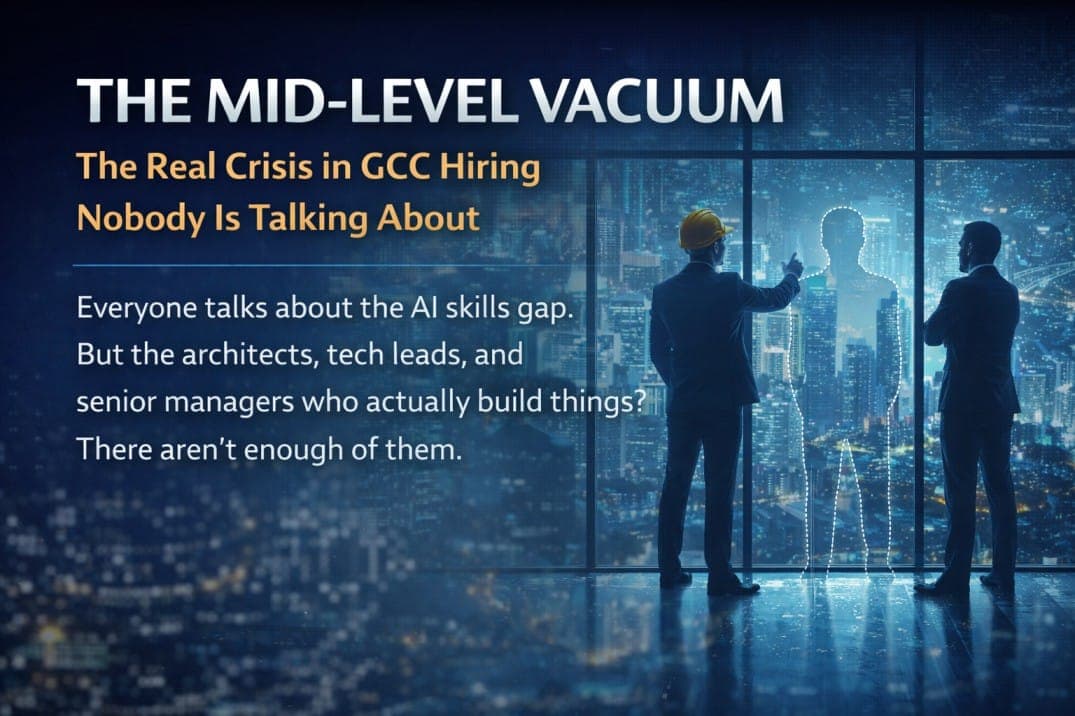
This is not an unusual story. Across India’s 1,700+ GCCs, some version of this plays out hundreds of times every quarter. And it points to what may be the most consequential — yet least discussed — talent crisis in the Indian technology ecosystem: the mid-level vacuum.
What Is the Mid-Level Vacuum, and Why Does It Matter More Than the AI Skills Gap?
Open any industry report on GCC hiring challenges in India and you’ll find page after page about the AI skills shortage. The numbers are real: 53% of GCCs report an AI skill deficit, demand for GenAI talent has surged 300% year-over-year, and salary premiums for AI/ML specialists have climbed 30–50% above market averages. These are genuine challenges.
But they obscure a deeper, more structural problem. The mid-level vacuum — the acute shortage of professionals with 8–15 years of experience who serve as the operational backbone of any GCC — affects every function, every technology stack, and every sector. It’s not a niche gap. It’s a systemic void.
These mid-level professionals — your tech leads, senior architects, engineering managers, principal engineers, and domain specialists — are the people who translate strategy into execution. They’re the ones who mentor junior engineers into productive contributors. They’re the ones who catch architectural flaws before they become production incidents. They’re the ones who navigate the complexity of global stakeholder management while keeping delivery on track.
Without them, senior leaders get overwhelmed managing too many direct reports. Junior staff lack mentorship and take twice as long to become productive. Projects stall because nobody has the experience to navigate complexity. Quality degrades. Timelines slip. And the organisation enters a downward spiral where problems compound faster than they can be solved.
“You can hire 50 brilliant freshers tomorrow. But without experienced mid-level professionals to lead them, mentor them, and channel their energy into structured output, you’ve just added cost without adding capability.”
— HR Head, BFSI GCC, Pune (speaking at a NASSCOM roundtable, 2025)
The Lost Generation: How India’s GCC Ecosystem Created Its Own Crisis
The mid-level vacuum didn’t appear overnight. It was engineered — unintentionally, over a decade — by the very dynamics that made India’s GCC sector so successful.
The Great Exodus of 2012–2018
Between 2012 and 2018, India experienced its most dramatic tech talent redistribution. The startup boom — fuelled by unprecedented venture capital inflows — pulled thousands of mid-career professionals out of GCCs and IT services companies. These were exactly the people with 5–10 years of experience at the time — professionals who, had they stayed, would be today’s 12–18 year veterans. The architects. The tech leads. The engineering managers.
Simultaneously, a significant cohort of India’s best mid-career talent migrated overseas, attracted by opportunities in the US, UK, and Southeast Asia. Consulting firms like McKinsey, BCG, and the Big Four expanded aggressively in India, siphoning domain expertise from GCCs. The result: a generation-sized gap in the experience pipeline that would take a decade to manifest — and is now impossible to ignore.
The Underinvestment in Internal Development
During the same period, most GCCs were operating under a GCC 2.0 or early 3.0 model: cost centres focused on delivery efficiency, with limited investment in leadership development or career progression for Indian talent. Promotions were slow, lateral growth opportunities were scarce, and the most ambitious professionals saw little reason to stay.
“We spent years treating our India centres as execution factories. We didn’t invest in growing leaders. Now we’re surprised there aren’t any. That’s not a talent crisis — that’s a leadership failure we need to own.”
— CTO, Healthcare GCC (anonymised), speaking at Nasscom GCC Conclave 2025
The Hiring Carousel: 60% GCC-to-GCC Circulation
Perhaps the most damaging dynamic is what industry analysts have started calling the “GCC hiring carousel.” According to HRKatha’s 2025 analysis of GCC talent flows, a staggering 60% of all new GCC hires now come from other GCCs. Companies are not creating new mid-level talent. They’re redistributing the same limited pool — at ever-higher salary premiums.
This internal circulation creates a zero-sum game: one GCC’s gain is another’s loss. The total supply of experienced mid-level professionals in the ecosystem doesn’t grow. Salaries inflate. Attrition rises. And the organisations that can’t match the bidding war lose their best people to competitors who offer 30–45% hikes for what is, functionally, the same role at a different company.
By the Numbers: Mapping the Vacuum
Let’s quantify how acute this shortage really is across the dimensions that matter most to GCC leaders.
| Metric | Data Point | Source |
|---|---|---|
| GCC-to-GCC hiring share | 60% of all new hires | HRKatha / Industry analysis, 2025 |
| Mid-level salary premium over market | 30–50% for specialised roles | Zinnov SIAR Report 2025–26 |
| Average attrition, mid-level GCC roles | 15–20% (higher in AI/ML) | ANSR Compensation Report 2025 |
| Time-to-fill, mid-senior GCC roles | 45–70 days average | SavannaHR benchmarking data |
| AI skill deficit across GCCs | 53% report shortage | NASSCOM-Zinnov 2025 |
| Salary hike average (GCC India, 2026) | 9.9% | Zinnov SIAH Report 2026 |
| GCCs extending LTIs to mid-level | 38% of organisations | ANSR / Zinnov 2025 |
| Mid-level roles as % of total GCC hiring | 65% of all hiring volume | Taggd GCC Hiring Trends 2025 |
The 65% figure is particularly telling. GCCs aren’t struggling to hire juniors — India produces 1.5 million engineering graduates every year. And they’re not primarily hunting for C-suite executives. The bulk of their hiring need — nearly two-thirds — sits squarely in the mid-level band. This is where the demand is highest, the supply is thinnest, and the competition is fiercest.
Two Stories from the Front Lines
Example 1: India’s 5.4-Million Paradox — A Workforce That Engineered Its Own Shortage
In December 2025, technology analyst Anupam Pattanayak published a widely-circulated analysis on India’s tech talent paradox that crystallised the problem with striking clarity. India has 5.4 million technology professionals — the largest tech workforce in the world outside the United States. Yet companies routinely struggle to fill mid-level positions, with some roles remaining open for 4–6 months.
The analysis revealed a structural bottleneck: India’s tech education system produces vast numbers of entry-level graduates, but the industry has systematically failed to invest in developing them into mid-level leaders. The result is what Pattanayak called a “talent distribution crisis” — an oversupply at the bottom, a thin band in the middle, and desperate demand at the top.
“India doesn’t have a talent shortage. It has a talent distribution crisis compounded by skill mismatch and unsustainable wage escalation. We have 5.4 million tech professionals and somehow can’t fill mid-level roles.”
— Anupam Pattanayak, Technology Analyst, December 2025
Example 2: The TCS Bench and the GCC Paradox
In early 2025, TCS — India’s largest IT services company — made headlines for having approximately 20,000 employees on its bench (not deployed to active projects). At the same time, GCCs across the country were reporting critical shortages of mid-level talent in cloud architecture, cybersecurity, and platform engineering.
The paradox was stark: tens of thousands of experienced technology professionals sitting idle at India’s largest IT employer, while GCCs a few kilometres away in Hyderabad and Bengaluru were paying 40–50% salary premiums to poach mid-level talent from each other. The disconnect wasn’t about numbers — it was about skills.
The Ripple Effects: What Happens When the Middle Is Hollow
The mid-level vacuum doesn’t just create hiring headaches. It sets off a chain reaction that degrades every dimension of GCC performance.
The Mentorship Deficit
Junior engineers in Indian GCCs are among the brightest in the world. India produces 1.5 million engineering graduates annually, and the talent entering GCCs is increasingly well-prepared technically. But raw talent without experienced mentorship is like a powerful engine without a transmission.
The Decision-Making Bottleneck
When the middle layer is thin, decisions that should be made at the team-lead level get escalated to directors and VPs. This creates two problems simultaneously: senior leaders become overwhelmed with operational decisions, while junior team members experience decision-making paralysis.
The Quality Erosion
Mid-level professionals are the quality gatekeepers of any engineering organisation. They review code, challenge design decisions, catch edge cases, and enforce standards.
“When even one experienced mid-level person leaves, you don’t just lose their output. You lose the gravitational pull they exerted on everyone around them — the standards they upheld, the questions they asked, the mistakes they prevented.”
— Engineering Director, Automotive GCC, Bengaluru
The Attrition Cascade
Perhaps the most dangerous ripple effect: mid-level departures trigger more departures. When a respected tech lead or senior architect leaves, the remaining team members — especially those who worked closely with them — begin questioning their own prospects.
The Salary Spiral: Paying More, Getting Less
The economics of the mid-level vacuum are punishing. Because supply is constrained and demand is relentless, salary inflation for the 8–15 year band has consistently outpaced both junior and senior-level compensation growth.
| Role (Mid-Level, 8–15 yrs) | GCC Salary Range (LPA) | YoY Growth | Demand vs. Supply |
|---|---|---|---|
| Cloud / Platform Architect | ₹35–55L | 18–22% | Severe deficit |
| AI/ML Engineering Lead | ₹40–60L | 25–35% | Extreme deficit |
| Cybersecurity Manager | ₹30–50L | 20–28% | Severe deficit |
| DevOps / SRE Lead | ₹28–45L | 15–20% | High deficit |
| Product Engineering Manager | ₹32–48L | 15–22% | High deficit |
| Data Engineering Lead | ₹30–50L | 18–25% | Severe deficit |
| FinOps / Cloud Economics Lead | ₹28–42L | 20–28% | Emerging deficit |
The irony of the salary spiral is that it doesn’t solve the problem. Paying 40% more to poach a mid-level professional from a competing GCC doesn’t create new talent. It simply moves the vacancy from one organisation to another while inflating costs for everyone.
Five Structural Solutions: Beyond the Bidding War
The mid-level vacuum won’t be solved by paying more. It requires structural interventions that expand supply, improve retention, and fundamentally change how GCCs think about talent development.
1. Build the Middle, Don’t Just Buy It
The most forward-thinking GCCs are investing in accelerated leadership development programmes that identify high-potential professionals at the 4–6 year mark and fast-track them into mid-level roles through structured mentorship, cross-functional rotations, and stretch assignments.
2. Tap Tier 2 and Tier 3 Talent Pools
The mid-level vacuum is most acute in Bengaluru, Hyderabad, and Pune. But experienced professionals exist in Kochi, Coimbatore, Ahmedabad, Jaipur, and other Tier 2 cities.
3. Design Asymmetric Retention Packages
Standard annual increments don’t retain mid-level talent when competitors are offering substantially higher hikes. GCCs need targeted retention strategies for critical roles.
4. Redefine “Mid-Level” with Skills-Based Frameworks
The traditional definition of mid-level — measured primarily by years of experience — is increasingly outdated. Skills-based frameworks can identify professionals whose demonstrated capability exceeds what their tenure alone suggests.
5. Partner with Specialised Recruiters Who Understand the GCC Ecosystem
Specialised GCC recruitment partners can bring deeper domain understanding, passive-candidate networks, and assessment frameworks calibrated for the GCC context.
The Bigger Picture: Why This Matters for India’s $100 Billion GCC Ambition
India’s GCC sector is projected to reach $100–110 billion in revenue by 2030, employ 2.5–2.8 million professionals, and generate significant new employment. These projections depend on having enough experienced professionals to lead, mentor, architect, and deliver.
“The mid-level vacuum isn’t just a hiring problem. It’s a nation-building problem. If India wants its GCCs to own global products and drive intellectual property, it needs the architects and tech leads to make that happen.”
— Swati, Career & HR Expert | SavannaHR
The organisations that solve this challenge — through development, distributed hiring, skills-based frameworks, and specialised recruitment partnerships — won’t just win the talent war. They’ll define what India’s GCC sector becomes in the next decade.
Sources & References
○ HRKatha — “The GCC Talent Reckoning” (2025)
○ Anupam Pattanayak — India’s Tech Talent Paradox (December 2025)
○ Zinnov — Salary Increase, Attrition & Hiring Trends 2025–26
○ Zinnov — Salary Increase, Attrition & Hiring Trends 2026
○ Zinnov — 5 Shifts Defining India’s GCC Story in 2025
○ ANSR — Key Compensation & Retention Trends 2025
○ Taggd — Hiring Trends Every India GCC Must Watch 2025
○ NASSCOM-Zinnov — India GCC Landscape Report FY2024–25
○ JobsPikr — TCS Layoffs, Bench Period, Skill Gaps & GCC Rise
○ PeopleMatter — India’s GCC Talent Landscape in 2025
○ Zyoin — India Tech Hiring 2025
○ NLB Services — India’s GCC Talent Trends 2025
○ IBEF — Indian GCC industry outlook to 2030
○ NASSCOM Community — GCC Hiring FY25/FY26
○ SavannaHR internal benchmarking data and industry analysis (Q1 2026)


