What GCC India Country Heads Are Really Hiring for in 2026
If you sit down with a dozen GCC India country heads in Bengaluru or Hyderabad today and ask what they are actually hiring for, you get a surprisingly consistent answer — one that looks very different from what the same group would have said in 2022 or even 2024. The role mix has shifted, the skill premium has sharpened, and the definition of a critical hire has narrowed dramatically. This is not a cyclical change. It is structural, and it has specific implications for anyone planning an India hiring budget in 2026.
At Savanna HR, we run leadership and specialist mandates for GCCs across India's top six hubs. The brief that comes in today is materially different from the one we were running twenty-four months ago. Here is what GCC country heads are actually asking for in 2026, based on live mandates and my conversations with the people sitting in those roles.
The shift from cost centre to capability centre is finally real
For years, industry analysts have written about GCCs evolving from cost arbitrage into strategic hubs. It is one of those observations that is so widely repeated it starts to feel like a cliche. In 2026, the cliche is finally the lived reality for most GCC leaders I speak to.
The Nasscom–Zinnov 5-Year Journey report makes the shift explicit: more than half of Indian GCCs are now driving portfolio and transformation initiatives rather than delivery. Research from EY's 2025 GCC Pulse Survey goes further, showing that 58 percent of Indian GCCs are already investing in agentic AI while 83 percent are scaling generative AI projects. Country heads today are not hiring to keep the lights on. They are hiring to own products, ship platform decisions, and in many cases, to set the technical direction for their entire global business.
This reframes the hiring brief from top to bottom. When the mandate is delivery, the ideal hire is an executor. When the mandate is ownership, the ideal hire is someone who has already built and scaled something comparable. Those are genuinely different candidate profiles, and a hiring plan designed for the first will fail at the second.
The six roles every GCC is hiring first
Across the mandates we run, one pattern holds almost universally. Whether the parent company is a Fortune 500 financial services firm, a US-headquartered SaaS leader, or a European manufacturing giant, the first layer of hires in 2026 tends to cluster around six roles. The titles vary; the underlying mandate does not.
| Role | What they actually own | Typical profile |
|---|---|---|
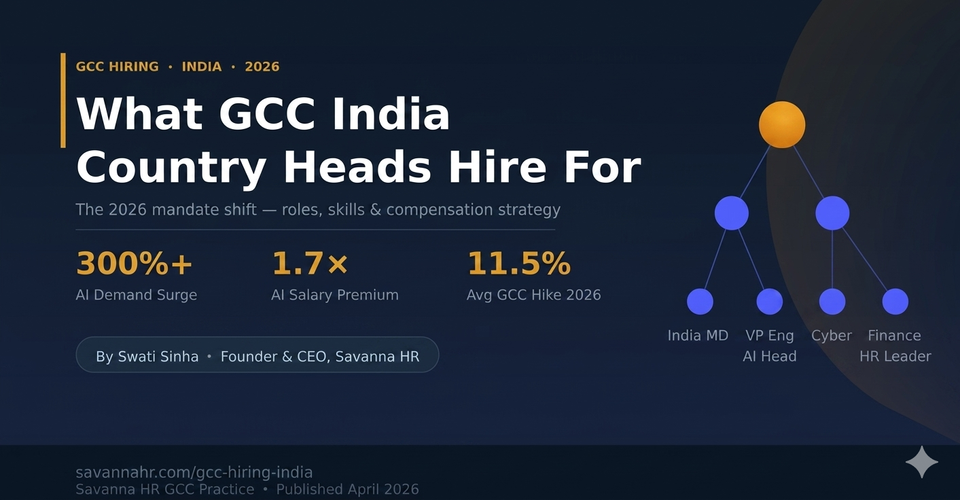
| India MD / GCC Head | Site charter, stakeholder management, capability strategy, scaling plan | 15-20 years, has run a function or P&L at global scale, deep India network |
| VP / Director of Engineering | Technical culture, architectural decisions, senior IC attraction | 12-18 years, platform or product DNA, ideally product-company background |
| Head of Data / AI Platform | AI/ML roadmap, data infrastructure, applied research programme | 10-15 years, production ML experience, fluent in LLMs and MLOps |
| Head of Cybersecurity | Zero-trust architecture, regulatory compliance, threat landscape | 12-18 years, financial services or product company experience |
| India Finance Controller / CFO | Entity set-up, transfer pricing, statutory compliance, board reporting | 12-18 years, has set up an Indian subsidiary, strong statutory fluency |
| Head of HR / India HRBP | Labour law, compensation architecture, hiring governance, culture | 10-15 years, has scaled a tech organization in India, HR leadership |
What strikes me about this list is not the roles themselves but the seniority. A year or two ago, many GCCs would have hired all of these at the Director level. In 2026, country heads increasingly want VP or SVP-level talent in at least three of these six chairs. The calculation is simple: if the centre is meant to own global functions within 24 months, the leadership needs to already know how to do that. Developing it in-house is a two-year investment most global CEOs are unwilling to make.
The three skills every GCC India head is now asking for
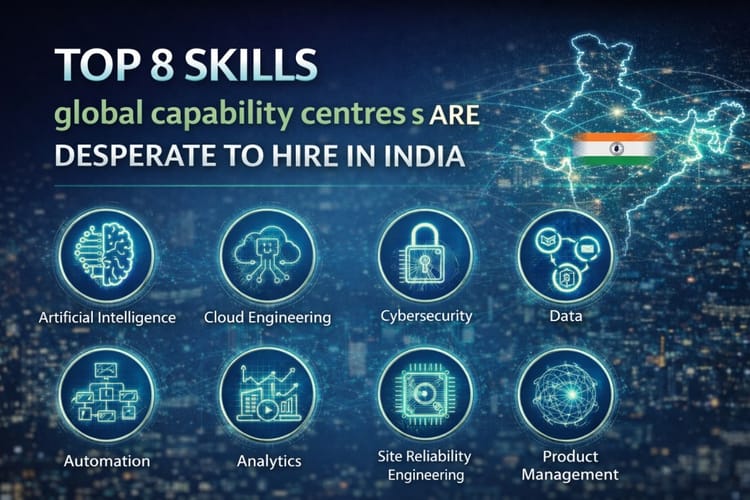
Beyond the roles, there are three skill clusters that show up in almost every brief we take now — sometimes named explicitly, sometimes buried in the job description, but always central to what the hiring manager actually wants.
1. AI and machine learning at production scale
The distinction between "experience with AI" and "production AI" has become the single biggest filter in senior GCC hiring. Industry estimates suggest demand for AI specialists in India has surged more than 300 percent since 2024, and many brief writers will happily accept candidates whose LinkedIn profiles mention AI work. Country heads, in my experience, will not. They want people who have taken an AI product from concept to scaled production, handled the governance and ethics questions, and can explain why their last model worked or did not.
Demand for these profiles is projected to cross one million AI-related GCC roles by 2026, against an India AI skills deficit that research estimates at roughly 53 percent of demand. That gap is why the premium for genuine production AI talent runs around 1.7 times the hike of adjacent roles, and why signing bonuses of ₹30,000 to ₹40,000 for AI talent are now standard, not exceptional.
2. Cloud platform and DevSecOps fluency
The second skill cluster is broader but no less in demand. GCCs in 2026 are hiring for cloud platform engineering, SRE, DevSecOps, and Kubernetes-native roles at a pace that is hard to keep up with. What has changed is the expectation of depth. Five years ago, a senior cloud engineer with AWS certifications was considered a strong hire. Today, country heads want people who can reason about multi-cloud, zero-trust security, cost optimisation, and platform reliability at the same level. The title on the resume matters less than the architectural decisions the candidate can defend in an interview.
3. Domain depth, not just technical breadth
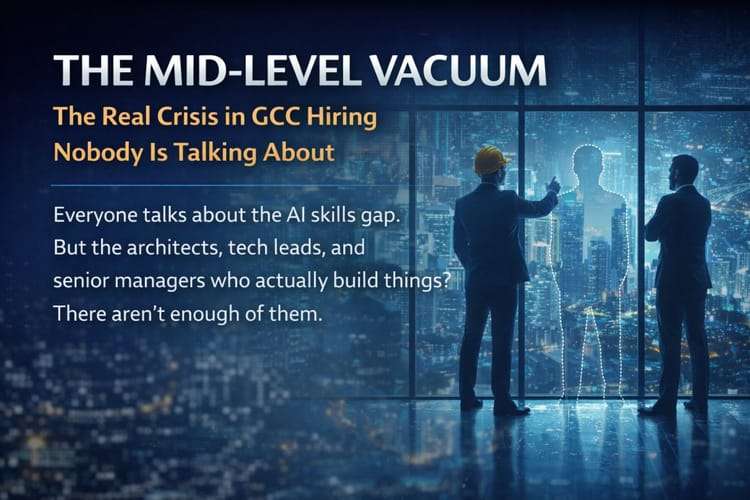
The third shift is the one most global leaders underestimate. Nasscom research indicates that about 72 percent of GCC leaders now cite the lack of upskilled, domain-literate talent as a top concern. The mid-senior band — roughly eight to fifteen years of experience — combining deep technical skill with genuine domain fluency in BFSI, healthcare or manufacturing is the hardest talent pool to access in the Indian market today.
For country heads, this means the search for a strong platform engineer is no longer enough. The real brief is for a platform engineer who understands insurance underwriting, or a data scientist who has built models for supply-chain optimization, or a cybersecurity lead who has dealt with RBI compliance. Domain-literate technical talent is what makes a GCC genuinely capable of owning a global function rather than merely supporting it.
Demand for AI specialists in India has surged more than 300 percent since 2024 — and the supply has not kept pace.
Tier-2 cities are in the mix for the first time
One of the more striking shifts in 2026 is how routinely Tier-2 cities come up in conversations about GCC expansion. Two years ago, this was a future-state conversation. Today, more than 220 GCC units operate across 18-plus Tier-2 cities, and hiring growth in these locations ran roughly 21 percent year-on-year compared with 11 percent in the metros.
Country heads are asking us about Coimbatore, Ahmedabad, Jaipur, Kochi, Indore and Vadodara as real options — often as satellite locations anchored to a Tier-1 hub, sometimes as primary sites for centres with specific mandates. The salary arbitrage is substantial, with compensation running 15 to 30 percent lower than Bengaluru, and state policies introduced after the Union Budget 2025-26 have added tangible incentive structures in several of these cities.
My honest advice to country heads considering Tier-2 is to treat it as a scale play, not a founding play. Anchor your leadership and first forty hires in a Tier-1 city where the capability actually sits, then open a Tier-2 site for roles where the talent pool is wide enough and the proximity to senior leadership is less critical — typically mid-level engineering, QA, shared services and analytics functions.
Compensation: the skill premium has replaced the title premium
Zinnov's 2026 research, drawn from more than 90 GCCs, places average GCC salary hikes at 11.5 percent, meaningfully above the 9.1 percent average for India Inc at large. But the number underneath that average tells the real story. Hikes for niche skills — AI, cloud, cybersecurity — are running at roughly 1.7 times the rate for adjacent roles. Signing bonuses for AI talent are now routine. The old model of paying by role and seniority is steadily being replaced by a skill-priced market where two people with identical titles can earn very different totals depending on what they actually build.
The implication for a country head is practical: you cannot import your global compensation framework unchanged and expect it to work here. The bands will be wrong. A senior engineer building internal tools is not paid like a senior engineer building the core AI platform, even if their level, years of experience and scope of responsibility all look identical on paper. If your offer does not distinguish between the two, you will lose the second one and you will never quite understand why.
Stealth hiring is now the default for flagship mandates
The last pattern worth flagging is the increase in confidential searches. Of the 170-plus new GCC setups in India in 2025, a meaningful share were managed in complete stealth through the leadership hiring phase. The reasons vary — competitor signalling, headquarters-led announcement timelines, sensitive repositioning of existing operations — but the practical need is the same. Confidential hiring requires a recruitment partner who has done it before and can run an entire candidate journey without naming the company until the offer stage.
At Savanna, we run a meaningful slice of our GCC mandates confidentially for exactly this reason, and it is one of the few areas where the market consistently pays a premium for deep experience rather than low cost.
What this means if you are hiring for a GCC in 2026
Pulling the threads together: if you are a country head or global HR leader building out your 2026-27 hiring plan, three practical takeaways stand out.
- Hire seniority deliberately, not reactively. Your first six hires set the ceiling of what the centre can own. Compromising on these to save one or two lakhs per month costs you the next two years of ownership.
- Build your compensation framework around skills, not roles. Map the four or five capabilities you genuinely need, price them against live market data rather than published surveys, and accept that a meaningful minority of your team will be paid above their nominal level.
- Invest in a hiring partner who can run confidential, leadership-level searches end-to-end. The difference between a firm that fills requisitions and one that actually understands the market shows up most clearly in the searches that cannot be advertised.
The Indian GCC market in 2026 rewards precision. The firms that get there first — with the right seniority, the right skill priority and the right compensation architecture — are the ones that will own their global functions within three years rather than ten.
Book a confidential GCC consultation
Savanna HR runs leadership and specialist mandates for GCCs across Bengaluru, Hyderabad, Pune, Mumbai, Chennai and NCR. We offer a free four-business-hour market brief for any company considering a serious India hiring plan, covering talent availability for your priority roles and indicative compensation bands for 2026.
Visit: savannahr.com/gcc-hiring-india · Read: GCC Skills Demand Report Q1 2026
About the author
Swati Sinha is the founder and CEO of Savanna HR. She has spent ten years in Indian recruitment and has overseen more than 3,500 placements across ecommerce, manufacturing, banking, insurance, private universities and GCCs. Savanna HR is based in Gurugram and supports hiring across India's top talent markets.
Sources and further reading
- Nasscom–Zinnov: India GCC Landscape — The Five-Year Journey EY GCC Pulse Survey 2025
- Zinnov: Salary Increase, Attrition & Hiring Trends – India GCC View 2026
- Taggd: Hiring Trends Every India GCC Must Watch 2026
- Nasscom: GCC Annual Report and associated policy research
- HRBx: India GCC City Playbooks 2026
- Savanna HR: GCC Skills Demand Report Q1 2026