Bangalore vs Hyderabad vs Pune for Your GCC: A 2026 Talent-Supply Comparison
Every month, we sit with at least two or three global HR leaders or GCC India heads who are wrestling with the same question: Bangalore, Hyderabad, or Pune? Sometimes Chennai joins the shortlist. Occasionally a Tier-2 city enters the conversation. But the core choice almost always comes down to these three.
The decision is far from trivial. The right city can accelerate your GCC by 12 to 18 months and materially lower your blended cost over the first five years. The wrong city will drain senior hiring budget, introduce attrition volatility, and quietly cap how much your centre can actually own. This is not a question of which city has the best skyline or the friendliest state government. It is a question of where the specific capability you are building actually sits — and what you are willing to pay, in money and time, to access it.
This comparison is drawn from live data across Nasscom, Zinnov, and Savanna HR's own placement mandates through 2025 and the first quarter of 2026. It is structured to answer the question a serious buyer is actually asking, not to crown an overall winner. There is no overall winner. There are only right answers for specific situations.
The three-city matrix: how they actually compare
| Dimension | Bengaluru | Hyderabad | Pune |
|---|---|---|---|
| GCC count | 875+ | Rapidly growing; fastest mover for US-HQ centres | 360+ (up from 210 in 2019) |
| Share of India AI/ML talent | ~50% | Strong in cloud, BFSI, cybersecurity | Strong in enterprise engineering, auto-tech |
| Salary level (relative) | Baseline +25 to +35% vs Pune | 15–25% below Bengaluru | 20–30% below Bengaluru |
| Real estate (relative) | Baseline +40 to +50% vs Pune | 20–30% below Bengaluru | Lowest of the three |
| Attrition | 18–20%+ | ~15% | ~14% (lowest Tier-1) |
| Policy support | Karnataka IT ecosystem, mature | Telangana AI Mission, active state support | Maharashtra GCC ecosystem, mature |
| Best-fit capabilities | Product engineering, deep AI/ML, research | Cloud, BFSI, cybersecurity, scaling ops | Enterprise engineering, QA, BFSI tech, auto |
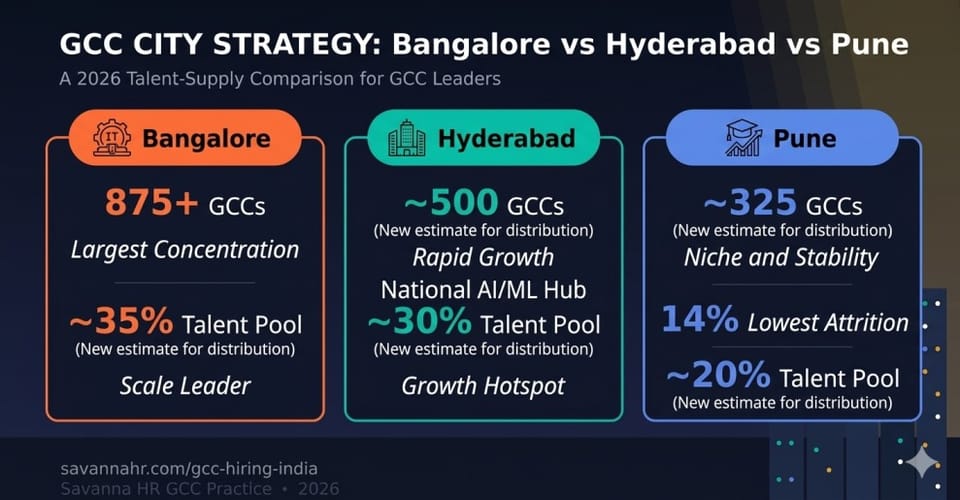
Let us start with the headline numbers. Here is how Bengaluru, Hyderabad, and Pune stack up on the dimensions most GCC leaders care about in 2026.
Three things jump out of this table. First, the cost gap between Bengaluru and the other two is real and meaningful — a GCC of 100 engineers in Pune typically runs several crores cheaper annually than the same centre in Bengaluru. Second, attrition in Bengaluru is materially higher than Pune, sometimes by four to six percentage points, which compounds over time. Third, the capabilities each city is strongest in are genuinely different. Bengaluru's dominance in AI/ML is not marketing; it reflects where the deep talent actually lives. Hyderabad and Pune have their own specialities, and they are not interchangeable.
When Bengaluru is the right choice
Bengaluru has more than 875 GCCs today and concentrates roughly half of India's AI and machine learning talent. For a specific set of mandates, the city is without peer — and pretending otherwise wastes your hiring budget.
You should seriously consider Bengaluru if your centre is being built around deep AI/ML research, staff-level platform engineering, senior product management, or data science leadership with production experience. The concentration of product companies, well-funded startups, and mature GCCs in the city means there is a deep pool of senior candidates who have done exactly what you need at the scale you need it, which is genuinely hard to replicate elsewhere.
The honest trade-offs are real, though. Salaries run 25 to 35 percent above Pune and premium office space in Whitefield or ORR can cost 40 to 50 percent more. Attrition is the highest among major GCC cities, often above 20 percent for competitive engineering functions, and aggressive counter-offers are standard. If you choose Bengaluru, you are effectively choosing to pay a premium in cash, real estate and management time in exchange for access to the deepest senior-talent pool in India. For the right capability, it is worth it. For many others, it is not.
When Hyderabad is the right choice
Hyderabad has become the most balanced GCC city in India, and it is no longer a secret. A disproportionate share of new US-headquartered GCCs chose Hyderabad in the last two years, and companies like Apple, Amazon, Google and Microsoft have expanded aggressively in the city's HITEC City and Financial District corridors.
Hyderabad makes sense if you are scaling a centre in cloud, BFSI, cybersecurity or enterprise digital functions, particularly when you need a long-term predictable Best-fit capabilities Product engineering, deep AI/ML, research Cloud, BFSI, cybersecurity, scaling ops Enterprise engineering, QA, BFSI tech, auto Dimension Bengaluru Hyderabad Pune Savanna HR · Gurugram · savannahr.com/gcc-hiring-india cost base. Salaries run 15 to 25 percent below Bengaluru, real estate is 20 to 30 percent cheaper, and attrition is meaningfully lower — typically around 15 percent for mid-level roles. The Telangana state government has been unusually active in attracting GCCs, and the Telangana AI Mission is one of the more structured state- level interventions in the country.
The honest limitation of Hyderabad is that its engineering culture skews slightly more towards enterprise and services than towards the product-first, startup-DNA talent that defines Bengaluru. That is changing rapidly, but if you need 15 senior AI research leaders next quarter, Bengaluru will fill the requisition faster. For almost any other scaled capability, Hyderabad is a genuinely strong choice — and often the better one for GCCs prioritizing cost-to-capability ratio over absolute depth.
When Pune is the right choice
Pune is the quietly exceptional option in India's GCC landscape. The centre count has risen from roughly 210 in 2019 to over 360 in 2025, making it the fastest- growing Tier-1 GCC city, and yet it remains materially cheaper than either Bengaluru or Hyderabad. Attrition is the lowest among Tier-1 cities, typically around 14 percent, and the talent pool has deepened substantially over the last five years.
Pune is the right choice if your centre is built around enterprise engineering, BFSI tech, automotive and embedded systems, QA and DevOps, or mixed-portfolio scaling with a bias towards stability. Operating costs run 20 to 30 percent below Bengaluru, real estate in Hinjewadi and Kharadi remains competitive, and the family-friendly nature of the city genuinely contributes to lower attrition. Many of our manufacturing and BFSI GCC placements go to Pune, and the feedback from hiring managers is consistent: candidates stay longer, and teams achieve velocity faster.
The constraint is at the top of the seniority pyramid. Very senior leadership talent — GCC heads, VP Engineering, Chief Technology Officers — is thinner in Pune than in Bengaluru, though this is steadily changing as more senior leaders relocate from Bengaluru in search of quality of life and cost efficiency. For the next tier down, Pune is often the smartest choice in India.
Many of our manufacturing and BFSI GCC placements go to Pune. Candidates stay longer and teams achieve velocity faster.
And Chennai — the option that gets forgotten
Chennai rarely makes it into the initial shortlist, but it should be in the conversation more often than it is. It is India's quiet workhorse for platform engineering, backend reliability, and R&D, with the lowest attrition of any Tier-1 city. The engineering culture is known for structured fundamentals, and the city's history in automotive, BFSI and enterprise technology has produced a talent pool that is under-hyped relative to its quality.
Savanna HR · Gurugram · savannahr.com/gcc-hiring-india Chennai makes particular sense for GCCs building in platform engineering, reliability engineering, SRE, backend infrastructure, or deep R&D functions where long-tenure talent matters more than rapid scaling. Salaries are comparable to Pune, and the stability of the workforce is often the deciding factor for global leaders who have already lived through Bengaluru attrition once.
What about Tier-2 cities?
Tier-2 cities are, in 2026, a real option for the first time. More than 220 GCC units now operate across 18-plus Tier-2 cities, with Coimbatore, Ahmedabad, Jaipur, Kochi, Indore and Vadodara leading the field. Hiring growth in Tier-2 is running approximately 21 percent year-on-year against 11 percent in metros, and the Union Budget 2025-26 introduced a national guidance framework that has accelerated state-level GCC policies in at least ten states.
The salary arbitrage is substantial. Compensation in Tier-2 typically runs 15 to 30 percent below Tier-1 cities for equivalent talent, and total operating costs can run 35 to 40 percent lower when real estate and compliance are included. That said, the senior and staff-level talent pool thins out quickly outside the metros, and you will struggle to hire a Director of Engineering directly into Coimbatore or Indore with the same speed you would in Bengaluru.
Our recommendation, consistent with what most sophisticated GCCs are actually doing, is to treat Tier-2 as a satellite strategy, not a founding one. Anchor your leadership and foundational team in a Tier-1 city aligned with your capability, let the centre stabilise, and then open a Tier-2 site for roles where the talent pool is genuinely adequate and proximity to senior leadership matters less. Mid-level engineering, QA, analytics, shared services, and support functions are the usual targets for this second wave.
A simple decision framework for GCC leaders
After ten years of running these conversations, we have a working framework that cuts through most of the noise. Ask yourself three questions in order, and the city choice usually becomes obvious.
Question 1: What is the hardest-to-hire capability in your first twenty roles?
If it is deep AI/ML leadership, staff-level product engineering, or research talent, anchor in Bengaluru. If it is cloud, BFSI, or cybersecurity scaling, Hyderabad is usually the better bet. If it is enterprise engineering, auto/embedded, QA/DevOps, or BFSI tech, Pune is often the smartest choice.
Question 2: What is your attrition tolerance?
If you can absorb 18 to 20 percent attrition because you are paying a significant premium and your HQ has strong brand appeal, Bengaluru works. If you need more predictable tenure to execute a multi-year platform roadmap, Hyderabad or Pune will serve you better.
Question 3: How cost-sensitive is your five-year plan?
If cost efficiency compounds over a five-year horizon and you are scaling from fifty to several hundred people, Pune and Hyderabad will save you tens of crores without materially compromising quality for most roles. If you are building a 30- person specialist centre and every hire must be top-decile in their specific skill, the Bengaluru premium may be fully justified.
How Savanna HR helps you model this decision
Choosing the right city is one of the highest-stakes decisions in the GCC setup journey, and it is one where data, experience and local market knowledge genuinely matter. At Savanna HR, we support GCC leaders through this decision in four specific ways.
- Live placement data across Bengaluru, Hyderabad, Pune, Chennai, Mumbai and NCR — so the compensation and time-to-hire numbers you work from are current, not last year's published survey averages.
- City-specific talent mapping for your priority roles, identifying exactly how deep the pool is in each location for what you actually need.
- A city recommendation grounded in your charter, capability priorities, attrition tolerance and cost envelope — not a generic checklist.
- Confidential handling for pre-announcement or stealth GCC setups across all our supported cities.
Talk to our GCC team about your city decision
We offer a free four-business-hour city brief for any company evaluating an India GCC setup or expansion. The brief covers talent availability for your priority roles, indicative 2026 compensation bands by city, and a recommendation tailored to your charter. No obligation to engage.
Visit: savannahr.com/gcc-hiring-india · Read: GCC Skills Demand Report Q1 2026
About this report
This comparison is authored by the Savanna HR GCC practice and reviewed by Swati Sinha, Founder and CEO. It draws on Nasscom and Zinnov research, industry reporting from 2025 and 2026, and Savanna HR's own placement data across its GCC mandates. Figures are indicative and intended for planning purposes; specific roles and seniority bands may vary materially from these averages.
Sources
- Nasscom–Zinnov: India GCC Landscape — The Five-Year Journey
- Nasscom–Oliver Wyman–R Systems report on Indian GCCs, November 2025
- HRBx: India GCC City Playbooks 2026 — Bengaluru, Hyderabad, Chennai, Pune
- Zinnov: Salary Increase, Attrition & Hiring Trends – India GCC View 2026
- Plugscale: India GCC Landscape 2026 — Bengaluru vs Pune strategy guide
- CXO Digital Pulse / Zyoin Group research on GCC compensation 2026
- Nasscom: GCC Policies of India (Union Budget 2025-26)
- Savanna HR placement data across 6 Indian GCC hubs, 2024–Q1 2026