Top 15 University Recruitment Challenges in 2026
Higher education hiring is harder than it has ever been
University recruitment in 2026 sits at the intersection of three major shifts. In India, NEP 2020 implementation is mandating new multidisciplinary roles, cluster universities, and tenure-track pathways that the sector has never had to hire for at scale. Globally, the AAUP reports that the adjunctification trend is reversing in some disciplines while deepening in others, creating mixed signals for candidates. And everywhere, PhD pipelines in STEM are being pulled toward industry at salaries universities simply cannot match.
After running 200+ academic searches over the last five years, we see the same 15 challenges surface again and again. Here they are, grouped into four categories, with the solutions that actually work.
Category 1: Sourcing challenges
1. The shrinking PhD pipeline in STEM. India produced about 24,000 PhDs in 2023, but less than 35% entered academia within two years. Solution: broaden sourcing to postdocs from adjacent countries (Nepal, Sri Lanka, Vietnam), and build faculty-in-residence programmes that convert industry PhDs back into academia.
2. Low offer-acceptance rates from top candidates. Tier-1 faculty candidates often hold 3+ offers. Solution: reduce time-to-offer below 45 days and include non-cash sweeteners — research seed grant, travel budget, relocation, spouse placement support.
3. Geographic unattractiveness. Rural or tier-3 city campuses struggle. Solution: lead with cost-of-living adjusted total compensation, stronger housing, and a 2-year rotation option to a partner tier-1 campus.
4. Weak employer brand. Many universities have no dedicated careers site, no faculty testimonials, no research visibility. Solution: treat your careers page like a product — faculty stories, research outputs, clear comp bands.
Category 2: Process challenges
5. Slow decision-making by committees. The #1 reason candidates walk. Solution: structured scorecards, pre-committed decision dates, and a committee chair empowered to break ties.
6. Fragmented candidate experience. Candidates get emails from 5 different people. Solution: one dedicated recruiting coordinator per search; no exceptions.
7. Compliance bottlenecks (UGC, AICTE, NAAC). Doctoral equivalence, API scores, teaching-research ratios. Solution: maintain a living compliance checklist and pre-screen candidates against it before committee review — not after.
8. Budget approvals that lag the market. HR wants to offer ₹22L; finance approves ₹18L three weeks later; candidate is gone. Solution: pre-approved comp bands per role, reviewed biannually.
Category 3: Evaluation challenges
9. Over-reliance on publication counts. Publication volume correlates weakly with teaching ability or collegiality. Solution: structured 4-factor scorecard — research impact, teaching, service, strategic fit.
10. Teaching demos that are theatre, not signal. A 45-minute lecture to faculty tells you little about how a candidate handles undergraduates. Solution: require a demo to actual students where possible, and add a 15-minute office-hours simulation.
11. Reference checks done too late or too thinly. Solution: structured reference calls with 5–6 pre-defined questions, done before the final offer, with at least one off-list reference.
Category 4: Retention and pipeline challenges
12. High 2-year attrition among new hires. Often not a hiring problem but a mentorship gap. Solution: assigned senior mentor, 90-day check-in, and a first-year research starter kit.
13. Inadequate diversity in shortlists. Most searches end up with shortlists that mirror the existing faculty mix. Solution: mandate a diverse slate — no final interview stage proceeds without representation from under-represented groups in the discipline.
14. Internal mobility is invisible. Strong internal candidates get passed over because nobody knows they are interested. Solution: internal expression-of-interest process that runs before external posting.
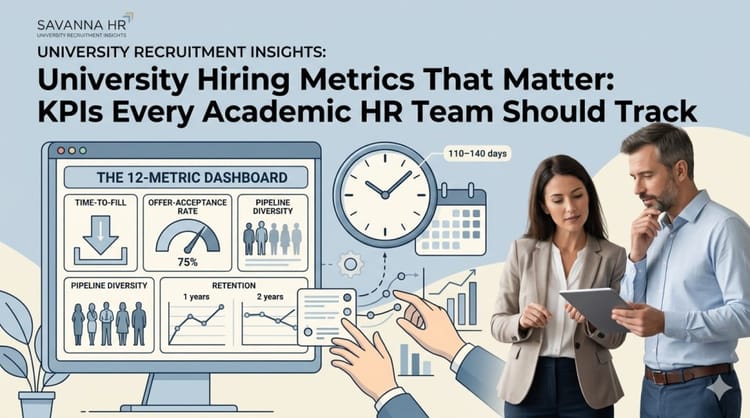
15. No data on what actually works. Universities rarely track source-of-hire, interview-to-offer ratios, or 1-year performance by channel. Solution: a simple quarterly recruitment dashboard (see our separate blog on university hiring metrics).
The meta-solution: stop treating hiring as an administrative function
If there is one unifying insight across these 15 challenges, it is that the universities that solve them have repositioned recruitment as a strategic function, not a paperwork function. That means a dedicated university recruitment lead, a data-driven playbook, and — increasingly — a specialist external partner who brings pipeline, compliance expertise, and speed to the table without replacing the committee’s judgement.
Quick self-audit
If your university cannot answer these three questions in under five minutes — median time-to-fill for faculty, offer-acceptance rate in the last 12 months, and 2-year attrition among recent hires — you are almost certainly losing talent you do not need to lose.
The bottom line
Higher education recruitment is harder in 2026 than it was in 2016, but it is not mysteriously harder. The challenges are identifiable, the solutions are known, and a handful of institutions have already operationalised them. The ones that adopt the playbook now will spend the next decade attracting the faculty who shape their programmes. The ones that do not will spend that decade writing apologies to accreditation bodies.