Setting Up a GCC in India in 2026: The Complete Hiring Playbook
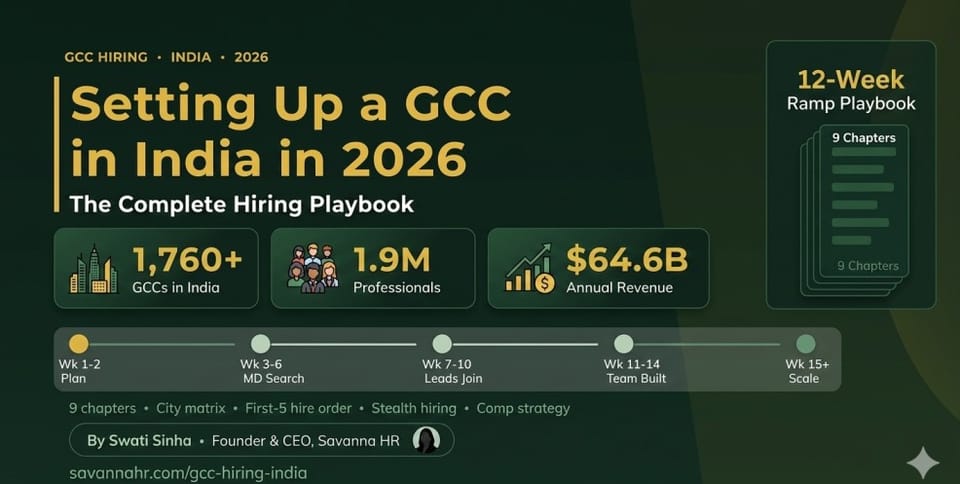
Over the last decade, I have watched Indian GCCs transform from quiet cost arbitrage plays into the strategic nerve centres of some of the world's most ambitious enterprises. The change has been extraordinary. India now hosts more than 1,760 Global Capability Centres, employs close to 1.9 million professionals, and generates around $64.6 billion in annual revenue — numbers that, according to the Nasscom-Oliver Wyman-R Systems report released late 2025, mean roughly half of the Fortune 500 now runs a meaningful part of its digital backbone from Indian soil.
But here is the uncomfortable truth no one tells a company at the start of its India journey: setting up a GCC is the easy part. Hiring the right people, in the right order, in the right city, with the right compensation architecture — that is where most GCCs silently succeed or fail, long before anyone notices.
I have spent the last ten years at Savanna HR running leadership and specialist hiring mandates for GCCs across Bengaluru, Hyderabad, Pune, Mumbai, Chennai and the NCR. I have seen the patterns that separate the centres that become strategic assets from the ones that become expensive side projects. This playbook is what I wish every global HR leader had when they sit down to start their India journey in 2026.
1. Why GCCs fail: three patterns we keep seeing
Most public commentary about GCCs focuses on the success stories — the centres that grew to 5,000 people, built global products, and now own P&Ls. That is useful, but it teaches you nothing about what not to do. The more instructive data sits in the GCCs that underperformed, and almost all of them fail for one of three reasons.
Pattern 1: The wrong first five hires
The order in which you make your first leadership hires determines the DNA of the centre for the next decade. I have seen companies spend six months finding the perfect India MD and then hand that leader a team of junior engineers to manage, with no senior engineering or product voice anywhere in the picture. By month 12, the MD is running a staffing operation, not a capability centre. The talent they hoped to attract never joined, because there was no one for ambitious senior candidates to learn from.
Pattern 2: Confusing city choice with cost choice
The single most common mistake in 2026 is still picking a city based on a spreadsheet comparison of average salaries. Bengaluru is 25 to 35 percent more expensive than Pune on compensation, and real estate in the premier Bengaluru tech parks runs 40 to 50 percent higher than Pune. Those numbers are real. But if the capability you need — say, senior AI/ML leaders with production experience — is concentrated in Bengaluru, hiring in Pune will cost you nine months of time-to-hire, not a few lakhs per head. The correct question is never "which city is cheapest" — it is "where does the specific capability I need actually sit".
Pattern 3: Treating India as a labour market instead of a capability market
The framing matters more than HR leaders often realise. If you walk in believing India is a pool of competent people who will execute what headquarters designs, you will build a delivery centre and wonder why the ownership culture never emerges. If you walk in believing India is a capability market where ownership, architecture and product judgement can be hired end-to-end, you build a centre that eventually takes over entire global functions. Zinnov's recent research makes this shift explicit: more than half of Indian GCCs are now running portfolio and transformation initiatives, not back-office delivery. The companies that set up for that outcome from day one get there far faster.
The correct question is never which city is cheapest — it is where the specific capability I need actually sits.
2. The 12-week ramp that actually works
In my experience, the right way to measure the quality of a GCC setup is not how fast you hit headcount, but how fast you hit capability depth. These two are not the same. A centre at 100 people with four strong leaders is operationally stronger than one at 300 people with two overwhelmed leaders. Every successful setup I have supported at Savanna has followed a version of the 12-week rhythm below.
| Weeks | What happens | Hiring focus |
|---|---|---|
| 1 – 2 | Site charter, capability definition, location decision, global-India governance model | Define scope, success metrics, reporting lines. No hires yet. |
| 3 – 6 | India MD search opens. Headhunter engaged. Parallel: identify one or two anchor engineering leaders. | MD confidentially shortlisted. Engineering leader 1 in pipeline. |
| 7 – 10 | MD joins. First engineering lead onboards. Search for second leader, finance/HR controller, recruiter. | Founding leadership takes shape. First 3–5 hires in motion. |
| 11 – 14 | Second leader joins. First engineering ICs onboarded. Recruiter operational in-house. | Centre has ~10 real people, not 10 requisitions. |
| 15+ | Capability expansion begins. Dedicated TA team runs the engine. Quarterly hiring plans | Centre scales with discipline. |
Notice that there are no hires before week three. This is deliberate. The worst decisions in a GCC are made in the first six weeks because teams feel pressure to show visible progress to headquarters. Resist this. Nothing you gain by hiring two individual contributors in week two is worth the signal it sends the market — that your centre is a delivery shop, not a capability play. Once you have your India MD in place, every subsequent hire becomes easier, because strong senior candidates want to meet the leader they will be working with, not a recruiter and a slide deck.
3. Choosing the right city: Bangalore isn't always the answer
I wish I had a straightforward answer for every client that walks in asking which Indian city they should build in. The honest truth is that the right city depends on the capability you are building, the leadership density you need, the retention profile you can tolerate, and the timeline you have. Here is what the 2026 numbers look like across India's four dominant GCC cities, based on data from Nasscom, Zinnov and industry research.
| City | GCC count (2026) | Salary premium vs Pune | Attrition | Best for |
|---|---|---|---|---|
| Bengaluru | 875+ | +25–35% | 18–20%+ | Deep AI/ML, product engineering, startup-DNA tech |
| Hyderabad | Rapidly growing | +10–15% | ~15% | BFSI, cloud, cybersecurity, policy-backed scaling |
| Pune | ~360 (up from 210 in 2019) | Baseline | ~14% | Enterprise engineering, auto-tech, BFSI tech, stable scaling |
| Chennai | Established | -5 to +5% | Lowest of Tier-1 | Platform engineering, backend, R&D, reliability |
When Bengaluru is the right choice
If you are building a capability that depends on very senior AI/ML, platform engineering, or deep-tech research leadership, Bengaluru is still without peer. Industry research suggests the city concentrates around half of India's AI/ML talent, and its startup ecosystem means leaders with product-first DNA are abundant. You pay for this — in salary, in real estate, and in attrition — but for certain capabilities, there is no viable substitute.
When Hyderabad is the right choice
Hyderabad has quietly become the most balanced GCC city in India. It combines a deep and still-growing talent pool in cloud, BFSI and cybersecurity with active state policy support, including the Telangana AI Mission. Real estate is materially cheaper than Bengaluru and attrition runs about three to five percentage points lower. For GCCs that need predictable scale and cost visibility over a multi-year horizon, Hyderabad often wins.
When Pune is the right choice
Pune is the fastest-growing Tier-1 GCC city — the count has jumped from roughly 210 centres in 2019 to more than 360 today. The combination of strong automotive and BFSI engineering talent, operating costs 20 to 30 percent below Bengaluru, and the lowest Tier-1 attrition makes it a compelling choice for enterprise engineering, QA, DevOps and mixed-portfolio centres. If stability and cost predictability matter more to you than being at the bleeding edge of AI research, Pune is a serious option.
Chennai, and the Tier-2 question
Chennai is India's quiet workhorse for platform engineering and backend reliability, with the lowest attrition of any Tier-1 city. It is often overlooked but almost never a bad choice for the right charter. And in 2026, the Tier-2 story is real for the first time — Coimbatore, Ahmedabad, Jaipur, Kochi, Indore and others now host more than 220 GCC units combined, with hiring growth running roughly twice the metro rate. Salaries run 15 to 30 percent lower, and many of these cities now feature in state-level GCC policies introduced after the Union Budget 2025-26 signalled national guidance for the sector.
My practical advice: for your first India centre, anchor in a Tier-1 city where your core capability actually sits. Once that centre is stable, you can open a Tier-2 satellite for roles where proximity to senior leadership matters less.
4. The first five hires, in the right order
If you remember nothing else from this playbook, remember that the order of the first five hires matters more than the pace. In ten years of running these searches, I have never seen a GCC recover quickly from getting this wrong, and I have rarely seen one fail that got this right. Here is the order that works.
Hire 1: The India MD / GCC Head
This is the only hire where I tell clients to slow down and take three to five months if necessary. You are looking for someone who has built a function at scale in India, understands global stakeholder management intimately, and — crucially — has the personal credibility to attract the next four hires. If you compromise here, you are hiring for a recruiter who happens to have a fancy title. Get this right, and the next four hires become genuinely easier.
Hire 2: The anchor engineering or product leader
This is the person who sets the technical culture of the centre. If your GCC will be software-heavy, hire a VP of Engineering or Head of Product before anyone else on the tech side. Their personal brand in the Bengaluru or Hyderabad ecosystem will matter enormously when you start hiring senior individual contributors. I have watched companies delay this hire by six months to save budget; they invariably end up paying a senior-talent premium for the next two years to catch up.
Hire 3: The India HR business partner or People Lead
Global HR policies do not map neatly onto Indian labour law, PF and ESI compliance, gratuity, or the practicalities of notice periods and counter-offers. A senior India HRBP in the first ten hires saves you from mistakes that take months to unwind later. They also become the operational backbone the MD needs to run a disciplined hiring plan.
Hire 4: The finance controller or India CFO
Someone who has actually set up an entity in India, understands GST, transfer pricing, statutory audit timelines, and the practicalities of monthly close for an Indian subsidiary. Without this, your MD and HRBP will spend half their time on finance queries from global teams — a waste of both their time and your investment.
Hire 5: The in-house recruiter
By the time you are hiring beyond the first ten people, your recruitment partner should be supplementing an in-house recruiter, not carrying the whole load. A strong senior recruiter can run 40 to 60 percent of your mandates efficiently, leaving agencies like Savanna to handle the confidential and senior leadership roles where speed, discretion and network depth actually matter.
5. Stealth hiring: when and how to go confidential
More than 170 new GCCs were set up in India in 2025 alone, according to Nasscom data — and a striking share of them were handled in complete stealth until launch day. There are legitimate reasons for this. You may not yet have finalised your public strategy. Your competitors may be watching. Your headquarters may want to announce the centre on its own timeline. Whatever the reason, confidential hiring is a real skill, and very few recruitment partners do it well.
The core principle of stealth hiring is that you are hiring people into an opportunity they cannot Google. This changes almost every step of the search. Candidates cannot be sent a company name in outreach; interviews happen under NDA; offer letters may use a placeholder entity; reference checks are done without naming the hiring company. All of this is doable, but only if the recruitment partner has done it before and has a network of senior candidates who trust them enough to engage anyway.
At Savanna, we run a meaningful share of our GCC mandates as confidential searches — particularly for India MD, VP Engineering and CFO roles where competitor signalling can compromise the entire plan. If you are setting up and do not yet want to go public, structure the partnership so your search firm becomes the interface with candidates from the first conversation through offer. It is the single most practical way to protect a launch.
You are hiring people into an opportunity they cannot Google. That changes every step of the search.
6. Compensation: pay for skill, not for role
The most important compensation shift in Indian GCCs in 2026 is the move from role-based to skill-based pay. Zinnov's 2026 research, drawn from 90+ GCCs, indicates salary increments in GCCs running around 11.5 percent on average — materially above the 9.1 percent India Inc average. But the headline number conceals what is actually happening: niche skills in AI, cloud and cybersecurity now command roughly 1.7 times the hike of adjacent roles, and signing bonuses of ₹30,000 to ₹40,000 for AI talent have become routine.
The strategic implication is simple: if you build your comp structure the way your headquarters does — pay bands anchored to role titles — you will underpay your most critical hires and overpay everyone else. Indian tech talent today prices risk, ambiguity and skill scarcity far more aggressively than most global companies expect. A Staff Engineer with production AI/ML experience does not sit in the same band as a Staff Engineer building internal tools. If your offer treats them identically, the first one will decline, and you will not know why.
The practical fix is to build skill premiums explicitly into your Indian compensation framework from month one. Map the five or six skills you genuinely need, define what a market-leading offer looks like for each, and make peace with the fact that a meaningful minority of your India team will be paid above their nominal level. Companies that delay this are the ones that, twelve months in, discover they have quietly lost their best people and are paying above market for the ones who stayed.
7. Scaling from 50 to 500: what changes
The transition from a 50-person centre to a 500-person one is where most of the operational pain in a GCC actually lives. At 50, the MD still knows every engineer's name. At 500, the centre has multiple layers of management, dedicated HR business partners, a structured calibration cycle, and at least one full-time recruiter per 100 open roles. Almost none of this is visible from the outside until you are in the middle of it.
The single most important thing you can do to make this transition smooth is to hire the leadership layer ahead of the team, not behind it. Every time I see a GCC scale from 100 to 300 without hiring Directors in advance, the MD ends up managing twelve direct reports, the hiring plan slips, and the best senior people leave because their growth path is not visible. Hiring two Directors six months before you need them costs you one or two crores in salary. Not hiring them costs you the next eighteen months of velocity.
The second shift is cultural. At 50, the culture is whatever the MD and first five hires happen to practice. At 500, the culture must be explicit, codified, and reinforced by a mid-management layer the MD no longer controls day-to-day. If you have not defined and written down what good looks like — decision rights, escalation paths, performance expectations, calibration rubric — by the time you cross 150 people, you will spend the next two years quietly dealing with the consequences.
8. Red flags that mean your GCC is in trouble
After ten years of running searches for Indian GCCs, there are four signals I have learned to trust. Any one of them is a warning. Two or more together, and the centre is almost certainly in trouble — regardless of what the headcount report says.
- Attrition above 25 percent in the first eighteen months. Tier-1 city average is 14 to 20 percent; if you are materially above this early, it is almost always a combination of weak leadership, unclear charter, and compensation that is not calibrated to the actual market.
- Senior searches staying open longer than 120 days. If a VP Engineering or Director search takes more than four months to close in Bengaluru or Hyderabad in 2026, the problem is almost never the market. It is the employer brand, the scope of the role, or the interview process.
- Offer-to-join dropout rate above 15 percent. A healthy GCC in 2026 converts 90 percent or more of offers into joiners. If your numbers are lower, candidates are either getting better counter-offers, or — more commonly — your offer process is too slow between final interview and offer letter.
- The MD is still personally sourcing candidates at month 18. This is the subtlest signal, but in my experience the most reliable. If the MD is still individually reaching out to candidates on LinkedIn nearly two years in, the recruitment function is not working, and almost every other problem the centre has downstream comes back to this.
The good news is that every one of these is fixable, and most of them are fixable in 90 days if you act on them. The bad news is that most GCCs wait until year two before they act — by which point they have already lost a cohort of senior people who will be hard to replace.
9. How Savanna supports GCC setup end-to-end
Over the last decade, Savanna HR has run leadership and specialist mandates for GCCs across Bengaluru, Hyderabad, Pune, Mumbai, Chennai and NCR. We have placed India MDs, VP Engineering roles, GCC Heads, CFOs, and senior functional leaders across technology, BFSI, manufacturing, insurance and higher education.
For companies setting up in India for the first time, we provide four things most agencies cannot: confidential handling of pre-announcement searches, market mapping calibrated to the specific capability you are building, compensation benchmarks drawn from live placement data rather than published surveys, and a practitioner's view of the trade-offs between cities, levels and timelines. Our Q1 2026 GCC Skills Demand Report covers the market dynamics in more detail, and is available free to any company evaluating an India setup.
If you are setting up a GCC or scaling an existing one, we would be glad to be your partner in the India talent market. We offer a free four-business-hour market brief for any company considering a serious mandate, with no expectation of engagement.
Book a confidential GCC consultation
Swati Sinha and the Savanna HR GCC team are available for a 30-minute confidential discussion on your India hiring plan. We will share a tailored market brief covering talent availability for your priority roles, a city recommendation, and indicative compensation bands — within four business hours of your first enquiry.
Visit: savannahr.com/gcc-hiring-india · Read the report: GCC Skills Demand Report Q1 2026
About the author
Swati Sinha is the founder and CEO of Savanna HR. She has spent ten years in Indian recruitment and has overseen 3,500+ placements across ecommerce, manufacturing, banking, insurance, private universities and GCCs. Savanna HR is based in Gurugram and supports hiring across India's top talent markets.
Sources and further reading
- Nasscom–Oliver Wyman–R Systems report on Indian GCCs, November 2025
- Nasscom–Zinnov: India GCC Landscape — The Five-Year Journey
- Nasscom: GCC Policies of India (Union Budget 2025-26 framework and state policies)
- Zinnov: Salary Increase, Attrition & Hiring Trends – India GCC View 2026
- HRBx: India GCC City Playbooks 2026 — Bengaluru, Hyderabad, Chennai, Pune
- Zinnov–Indiaspora: GCC AI Opportunity Report 2026
- Economic Times and Business Standard reporting on GCC hiring trends, 2025–2026
- Savanna HR: GCC Skills Demand Report Q1 2026