
Why international faculty recruitment is a strategic must — and why most universities get it wrong
For Indian universities in particular, the NEP 2020 explicitly encourages international faculty to strengthen research, diversify perspectives, and improve global rankings. Top-20 QS-ranked Indian institutions now hire 4–12% of new faculty from outside India, and cluster universities under the HEFA framework are pushing that higher. Globally, US R1 universities hire roughly 25–30% of their tenure-track faculty from non-US citizens on H-1B or O-1 visas.
Yet most universities approach international faculty hiring with the same process they use for domestic hires, then wonder why offers fall through, candidates withdraw at the visa stage, or hires leave within 18 months. The challenges are predictable and the solutions are knowable. This is the full playbook.
Stage 1: Before you post the role
Confirm visa feasibility
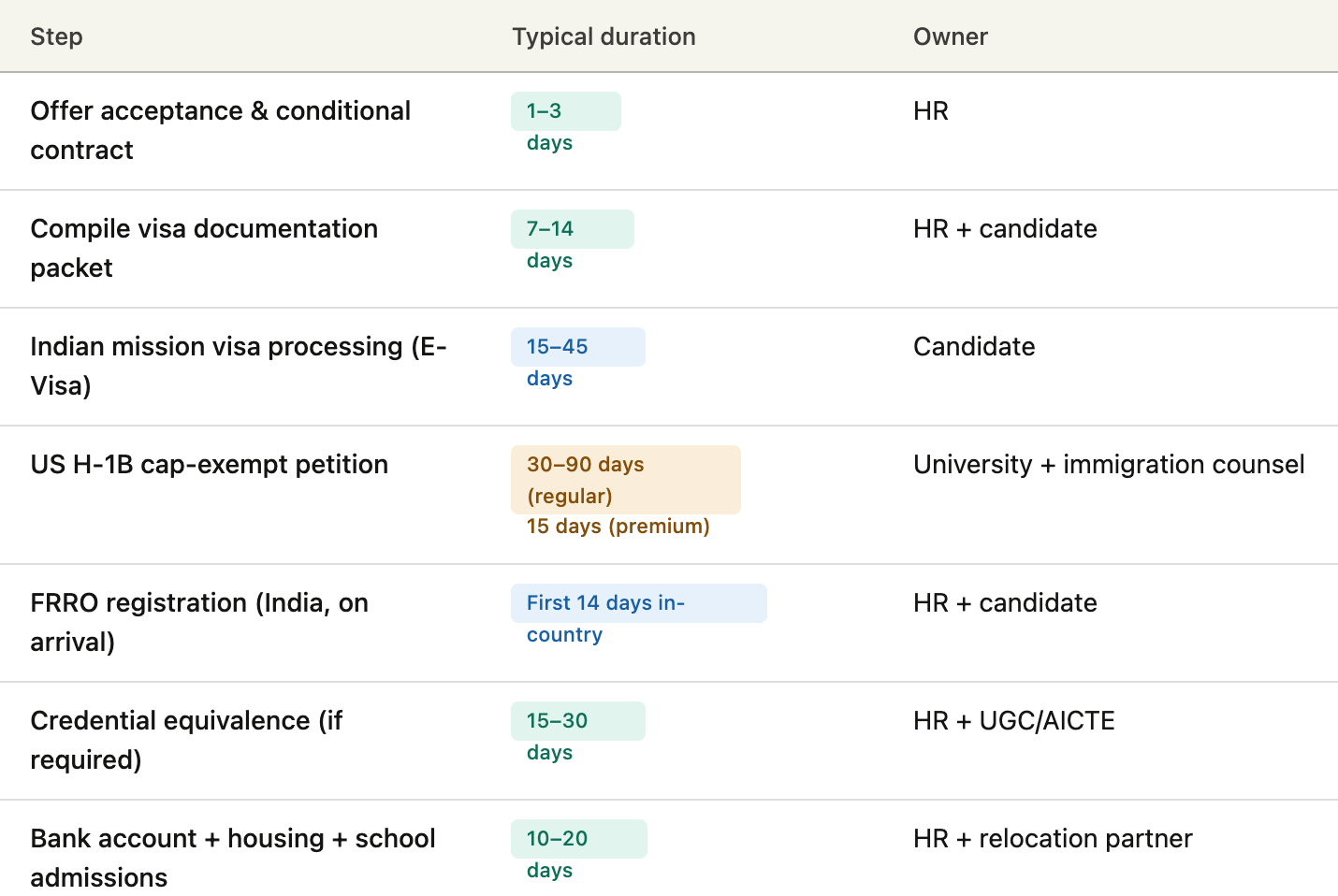
In India, international hires typically come on an Employment Visa (E-Visa). The position must pay a minimum of USD 25,000 per year (roughly ₹20.8L at current rates) — this is a hard floor, not a guideline. For US hires, an H-1B cap-exempt status applies to institutions of higher education, meaning universities can file H-1B petitions year-round without the lottery. An O-1 is available for faculty of “extraordinary ability” and is faster but stricter on evidence. Confirm which visa class fits before the role is posted.
Pre-structure the compensation package
International candidates evaluate total comp in their home currency. A ₹35L Indian package reads as approximately $42,000 to a US candidate — which is not competitive with US public university scales. The fix is to add international-hire supplements: accommodation (or 25–35% HRA), international travel allowance, dependent school fee reimbursement, and a biannual home-country travel allowance. Structured well, total value often exceeds headline base by 35–50%.
Stage 2: Sourcing international candidates
International faculty sourcing looks different from domestic. LinkedIn helps, but the highest-yield channels are discipline-specific:
- Postdoc lists at target universities (e.g., Stanford, MIT, Oxford, NUS) — directly contactable with a well-framed research pitch.
- Conference alumni networks — ACM, IEEE, APA, ASA, and discipline-specific society rosters.
- Diaspora networks — Indian-origin faculty abroad often want to return for career-stage reasons (dual-career, elderly parents, cost of living). A structured diaspora outreach programme can yield 8–12 qualified candidates per discipline per year.
- Partner-institution pipelines — MOUs with foreign universities that create structured postdoc-to-faculty pathways.
Stage 3: Interviewing across time zones and cultures
Three practical rules that prevent most process failures. First, always offer the candidate their choice of time slot — never dictate one based on your convenience. Second, make the research talk virtual in round one and in-person only for finalists; a flight to India from the US is a 48-hour commitment you should not ask for prematurely. Third, have at least one committee member from a similar international background on the panel; this signals cultural awareness and catches blind spots in the questions being asked.
Stage 4: The visa and documentation marathon
Stage 5: Cultural onboarding is where retention is won or lost
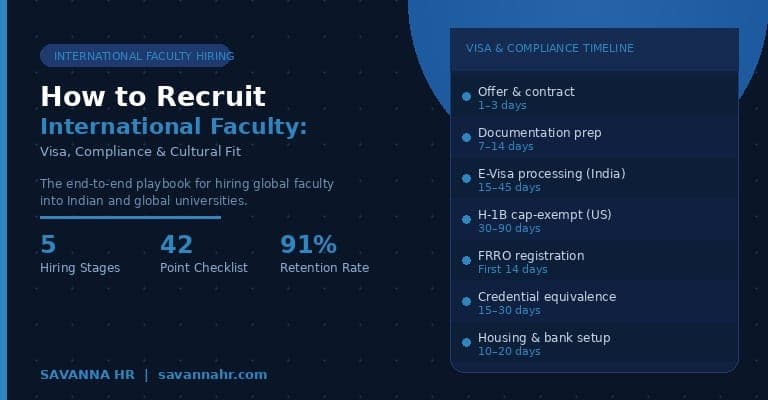
Hiring international faculty is 40% of the work. Keeping them is the other 60%. The retention data is stark: universities with a structured international-hire onboarding programme show 18-month retention of 91%. Universities without one show retention of 62%. That 29-point gap costs real money — a single lost international hire typically costs ₹35–50L in recruiting, relocation, and re-hiring expenses, plus the opportunity cost of the research programme that never starts.
The elements of a strong onboarding programme:
- Cultural buddy system. A senior faculty member assigned for the first 6 months — not as a research mentor but as a cultural and logistical guide.
- Spousal and family support. Dual-career dilemmas are the #1 reason international hires leave. Offer real help: spouse CV review, introductions to local employers, international school liaison, parent visa assistance.
- Research runway. A startup grant (₹20–50L for senior hires) and lab space commitment before arrival, not after.
- Administrative concierge. One named contact for bank, housing, tax, FRRO, school, and internet — for the first 90 days.
- Teaching load protection. Reduced teaching load in year 1 while they acclimatise to the student base and pedagogy.
Compliance watch-outs
A handful of compliance mistakes cause almost all the problems we see:
- E-Visa salary below the USD 25,000 floor — the visa will be refused or rescinded.
- Payment in foreign currency without RBI-compliant structuring — triggers FEMA issues.
- Missing credential equivalence from AIU for non-Indian PhDs — can invalidate the hire for UGC-scaled roles.
- FRRO registration missed in the first 14 days — creates a compliance flag that follows the candidate and institution.
- Tenure clock not adjusted for visa timing — can disadvantage the candidate in their first tenure review.
“The best international hires we have made were not the ones with the strongest CVs. They were the ones where our onboarding made them feel expected, not tolerated. That difference is the entire game.” — Pro-VC, research-intensive Indian university
The Savanna HR international faculty checklist
We use a 42-point checklist across five stages — feasibility, sourcing, interviewing, documentation, onboarding — for every international search we run. Universities that adopt even the top 20 items on the list see measurable improvements in offer-acceptance rate, time-to-join, and 18-month retention.