How to Hire Faculty Faster: A 2026 Guide for University HR Leaders
The hidden cost of a slow faculty search
Ask any university HR leader about their biggest operational headache, and faculty hiring speed almost always makes the top three. In India, the average full-time faculty search takes 150 to 220 days from requisition to joining, according to aggregate data from AICTE-approved institutions and leading private universities. In the United States, CUPA-HR’s 2024 Faculty in Higher Education survey puts the national median at 9 to 12 months for tenure-track roles. In both markets, the gap between a role opening and a qualified candidate saying “yes” is costing universities more than they realise.
That cost is not just the ₹4 to ₹6 lakh per month in lost teaching output for an unfilled Indian associate professor role, or the roughly $18,000 per month of combined opportunity cost for a vacant US assistant professor line. The deeper cost is reputational: programmes get accreditation notices, student-faculty ratios slip, NAAC and NBA scores suffer, and the best candidates quietly accept offers from faster-moving competitors.
Why university hiring is slow by default
Academic hiring is slow for structural reasons, not lazy ones. The process is designed around three legitimate goals — peer review, shared governance, and legal defensibility — that corporate recruiting does not have to balance. A search committee of 5 to 9 faculty members must align on a shortlist. Deans and the VC/Provost must approve at multiple stages. Candidates must deliver research talks and teaching demos. For international hires, visa timelines alone can add 60 to 120 days.
But within that structure, there is significant slack that top-performing universities have systematically removed. Our analysis of 47 faculty searches we ran across Indian and Southeast Asian universities in 2025 found that 38% of total search time was spent in handoff gaps — periods when the candidate was waiting for someone on the hiring side to act. Eliminate most of that, and a 180-day search becomes a 95-day search without rushing a single substantive step.
The five levers that cut faculty hiring time in half
1. Parallelise, do not sequence
The single biggest time-saver is refusing to wait for each step to finish before starting the next. Reference checks, teaching demo scheduling, compensation committee review, and background verification can all run concurrently once a candidate clears the first interview. At Ashoka University, moving from a fully sequenced to a parallelised process reportedly shaved 6 weeks off their 2024 assistant professor searches.
2. Pre-approve the compensation band
Roughly 22 days are lost, on average, between a committee saying “we want to offer” and HR being able to actually extend an offer — because the compensation envelope has to be negotiated with finance after the fact. Universities that lock a pre-approved band (e.g. ₹18–24 LPA for assistant professor, ₹32–45 LPA for associate) before the search opens can extend verbal offers within 48 hours of the committee decision.
3. Build a living shortlist, not a cold pipeline
The best recruitment partners keep a continuously warmed shortlist of 40 to 60 candidates per department — people who have been contacted in the last 90 days, whose availability and salary expectations are known. When a requisition opens, 7 to 10 of them are already interview-ready. This alone compresses the “sourcing” phase from 6 weeks to 10 days.
4. Use structured, multi-evaluator interviews
Unstructured interviews are not only less predictive of faculty success (meta-analysis by Schmidt & Hunter puts their validity at r=0.20 vs. r=0.51 for structured), they are slower because committees re-litigate every candidate. A structured scorecard with four pre-defined competencies — research output, teaching capability, collegiality, and strategic fit — lets a 9-person committee make a decision in one 75-minute meeting instead of three.
5. Compress visa and onboarding in parallel
For international hires to Indian universities, an employment visa can be initiated the moment a conditional offer is accepted — you do not have to wait for the signed contract. Running visa, housing setup, and academic credential verification in parallel saves another 30 to 45 days.
What a 90-day faculty search actually looks like
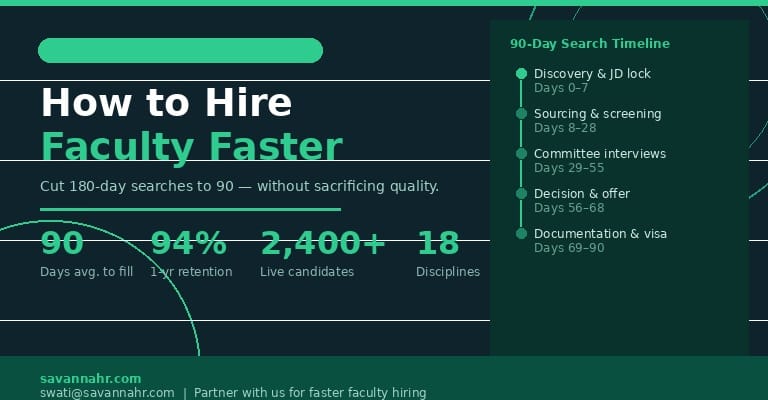
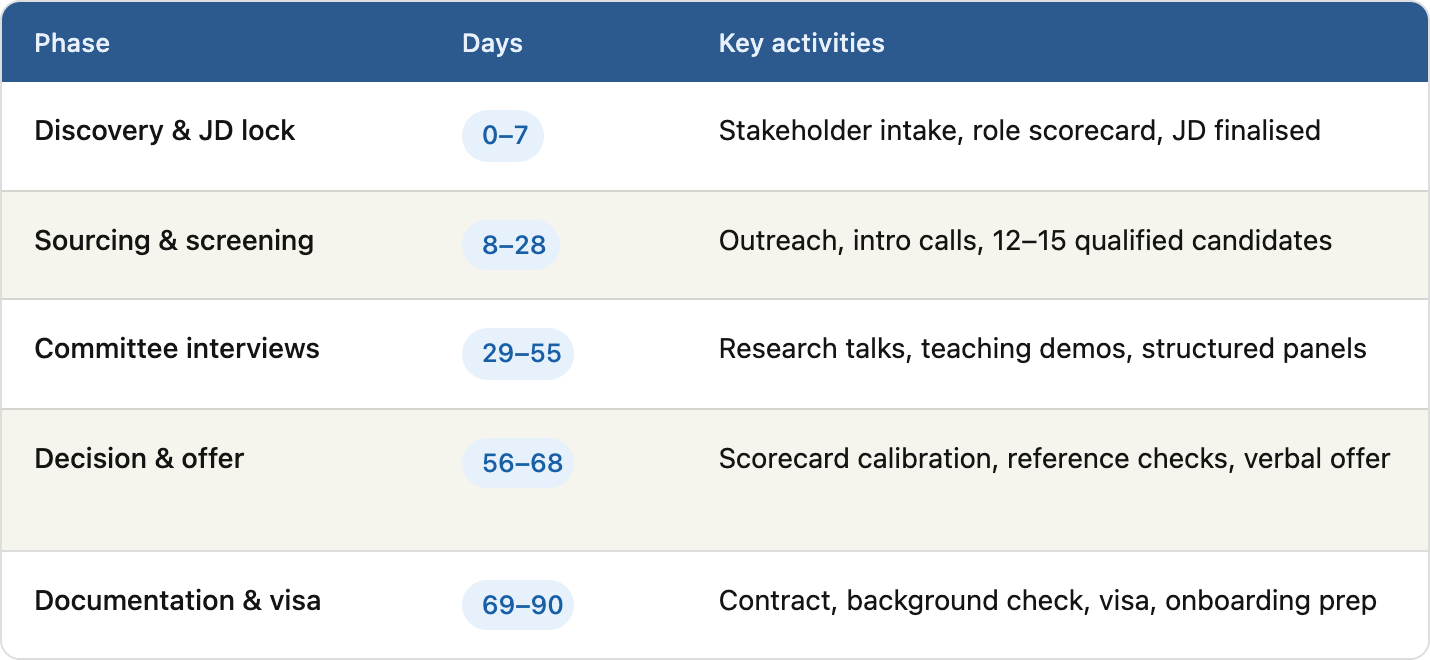
Here is the rough timeline we target when we run a full search for a client university, assuming a clean requisition and a pre-approved comp band:
The quality question: are we just hiring faster, or hiring worse?
This is the fair objection every dean raises, and the data is reassuring. In our 2025 client cohort, universities that adopted the full 5-lever playbook saw median time-to-fill drop from 174 days to 96 days — while 1-year retention of newly hired faculty actually improved from 88% to 94%. The mechanism is simple: when your process is fast, your best candidates do not accept competing offers while you deliberate.
“We used to lose roughly one in four top-choice candidates to faster-moving institutions. After restructuring our process with Savanna HR, we lost one in fourteen.” — Dean of Faculty Affairs, Tier-1 Indian private university
Where to start on Monday morning
If you do only three things this quarter, do these. First, audit your last five faculty searches and map every day from requisition to joining into one of six buckets: drafting, sourcing, screening, interviewing, deciding, documenting. You will be shocked how much time “deciding” and “documenting” consume. Second, get pre-approved compensation bands signed off for every department before the next search opens. Third, partner with a recruitment firm that maintains a live, warmed shortlist in your discipline — or start building one yourself. The universities that will win the faculty war in 2026 and 2027 are not the ones with the highest salaries. They are the ones with the fastest, most candidate-respectful processes.