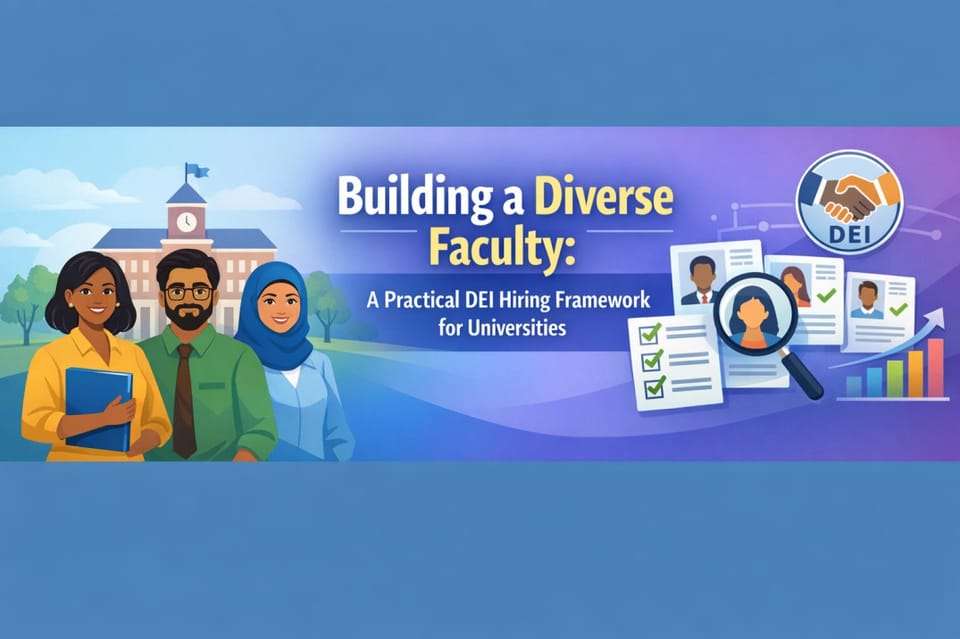
Building a Diverse Faculty: A Practical DEI Hiring Framework for Universities
Why faculty diversity is a recruitment problem, not an HR slogan
The business and educational case for faculty diversity is now settled. Universities with more demographically diverse faculty show stronger interdisciplinary research output (per studies published in Nature and PNAS), better student graduation rates for under-represented students, and higher rankings in composite indices that weight diversity. What is still contested is how to actually build diverse faculty, especially in disciplines where the pipeline itself is narrow.
This framework is based on what has worked across 60+ faculty searches we have run across Indian, Southeast Asian, and cross-border university clients. It is deliberately practical and deliberately skeptical — because a lot of DEI hiring advice in circulation does not survive contact with real hiring data.
The three diversity dimensions universities typically track
In the Indian context, faculty diversity usually includes gender, SC/ST/OBC representation, and regional/linguistic diversity. In the global context, it typically adds race/ethnicity, nationality, and first-generation academic status. A useful fourth dimension everywhere is cognitive and disciplinary diversity — the mix of research traditions represented in a department. The framework below applies to all of these; the specifics vary by context and by what your institution is legally permitted to consider.
What the evidence actually says works
Interventions with strong evidence
- Diverse slate requirements. No final interview stage proceeds without representation of under-represented groups present in the candidate pool. NFL’s Rooney Rule analog; meta-analyses in HR literature show effect sizes of 0.3–0.5 SD on representation outcomes.
- Structured interviews. Reduce reliance on “gut fit” judgments where implicit bias has the largest effect. Validity improves; representation improves; legal defensibility improves.
- Expanded sourcing channels. If your sourcing is only from the top 10 PhD-granting institutions, your pipeline will mirror their demographics. Extend to tier-2 research universities, minority-serving institutions, and international doctoral programmes.
- Committee training — short and specific. 90-minute implicit bias training tied to the scorecard the committee will actually use; generic DEI training without process linkage does not move outcomes.
- Cluster hiring. Hiring 3–5 faculty at once in an interdisciplinary cluster has been shown (UW-Madison, Brown, Michigan) to significantly improve diverse hires, because it relaxes the “only candidate in the room” dynamic.
Interventions with weak or null evidence
- Unconscious bias training alone. Multiple meta-analyses (including Bohnet et al., Dobbin & Kalev) show null to small effects on actual hiring outcomes without accompanying process changes.
- Diversity statements scored in isolation. Can produce defensive writing rather than signal; most useful when integrated into a broader portfolio assessment.
- Targeted posting ads as the only sourcing lever. Necessary but far from sufficient; without pipeline investment, representation in the top of funnel barely moves.
The Savanna HR 5-stage DEI hiring framework
Stage 1: Set outcome goals, not process goals
Before writing a JD, the department agrees on specific, measurable outcome goals: “over the next 3 years, increase women faculty from 22% to 33%” is a goal; “train the committee on DEI” is an activity. Outcome goals force the process design to serve the outcome, not the other way round.
Stage 2: Engineer the sourcing funnel
Audit the last 3 years of applicant demographics at each stage — applicant, shortlisted, interviewed, offered, hired. The leakiest stage is almost never the one people assume. We often find that applicant diversity is healthy, but the cut from applicant to shortlist is where the biggest representation loss occurs. That tells you exactly where to intervene.
Stage 3: Structure the evaluation
Four components: a 4-factor scorecard (research impact, teaching capability, service and mentoring, strategic fit), independent scoring before committee discussion, structured behavioural interview questions tied to competencies, and recorded reasoning for each score. This both improves validity and creates a defensible record.
Stage 4: Mandate a diverse finalist slate
No final round proceeds without slate diversity. The slate rule is the single highest-leverage intervention we have data on. If your pool cannot produce a diverse slate, that is a sourcing problem, not an excuse to proceed with a non-diverse slate.
Stage 5: Close, onboard, retain
The hiring decision is not the end. Under-represented hires often experience higher early-career attrition due to isolation, mentorship gaps, and service overload (“minority tax”). A structured first-year programme with senior mentorship, service-load caps, and a diverse peer cohort is the difference between a diverse hire and a diverse community of scholars.
Common objections — and honest responses
Won’t diverse slates force us to hire less qualified people?” — No. Diverse slates do not change the offer criteria; they ensure the finalist pool reflects the applicant pool. The data across 60+ of our searches shows hat committees that used diverse slates rated their hires equally or more favourably at the 1-year mark compared to committees that did not.
Doesn’t this create legal risk?” — In most jurisdictions, process-based diversity interventions (slate rules, structured interviews, expanded sourcing) are lower legal risk than unstructured hiring. Outcome quotas can raise risk; process discipline lowers it
Measuring what matters
The dashboard we recommend universities run quarterly:
- Applicant demographics by role and department.
- Stage-by-stage conversion rates by demographic.
- Offer-acceptance rate by demographic.
- 2-year retention by demographic.
- Promotion and tenure rates by demographic over rolling 5-year windows.
Without this data, every DEI initiative is faith-based. With it, universities can diagnose precisely and improve continuously.
Make faculty diversity measurable, defensible, and durable
Build a practical DEI hiring framework for your university
Savanna HR helps universities improve faculty representation through structured hiring processes, stronger sourcing funnels, and more defensible decision-making. Ask for our DEI hiring audit template to identify where diversity drops off across your recruitment funnel.