
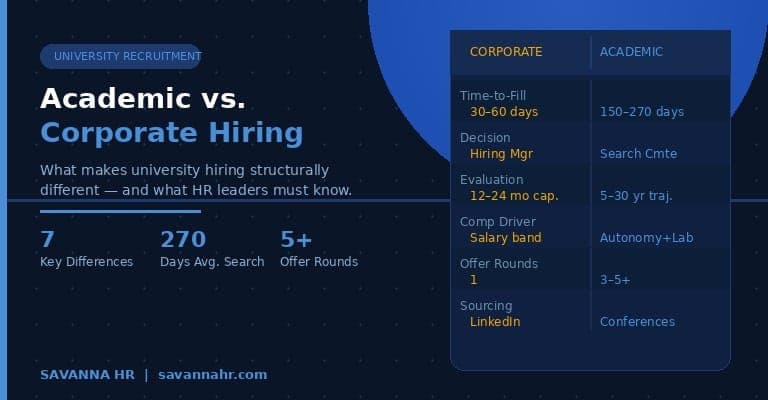
The most expensive recruiting mistake we see universities make is hiring a talent acquisition leader from a corporate background and expecting them to apply the corporate playbook unchanged. It almost never works. Not because corporate recruiters are bad, but because academic and corporate hiring are structurally different on at least seven dimensions. Universities that ignore this end up with frustrated recruiters, alienated faculty committees, and slower hiring than they started with.
This post lays out those seven differences clearly, so HR leaders moving between the two worlds — or building a hybrid team — know exactly what to translate, what to preserve, and what to throw out.
The seven structural differences
1. Governance: one person vs. a committee
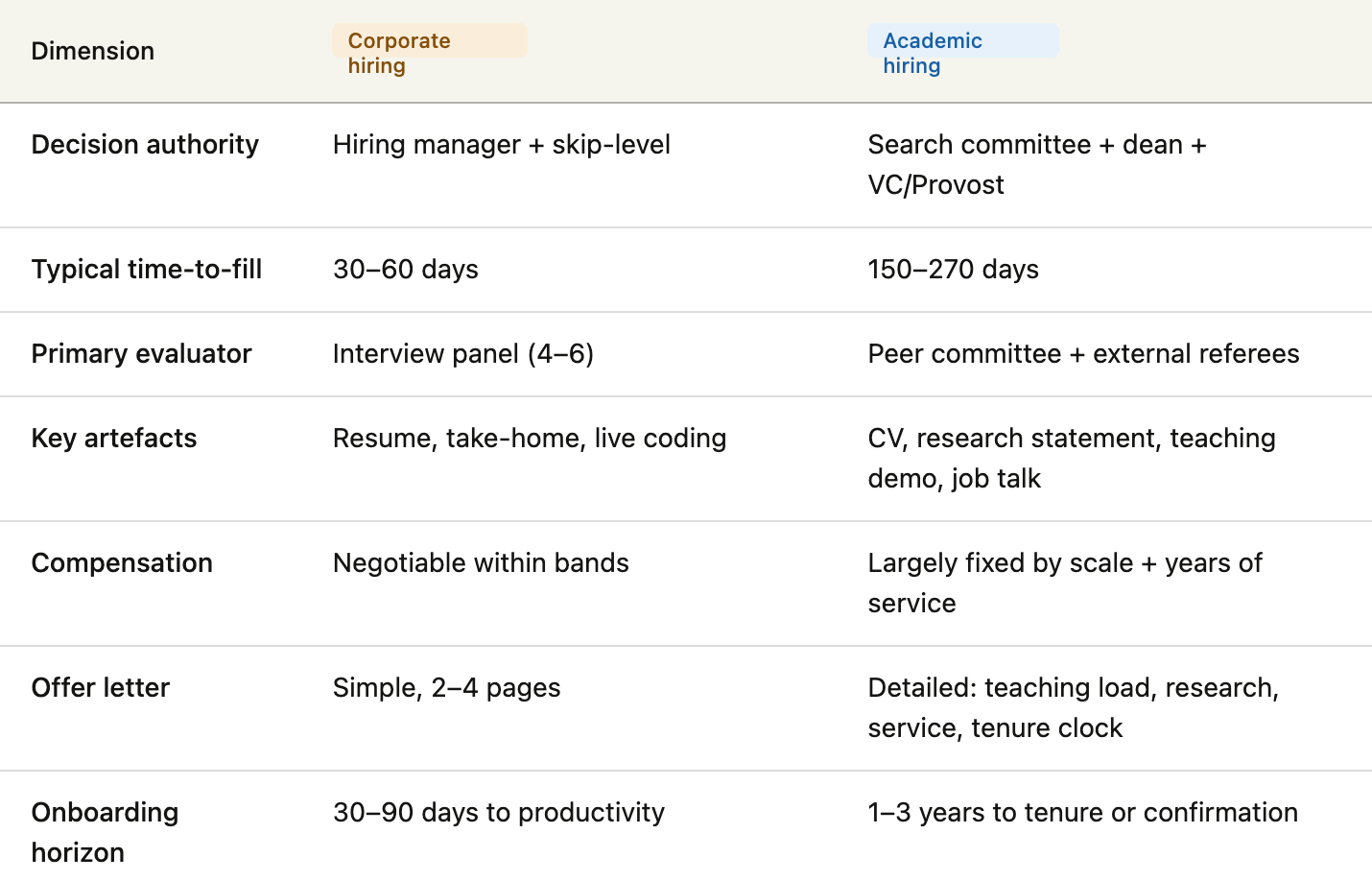
In corporate hiring, the hiring manager owns the decision. In academic hiring, the search committee is both evaluator and owner — and the dean cannot (and should not) override them casually. This is not bureaucratic inertia; it is peer review, the same principle that governs publication. Recruiters who try to “push a great candidate through” learn the hard way that committees have long memories.
2. Evaluation: potential vs. trajectory
Corporate hiring largely evaluates capability for the next 12–24 months. Academic hiring evaluates a 5- to 30-year trajectory: will this person win grants, publish, mentor doctoral students, earn tenure, and eventually contribute to institutional leadership? The evaluation artefacts reflect that. A job talk is not an interview; it is a preview of the candidate’s research programme for the next decade.
3. Compensation: bands vs. scales
Corporate comp is flexible within bands, and high performers can be paid 30–50% above the band midpoint. Academic comp is typically governed by UGC pay scales (India), AAUP scales, or institutional scales that are far less negotiable. What is negotiable: startup research packages, lab space, teaching load in year 1, summer salary, and sabbatical eligibility. A recruiter who only talks base salary leaves real value on the table.
4. Time horizon: quarterly vs. multi-year
A corporate role open for 90 days is a crisis. An academic search that closes in 90 days is exceptional. The reason is not laziness — it is that universities are hiring someone whose contribution compounds over 20 years, and spending 6 months to get it right is a rational trade.
5. Candidate motivation: compensation vs. calling
This is the one corporate recruiters most often miss. The majority of top academic candidates are not primarily motivated by compensation. They are motivated by research autonomy, doctoral student quality, lab resources, proximity to collaborators, tenure-track clarity, and institutional prestige. A recruiting pitch that leads with base salary will lose to one that leads with research environment, even at 20% lower pay.
6. Sourcing channels: LinkedIn vs. conferences and citations
Corporate sourcing lives on LinkedIn, GitHub, and referrals. Academic sourcing lives at discipline conferences (NeurIPS, APSA, MLA, AES), in citation graphs (who is citing the papers you wish you had published?), and in doctoral cohorts of specific advisors. A recruiter who cannot read a CV and map it to the citation network of the field is fundamentally limited.
7. Offer process: one round vs. many
Corporate offers are typically one-shot, with limited back-and-forth. Academic offers go through multiple rounds — often 3 to 5 — covering startup, teaching load, space, summer salary, spousal placement, visa, and relocation. The offer letter itself is a substantive contract, not a formality.
The lesson I wish I had learned in my first year running academic recruiting: corporate-style urgency without academic-style rigour destroys trust with the committee. You only get one chance to lose it.” — VP People, global university network
What to borrow from corporate hiring (and what to leave behind)
To be clear, academic recruiting has plenty to learn from corporate: candidate experience, data instrumentation, pipeline building, employer branding, and offer-process speed are all areas where corporate leads. But the wholesale import of corporate practices — especially around decision authority, evaluation criteria, and compensation negotiation — does not work. The best university recruiting teams we see are deliberate hybrids: corporate-grade operations wrapped around academically legitimate decision processes.
The practical takeaway for HR leaders
If you are building or upgrading a university recruitment function, the question is not corporate or academic — it is which corporate practices improve the academic process without breaking its logic. Speed, data, and candidate experience: yes. Single-decider authority, comp-led pitching, and unstructured evaluation: no. The universities that navigate this well hire better faculty, faster, without losing the legitimacy their committees rely on.