What Is AI Resume Parsing? How HireXL Matches Talent 10x Faster
Every recruiter knows the feeling. A critical role opens. Applications flood in — 200, 500, sometimes over a thousand resumes for a single position. Each one is a different format: some in PDF, some in Word, a few in plain text, and the occasional creative portfolio that no system can read. Your hiring manager wants a shortlist by Thursday. Your inbox is drowning. And somewhere in that avalanche of documents is the perfect candidate — if only you could find them.
This is the problem AI resume parsing was built to solve. And at Savanna HR, it’s the problem we’ve been solving at scale — having AI-parsed over 5 lakh resumes through our proprietary platform, HireXL — turning an unmanageable mountain of candidate data into a structured, searchable, instantly actionable talent database.
But what exactly is AI resume parsing? How does the technology actually work? And what makes it the single most important capability separating modern recruitment agencies from the ones still stuck in 2015? Let’s break it down.
What Is AI Resume Parsing?
AI resume parsing is the process of using artificial intelligence — specifically natural language processing (NLP) and machine learning — to automatically extract, categorize, and structure information from resumes. It takes an unstructured document in any format and converts it into clean, machine-readable data: names, contact details, job titles, companies, skills, education, certifications, employment dates, and dozens of other data points.
Think of it as the difference between a filing cabinet stuffed with loose papers and a perfectly indexed digital library. The information is the same. The accessibility is completely different.
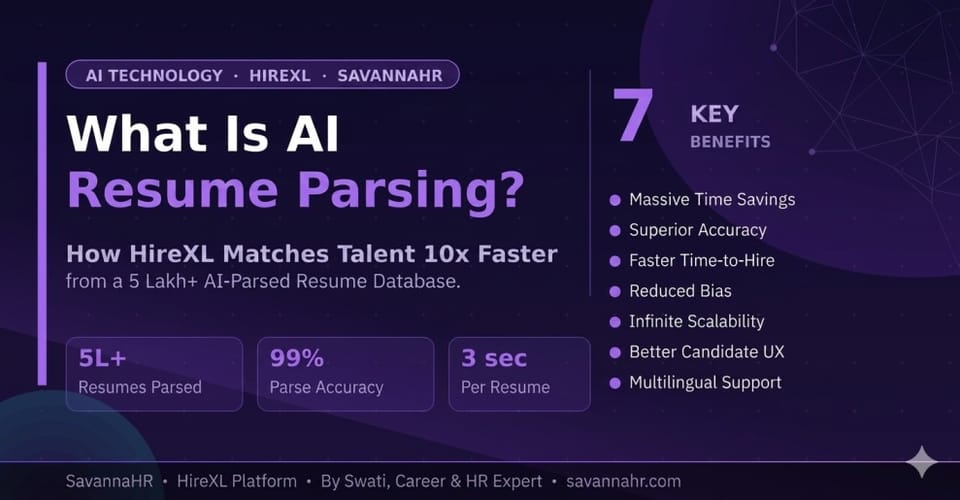
Modern AI-powered parsers go far beyond simple keyword extraction. They understand context. They know that “React” expertise implies JavaScript knowledge. They can differentiate between a current role and a previous one. They recognize that “Sr. PM” and “Senior Project Manager” are the same thing. The most advanced systems — including the one powering HireXL — can extract over 200 data points from a single resume with accuracy rates reaching 95–99%, processing each document in under three seconds.
How AI Resume Parsing Actually Works: The Technology Under the Hood
Understanding the mechanics helps you appreciate why AI parsing is such a leap over traditional keyword-matching systems. The process involves several sophisticated layers:
Document Ingestion. The system accepts resumes in virtually any format — PDF, DOCX, RTF, plain text, even image-based scans. OCR (optical character recognition) handles scanned documents, converting images of text into readable data.
Tokenisation and Text Processing. The raw text is broken into tokens — individual words and phrases. Part-of-speech tagging assigns grammatical roles to each token, helping the system understand sentence structure and meaning.
Named Entity Recognition (NER). This is where the AI identifies specific categories of information: names, organizations, locations, dates, job titles, educational institutions, and skills. NER models trained on millions of resumes can recognize patterns that rule-based systems miss entirely.
Contextual Embedding and Semantic Analysis. Modern parsers use deep learning models that understand words in relation to their surrounding context. This means the system can correctly interpret “Python” as a programming language (not a snake), or “Agile” as a methodology (not an adjective). It understands synonyms, abbreviations, and domain-specific terminology across industries.
Structured Output. The extracted data is organized into standardized fields — often as JSON or XML — and fed into the recruitment platform’s database, where it becomes instantly searchable, sortable, and matchable against open roles.
This entire pipeline executes in seconds. What would take a human recruiter 10–15 minutes per resume — reading, interpreting, manually entering data into an ATS — happens automatically, at scale, with higher consistency and fewer errors.
How AI Resume Parsing Powers Savanna HR — and Why HireXL Changes Everything
At Savanna HR, resume parsing isn’t a feature we added to keep up with the market. It’s the foundation our entire hiring engine is built on. Through HireXL, our AI-enabled recruiting platform, we’ve parsed and structured over 5 lakh (500,000+) resumes — building one of the deepest, most intelligent talent databases in the Indian recruitment ecosystem.
Here’s what that means in practice:
Instant Candidate Discovery. When a client comes to us with an urgent hiring need — say, a fintech startup that needs five senior backend developers in Bangalore within two weeks — we don’t start from scratch. HireXL’s AI searches our pre-parsed database of 5 lakh+ structured profiles, matching against skills, experience level, location, industry context, and career trajectory. Qualified candidates surface in minutes, not days.
A Living, Learning Database. Every new resume that enters HireXL doesn’t just get parsed once and filed away. The system continuously enriches candidate profiles as new data becomes available — updated skills, new certifications, career moves. Our database isn’t a static archive. It’s a dynamic, evolving talent marketplace that gets smarter with every interaction.
Consistency Across 5 Lakh+ Profiles. Human reviewers are inconsistent by nature — fatigue, unconscious bias, varying interpretations of the same information. HireXL applies identical parsing logic to every single resume, ensuring that a candidate’s skills are evaluated the same way whether they’re the first profile reviewed on a Monday morning or the 500th on a Friday afternoon.
Skill-First, Not Title-First Matching. Traditional databases search by job title. HireXL searches by skills, competencies, and potential. This means we find candidates who are genuinely capable of doing the job — not just candidates who happen to have held the same title at a previous company. It’s the difference between finding a “Senior Marketing Manager” and finding someone who has demonstrable expertise in demand generation, marketing automation, and team leadership — regardless of what their last employer called the role.
7 Benefits of AI Resume Parsing That Transform Recruitment
Whether you’re a recruitment agency, an in-house HR team, or a CHRO evaluating your tech stack, here’s what AI resume parsing delivers when implemented properly:
1. Massive Time Savings. AI parsing reduces data entry time by 75–90% and cuts initial screening time by up to 71%. At Savanna HR, this means our recruiters spend their time evaluating fit and building relationships — not copying and pasting from PDFs into spreadsheets.
2. Superior Accuracy. Advanced parsers extract data with 95–99% accuracy, compared to the inevitable errors and inconsistencies of manual entry. Fewer errors means fewer missed candidates and fewer embarrassing mix-ups.
3. Dramatically Faster Time-to-Hire. Organizations using AI-powered parsing and screening report 30–50% faster time-to-hire, with high-volume programs seeing reductions as high as 75%. Through HireXL, we’ve helped clients collapse 60-day hiring cycles into under three weeks.
4. Reduced Unconscious Bias. When AI evaluates resumes based on skills and experience rather than names, universities, or formatting choices, the first pass becomes inherently fairer. HireXL’s skill-first parsing criteria remove the unconscious filters that humans bring to manual screening — giving non-traditional candidates a real shot at being seen.
5. Scalability Without Headcount. Parsing 50 resumes manually and parsing 5,000 require very different levels of effort from a human team. For AI, the difference is negligible. This is what allowed Savanna HR to build a 5 lakh+ database without a proportional army of data-entry staff. The technology scales; the team focuses on what humans do best.
6. Enhanced Candidate Experience. One-click apply features powered by resume parsing have been shown to increase application conversion rates by up to 194%. When candidates can apply in seconds and receive faster responses because their profiles are instantly matched, your employer brand strengthens.
7. Multilingual and Multi-Format Support. Modern parsers, including HireXL’s engine, handle resumes in over 40 languages and virtually any file format. In a diverse talent market like India — where candidates submit resumes in English, Hindi, and regional languages, across PDFs, Word files, and even WhatsApp screenshots — this capability is not optional. It’s essential.
What AI Resume Parsing Means for Job Seekers
If you’re on the other side of the hiring table, understanding resume parsing is just as important. In 2026, 97% of Fortune 500 companies use applicant tracking systems that rely on parsing technology. If your resume can’t be parsed accurately, you’re invisible — regardless of how qualified you are.
Here are three practical takeaways. First, use clean formatting: avoid tables, columns, headers and footers, and embedded graphics that confuse parsers. 23% of ATS rejections are caused by parsing errors from poor formatting. Second, use both acronyms and full terms — write “Search Engine Optimization (SEO)” rather than just “SEO” — because modern systems use semantic analysis but older systems still rely on exact keyword matches. Third, submit in .docx format when possible, as it remains the most reliably parsed file type across systems in 2026.
The good news? AI-powered platforms like HireXL are actually better at recognizing transferable skills and non-linear career paths than keyword-only systems. If your experience doesn’t fit a neat template, AI might be the thing that finally gets you noticed.
The Bottom Line: Your Database Is Only as Good as Your Parsing
Every recruitment agency claims to have a “large candidate database.” But a database of unstructured, unsearchable resume files is not an asset — it’s a storage cost. The value isn’t in how many resumes you have. It’s in how well you’ve parsed, structured, and indexed them so that the right candidate surfaces at the right moment.
At Savanna HR, our 5 lakh+ AI-parsed resume database through HireXL isn’t just big. It’s intelligent. Every profile is structured, skill-mapped, and continuously enriched — turning raw candidate data into a searchable talent marketplace that delivers the right match in minutes, not weeks. That’s the power of AI resume parsing done right.
If you’re an employer still waiting weeks for shortlists, or a recruitment leader whose database feels more like a graveyard than a goldmine — it’s time to rethink the foundation. The technology is here. The results are proven. And at Savanna HR, we’re ready to show you what’s possible.