
The New Talent Model Indian Startups Need
In 2026, a quiet revolution is transforming how Indian startups build their leadership teams. Across Bangalore, Mumbai, Delhi, and increasingly in tier-2 cities, a growing number of startups are hiring experienced executives and specialists not as full-time employees but on a fractional basis, engaging them for a few days a week or a defined number of hours per month to provide the expertise the company needs without the full-time cost it cannot yet afford. This is the fractional hiring model, and it is rapidly becoming one of the most important innovations in India's startup talent ecosystem
The concept is not entirely new. Consulting and advisory relationships have existed for decades. But fractional hiring represents something fundamentally different from traditional consulting. A fractional CFO, CTO, or CMO is not an outside advisor offering recommendations from a distance. They are an embedded member of the leadership team who attends meetings, makes decisions, manages direct reports, and shares accountability for outcomes, just on a part-time basis. They bring the same depth of engagement as a full-time executive but distribute their time across two or three organizations, creating a model that serves both the companies that need their expertise and the professionals who want portfolio careers.
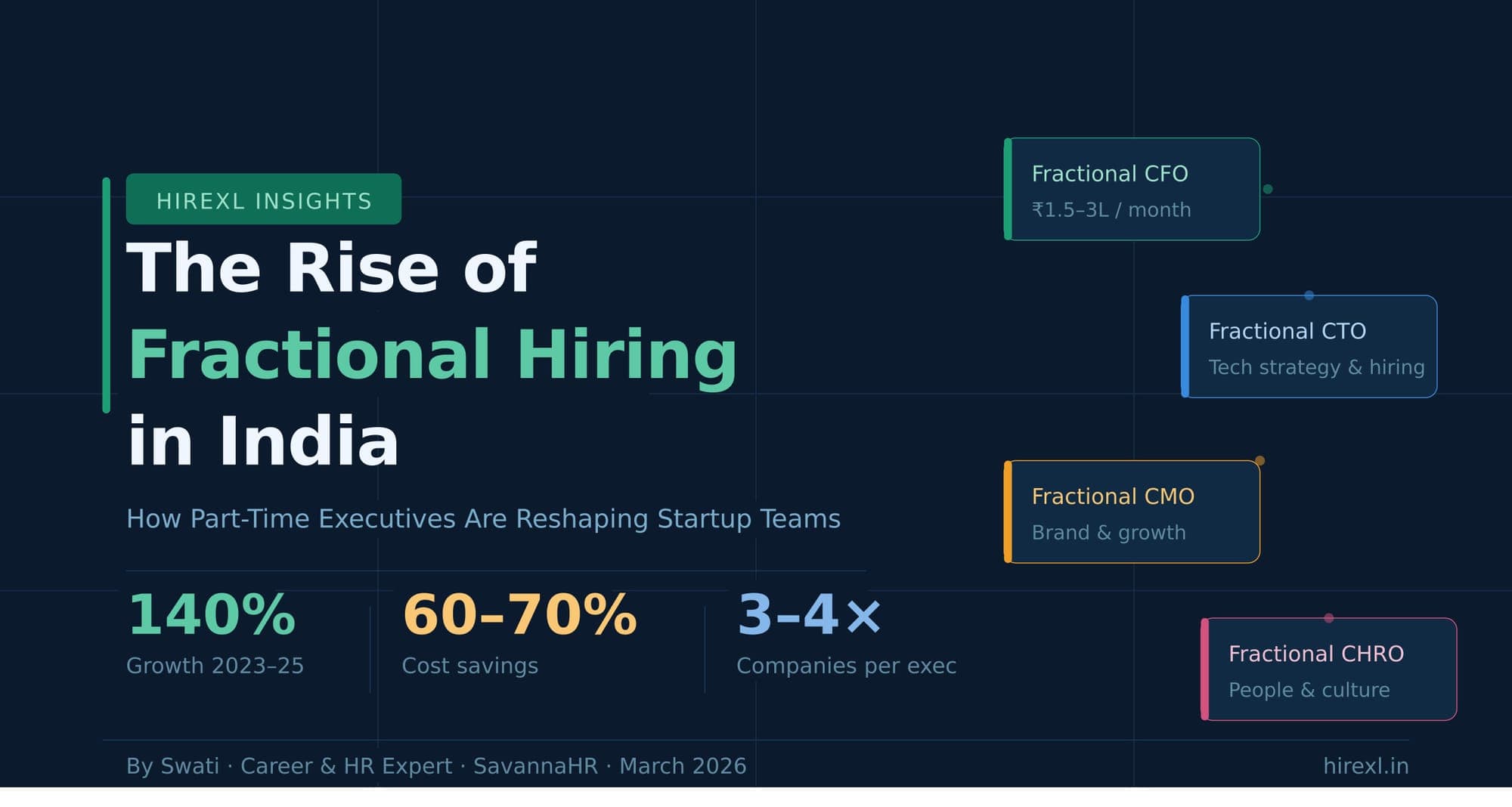
The numbers tell the story of rapid adoption. According to a 2025 survey by Flexing It, India's leading platform for independent professionals, the number of fractional executive engagements in India grew by 140 percent between 2023 and 2025, with the fastest growth in finance, technology, marketing, and human resources functions. For startups at the seed to Series A stage, where the need for senior leadership is acute but the budget for full-time C-suite salaries is prohibitive, fractional hiring is not a compromise. It is often the optimal solution.
Why Fractional Hiring Is Growing in India
| The Startup Maturity Gap
Most Indian startups at the seed and early Series A stage face a fundamental mismatch between what they need and what they can afford. They need the strategic guidance and operational expertise of experienced leaders to navigate critical decisions about product-market fit, go-to-market strategy, fundraising, compliance, and team building. But they cannot justify the 50 to 80 lakh rupee annual cost of a full-time CFO, CTO, or VP of Marketing when the entire company has only 10 to 20 employees and 18 months of runway.
This gap has traditionally been filled by founders wearing multiple hats, by junior hires who learn on the job, or by advisory boards whose engagement is too sporadic to be operationally useful. None of these solutions is satisfactory. Founders who spread themselves across too many functions become bottlenecks. Junior hires, no matter how talented, lack the pattern recognition that comes from years of experience. And advisors who attend a monthly board meeting cannot provide the day-to-day guidance that early-stage companies need. Fractional hiring addresses this gap directly by providing experienced leadership at a fraction of the full-time cost, typically 60 to 70 percent less.
| The Post-Pandemic Professional Landscape
The supply side of the fractional equation has been equally transformed. The pandemic and subsequent remote work revolution fundamentally changed how experienced professionals think about their careers. Many senior leaders who were laid off during the 2023 downturn discovered that they preferred the variety, autonomy, and impact of working with multiple companies to the politics, monotony, and commute of a single full-time role. Others, burned out by decades in corporate environments, found that fractional work offered a way to stay professionally engaged while maintaining the work-life balance they had come to value.
This shift has created a growing pool of highly experienced professionals, many with backgrounds at top- tier companies and startup success stories on their resumes, who are actively choosing fractional careers. These are not people who cannot find full-time jobs. They are people who have made a deliberate decision that the fractional model better serves their professional and personal goals. The quality of the fractional talent pool in India is, as a result, remarkably high and improving rapidly as the model gains mainstream acceptance.
Where Fractional Hiring Works Best
| Fractional CFO
The most established fractional role in India is the fractional CFO, and for good reason. Early-stage startups need financial expertise for fundraising preparation, financial modeling, compliance, tax planning, and investor relations, but they do not generate enough financial activity to justify a full-time finance leader. A fractional CFO can set up accounting systems, build financial models for fundraising, manage compliance and statutory filings, provide strategic input on pricing and unit economics, and serve as the primary interface with investors and auditors, all in 8 to 12 hours per week.
The impact is often transformative. Startups with fractional CFOs raise funding more quickly because their financials are investor-ready. They avoid the compliance pitfalls that catch many founders off guard. And they make better strategic decisions because they have a finance professional translating business decisions into their financial implications. The typical cost of a fractional CFO in India ranges from 1.5 to 3 lakh rupees per month, compared to 4 to 7 lakh per month for a full-time equivalent.
| Fractional CTO
For non-technical founders building technology products, a fractional CTO can be the difference between a successful product launch and a costly misadventure. A fractional CTO provides technology strategy, architecture decisions, technical team hiring and management, vendor evaluation, and quality oversight without the full-time salary and equity grant that a permanent CTO would command. They are particularly valuable during the product building phase, when technical decisions have outsized and often irreversible consequences.
The key to a successful fractional CTO engagement is clear scope definition. The fractional CTO should own specific deliverables, such as the technology architecture, the engineering hiring process, or the release management framework, and should have genuine authority to make decisions within their scope. A fractional CTO who is treated as a reviewer or advisor rather than a decision-maker will struggle to create the impact that justifies the engagement.
| Fractional CMO and Head of Growth
Marketing is another function where fractional expertise delivers outsized value for startups. Most early- stage companies cannot afford a senior marketing leader, but they desperately need one to define positioning, build the brand narrative, establish scalable acquisition channels, and create the content and thought leadership that drives awareness. A fractional CMO brings the strategic perspective to identify the highest-leverage marketing investments and the experience to avoid the costly experiments that consume budget without generating results.
| Fractional CHRO and People Lead
As startups grow beyond 20 to 30 employees, the people function becomes critical. Culture, hiring processes, compensation frameworks, performance management, and compliance all require professional expertise. A fractional CHRO can establish the foundational people systems that will scale with the company, from structured interview processes and compensation bands to employee handbooks and engagement surveys, at a fraction of the cost of a full-time hire. This is particularly valuable during growth spurts, when hiring velocity increases and the risk of cultural dilution is highest.
How to Make Fractional Hiring Work
| Defining the Engagement Clearly
The most common failure mode in fractional engagements is ambiguous scope. Without clear expectations about deliverables, time commitment, decision-making authority, and reporting relationships, fractional executives can find themselves in a frustrating limbo where they are expected to deliver executive-level impact with advisor-level involvement. Define the engagement with specificity: how many hours per week, which meetings they will attend, what decisions they own, and what outcomes they are accountable for over the next quarter.
| Integration with the Full-Time Team
A fractional executive who operates in isolation from the day-to-day team will have limited impact regardless of their expertise. Integrate them into the company's communication channels, include them in relevant team meetings, and ensure that the team understands their role and authority. The most effective fractional executives are those who are treated as full members of the leadership team during the time they are engaged, not as external consultants who parachute in for a few hours and disappear.
| Building Toward Full-Time If Appropriate
Many of the most successful fractional engagements evolve into full-time roles as the company grows and the need for dedicated leadership becomes clear. Structure the engagement with this possibility in mind: include provisions in the contract that address the transition from fractional to full-time, including how equity and compensation will be adjusted. This try-before-you-buy dynamic is actually one of the greatest advantages of fractional hiring, as it allows both the company and the executive to evaluate the fit before making a full-time commitment.
Cost Comparison: A full-time CFO at 60 LPA costs approximately 5 lakh per month including benefits. A fractional CFO providing equivalent strategic value at 2 days per week costs 1.5-3 lakh per month, a savings of 24-42 lakh annually.
Finding and Evaluating Fractional Talent
The fractional talent market in India is still developing its infrastructure, but several channels are emerging as reliable sources. Platforms like Flexing It, Toptal, and Catalant connect companies with vetted fractional executives across functions. LinkedIn has become a primary channel for fractional professionals to market their services, and many use the 'Open to Work' designation with 'fractional' or 'part-time' specifications. Industry-specific communities and networks are another rich source, particularly for specialized functions like fractional CTOs or fractional product leaders.
When evaluating fractional candidates, prioritize track record over credentials. The best fractional executives are those who have done the job full-time at a company of similar stage and size and can demonstrate specific, measurable outcomes. Ask for references from companies where they have worked fractionally, not just from their full-time career, since the skills required to be effective in a fractional capacity are somewhat different from those needed in a full-time role. Communication efficiency, rapid context-switching ability, and the judgment to prioritize the highest-impact activities within limited time are all essential qualities for fractional success.
Expect to pay a premium on an hourly basis compared to a full-time equivalent. A fractional CFO who charges 2.5 lakh per month for two days per week is technically more expensive per hour than a full-time CFO earning 60 lakh annually. But the total cost is significantly lower, and the value per rupee spent is often higher because you are accessing senior expertise precisely when and where you need it, without paying for the downtime that inevitably exists in any full-time role.
The Legal and Structural Considerations
Structuring fractional engagements properly is important for both legal compliance and a successful working relationship. In India, most fractional arrangements are structured as independent contractor or consulting agreements rather than employment relationships. This distinction has implications for taxes, benefits, intellectual property, and liability. Work with a lawyer to draft an agreement that clearly defines the nature of the relationship, the scope of work, the payment terms, confidentiality obligations, intellectual property ownership, and termination provisions.
For startups granting equity to fractional executives, the structure requires particular care. Options grants with standard four-year vesting may not be appropriate for an engagement that is expected to last 12 to 18 months. Consider time-based grants that vest over the expected engagement period, or milestone- based grants that vest upon the achievement of specific deliverables. Whatever structure you choose, ensure that the equity arrangement is documented in a separate agreement and reviewed by counsel with experience in equity compensation.
The Bottom Line
Fractional hiring is not a temporary trend or a pandemic-era workaround. It is a structural innovation in how companies access expertise that is here to stay and will only grow as India's startup ecosystem matures. For startups, it offers a way to access world-class leadership at a fraction of the full-time cost, with the added benefit of lower commitment risk and the flexibility to scale the engagement up or down as needs evolve. For experienced professionals, it offers a career model that combines impact, variety, and autonomy in ways that traditional employment cannot match.
The companies that learn to effectively leverage fractional talent will have a significant competitive advantage: they will make better strategic decisions, avoid costly mistakes, and build stronger foundations for growth than competitors who either go without senior expertise or overspend on full-time leaders they do not yet need. Start by identifying the one or two functions where external expertise would have the greatest impact on your next twelve months of growth. Then find the right fractional leader, structure the engagement clearly, and watch the impact unfold.
Sources & References
- Flexing It - India Fractional Executive Market Survey 2025
- Nasscom - Alternative Talent Models for Indian Startups
- Harvard Business Review - The Fractional Executive Economy
- McKinsey - Future of Work and Flexible Talent
- Toptal - India Freelance Executive Trends Report
- SHRM India - Independent Contractor Compliance Guide
- YourStory - Fractional Leadership in Indian Startups


