The Speed-Quality Paradox in Hiring
Every talent acquisition leader faces the same fundamental tension: hire faster or hire better. The pressure to fill open positions quickly is relentless and comes from every direction. Business leaders need headcount to hit revenue targets, engineering managers need engineers to ship products on deadline, and every day a critical role sits unfilled costs the company in productivity, morale, and competitive positioning. According to SHRM, the average cost of a vacant position in a tech company is approximately 1.5 times the daily salary of the role, which means a senior engineering position paying 40 lakh rupees annually costs the company roughly 16,000 rupees for every day it remains open.
But hiring too fast comes with its own steep costs. A compressed timeline often means fewer interview rounds, less thorough reference checks, and decisions driven by urgency rather than evidence. The result is a higher rate of bad hires, which as we have discussed extensively in our previous research, can cost three to five times the annual salary of the position. The startup that fills a role in two weeks only to see the person depart or underperform within six months has not saved time; it has doubled the total time-to-productive-hire while incurring significant additional costs.
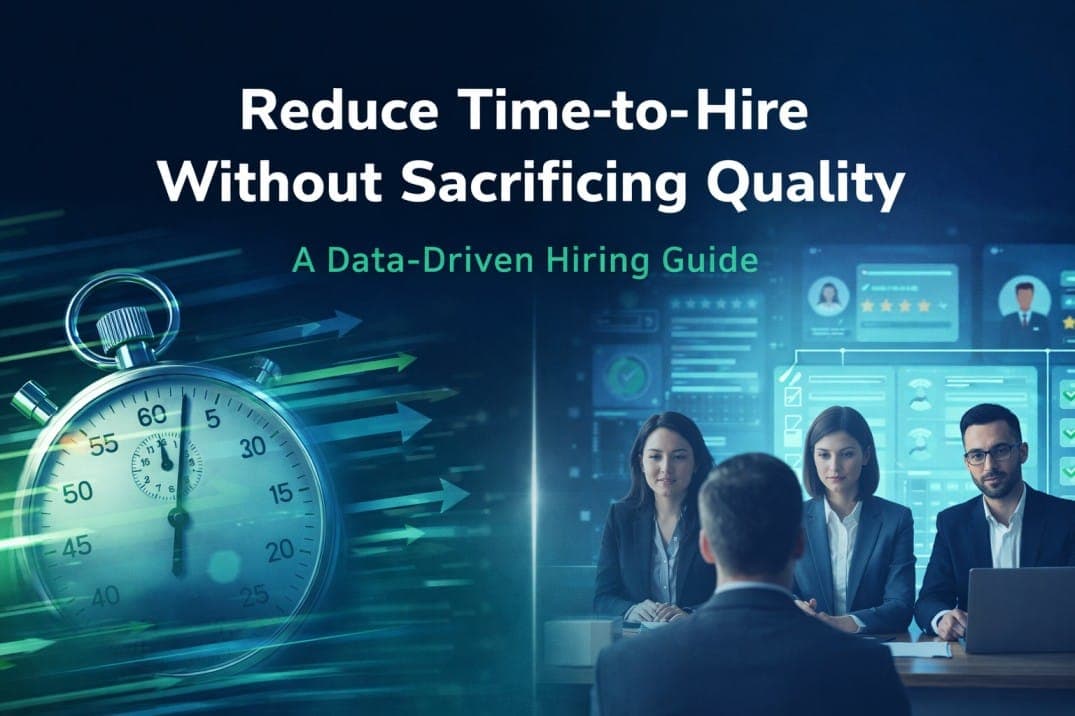
The good news is that speed and quality are not inherently opposed. The companies that hire both fast and well are those that have invested in process design, not those that have cut corners. This article presents a comprehensive framework for reducing time-to-hire by 40 to 50 percent while maintaining or even improving the quality of your hires, drawn from research and best practices in India's most effective hiring organizations.
Indian tech roles
senior tech position
with optimized process
Diagnosing Your Hiring Bottlenecks
Before you can fix your hiring speed, you need to understand where the time is actually going. Most companies track time-to-hire as a single metric, but this aggregate number masks the specific bottlenecks that are slowing you down. Break your hiring process into discrete stages and measure the time spent in each: job requisition to posting, posting to first qualified application, application to first screen, screen to first interview, interview rounds, offer generation, offer to acceptance, and acceptance to start date.
In our analysis of hiring data from over 200 Indian startups on the HireXL platform, the biggest time sinks are consistently in three areas: the gap between receiving applications and beginning interviews, which averages 8 to 12 days; the time between interview rounds, which averages 5 to 7 days per round; andthe offer generation and approval process, which averages 4 to 8 days. Together, these three bottlenecks account for 60 to 70 percent of total time-to-hire. Address them, and you will see dramatic improvements without touching the actual evaluation methodology.
Each of these bottlenecks has identifiable root causes. The screening delay is typically caused by recruiters who are overburdened with too many open requisitions and cannot review applications promptly. The interview scheduling gap is caused by the difficulty of coordinating busy interviewers' calendars. And the offer delay is caused by multi-layered approval processes designed for large organizations that are inappropriate for startup decision-making speed. Understanding these causes points directly to the solutions.
Strategy 1: Front-Load Your Pipeline
| Build Before You Need
The most effective way to reduce time-to-hire is to have qualified candidates already in your pipeline before a position opens. This requires a shift from reactive to proactive recruiting, where talent sourcing is a continuous activity rather than one triggered by an open requisition. In practice, this means maintaining relationships with strong candidates you have previously interviewed but not hired, engaging with passive talent through content and community involvement, and building talent pools organized by skill category and seniority level.
For Indian startups, this proactive approach is particularly valuable for roles that are consistently difficult to fill, such as senior engineering leads, product managers, and data scientists. By maintaining a warm pipeline of 10 to 15 pre-qualified candidates for each of these recurring role categories, you can begin the evaluation process within days of a new opening rather than starting from scratch. The time saved on the sourcing and initial screening phases alone can reduce overall time-to-hire by 15 to 20 days.
| Employee Referral Programs That Actually Work
Employee referrals are the fastest and highest-quality source of hire across virtually every industry and geography. Referral hires are typically made 40 percent faster than other sources, have 25 percent higher first-year retention, and produce candidates who are pre-vetted by someone who understands both the role and the culture. Yet many Indian startups have referral programs that are either nonexistent or so poorly designed that they generate minimal results.
An effective referral program requires three elements: meaningful incentives that are paid promptly, a frictionless submission process, and regular communication about which roles are open and what an ideal candidate looks like. The incentive should be substantial enough to motivate behavior, typically 25,000 to 75,000 rupees for mid-level roles and 1 to 2 lakh for senior positions, paid within 30 days of the referred hire's start date rather than after a probation period. The submission process should take less than two minutes and should not require the referring employee to upload a resume or fill out extensive forms. And the communication should be proactive and specific: rather than a generic 'refer your friends' email, send targeted messages about specific roles with clear descriptions of the ideal candidate profile.
Strategy 2: Streamline the Evaluation Process
| The Two-Interview Maximum
One of the most impactful changes you can make is to reduce the number of interview rounds. The conventional wisdom that more interviews lead to better decisions is not supported by research. After the third interview with a candidate, additional rounds produce diminishing informational returns while significantly increasing time-to-hire and candidate drop-off. For most roles, a well-designed two-interview process is sufficient: a structured behavioral and culture fit interview, followed by a technical or work-sample assessment.
The key is to make each interview count by ensuring that every interviewer has a specific assessment focus and a structured rubric. When two interviewers are evaluating the same competencies without coordination, you are not conducting two interviews; you are conducting one interview twice. Assign each interviewer a distinct set of competencies to evaluate, provide them with calibrated questions and rating criteria, and debrief immediately after the interviews while the information is fresh.
| Asynchronous Assessment Tools
Asynchronous assessments, where candidates complete evaluations on their own time rather than in a scheduled session, can eliminate the scheduling bottleneck entirely for certain stages of the process. For technical roles, platforms like HackerRank, CodeSignal, and Codility allow candidates to complete coding challenges at any time within a specified window, with automated scoring that instantly identifies the top performers. For non-technical roles, asynchronous video interviews where candidates record responses to predetermined questions allow hiring managers to evaluate at their convenience without the need for calendar coordination.
These tools work best as early-stage filters that reduce the number of candidates who need to participate in live interviews. By moving the initial technical screen to an asynchronous format, you can evaluate 50 candidates in the time it would take to schedule and conduct live screens with 10. The candidates who perform well on the asynchronous assessment then advance to live interviews where the focus can be on collaboration, communication, and cultural fit rather than basic skill verification.
| Structured Scorecards and Rapid Debriefs
The time between interview and decision is often consumed by unstructured deliberation, where interviewers share vague impressions in lengthy meetings without clear criteria for evaluation. Replacing this with structured scorecards that each interviewer completes independently within one hour of the interview, followed by a 15-minute calibration meeting, can compress the decision phase from days to hours. The scorecard should rate each target competency on a defined scale, include specific evidence for each rating, and culminate in a clear hire, no-hire, or strong-hire recommendation. When all interviewers have submitted their scorecards before the debrief, the discussion becomes focused and efficient rather than rambling and subjective.
Strategy 3: Accelerate the Offer Process
| Pre-Approved Compensation Bands
One of the most common delays in the offer process is the multi-level approval required for compensation decisions. By establishing pre-approved compensation bands for each role and level, you empower hiring managers to make offers within the approved range without additional authorization. The band should include a minimum, midpoint, and maximum for each compensation component, with clear guidelines about when offers above the midpoint are appropriate. Approvals should only be required for offers that exceed the established band, which should be the exception rather than the rule.
| Same-Day Offer Generation
Once the hiring decision is made, the offer should be generated and delivered within 24 hours, ideally the same day. Every day of delay between the verbal offer and the written offer is a day when the candidate is evaluating other opportunities, second-guessing their decision, and potentially receiving competing offers. Create offer letter templates for each role category that can be customized in minutes rather than drafted from scratch. Use digital signature tools like DocuSign or Zoho Sign to enable instant electronic acceptance, eliminating the delays associated with printing, signing, and scanning physical documents.
| The Candidate Close Strategy
The offer stage is not just an administrative process; it is a sales process. The best companies treat the period between offer and acceptance as an active engagement, not a passive wait. This includes a personal call from the hiring manager to reinforce enthusiasm about the candidate joining, a follow-up call or message from a potential team member to answer questions, and proactive outreach to address any concerns or competing offers. Data shows that candidates who receive personalized follow-up during the offer period are 30 percent more likely to accept and 40 percent less likely to back out after accepting.
Speed Benchmark: Best-in-class Indian startups are making offers within 10-14 days of first contact for most roles. If your process takes more than 25 days, you are losing top candidates to faster- moving competitors.
Strategy 4: Technology That Actually Helps
The recruitment technology market is flooded with tools promising to accelerate hiring, but not all of them deliver meaningful time savings. Focus your technology investment on the specific bottlenecks identified in your process audit. If scheduling is your biggest delay, invest in an AI scheduling tool like Calendly or GoodTime that can coordinate across multiple interviewer calendars automatically. If screening volume is the issue, implement an AI-powered screening tool that can surface the most relevant candidates from a large applicant pool within minutes rather than days.
For ATS selection, prioritize workflow automation capabilities over features. The best ATS platforms for speed-focused hiring are those that automate the transitions between stages: automatically advancingcandidates who pass screening thresholds, automatically triggering interview invitations when a candidate reaches the interview stage, and automatically generating offers when a hire decision is recorded. Each automation eliminates a manual handoff that adds hours or days of delay. Platforms like Greenhouse, Lever, and the emerging India-focused options like HireXL are increasingly building these automation capabilities directly into the workflow.
Strategy 5: Measure, Iterate, and Improve
Reducing time-to-hire is not a one-time project; it is a continuous improvement practice. Establish a weekly or biweekly review cadence where you examine your hiring funnel metrics, identify current bottlenecks, and test process changes. Track time-to-hire at each stage, candidate drop-off rates, offer acceptance rates, and the quality of hires measured by 90-day performance and retention.
Create a feedback loop that captures the candidate's perspective. A brief survey sent to every candidate who completes the interview process, regardless of outcome, can reveal friction points that internal metrics miss. Questions like 'Was the timeline for each stage communicated clearly?' and 'Was there any point where you considered withdrawing from the process?' provide actionable insights that directly inform process improvements.
Set specific targets for each metric and celebrate progress. A 10 percent reduction in time-to-hire per quarter is ambitious but achievable for most organizations, and the compound effect of consistent improvement is dramatic. A company that reduces its average time-to-hire from 42 days to 25 days over the course of a year has fundamentally transformed its competitive position in the talent market.
The Bottom Line
Speed in hiring is not about cutting corners or lowering standards. It is about eliminating waste, reducing friction, and designing a process where every step adds value and no step adds unnecessary delay. The companies that hire fastest are not those that skip interviews or rush decisions. They are those that have built hiring machines where qualified candidates flow smoothly from application to offer without getting stuck in scheduling limbo, approval bureaucracy, or indecision.
The framework presented here is not theoretical. Every strategy has been implemented by Indian startups that have achieved time-to-hire metrics that rival or exceed global best practices. The common thread is intentionality: treating the hiring process as a product that deserves the same attention to user experience, efficiency, and continuous improvement that you bring to your customer-facing products. Invest in your hiring process with the same rigor you invest in your product, and you will build teams faster, better, and more consistently than competitors who treat recruitment as an afterthought.
Related reading: Savanna HR hiring solutions · EdTech Recruitment in Gurgaon (2026) · How to Choose the Best Recruitment Agency in Gurgaon (2026): 7 Standards That Matter


