How to Reduce Time-to-Hire with AI: Cut Hiring from Months to Days
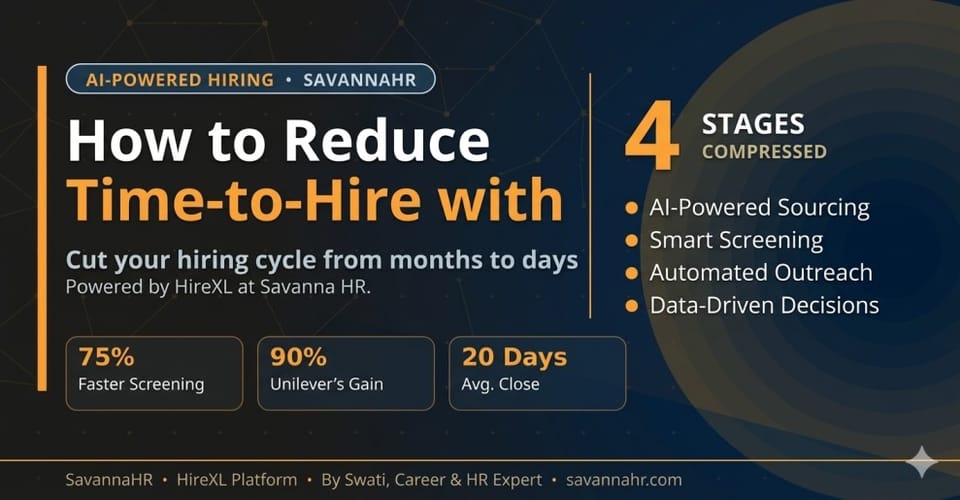
Here’s a number that should make every hiring manager uncomfortable: the average time-to-fill across industries in 2026 is 63 to 68 days. For engineering roles, it stretches past 60. For executive positions, you’re looking at 90 to 120 days. In a market where your top candidate has three competing offers within a week, every extra day in your hiring cycle is a day you’re losing talent to someone faster.
Now consider this: organizations using AI-powered recruitment workflows are reporting 40–75% reductions in time-to-hire. Unilever slashed time-to-fill for entry-level roles by 90%. Korn Ferry saw a 50% increase in sourcing volume and a 66% decline in time-to-interview. These aren’t marginal improvements. They’re structural transformations of the entire hiring funnel.
The question isn’t whether AI can speed up hiring. The evidence is overwhelming. The question is where exactly in your workflow it creates the most leverage — and how to implement it without sacrificing quality for velocity. That’s the question we’ve spent the last several years answering at Savanna HR, powered by our AI-enabled recruiting platform, HireXL.
The Anatomy of a Slow Hire: Where Time Actually Goes
Before you can fix your hiring cycle, you need to understand where the time actually disappears. Most organizations think their bottleneck is interviews. It rarely is. When we audit hiring workflows for our clients at Savanna HR, the same pattern emerges almost every time:
Sourcing eats 30–40% of total cycle time. Recruiters spend hours manually searching job boards, LinkedIn, and internal databases, often duplicating effort because there’s no single intelligent system connecting the dots across talent pools.
Screening is the silent killer. A single mid-level role can attract 250 to 500 applications. Without AI, a recruiter spends an average of 6–7 seconds per resume in a manual first pass — barely enough to read a name and a job title — and still burns 15–20 hours just on initial review.
Outreach and scheduling create invisible delays. The average back-and-forth to schedule a single interview is 4–7 emails. Multiply that by five interview rounds with four panellists each, and you’ve added two to three weeks of pure administrative friction.
Decision-making stalls at the final mile. Hiring managers sit on feedback for days. Competing priorities push debrief meetings out. The candidate who was your first choice last Monday has accepted another offer by Friday.
Each of these stages is a compounding delay. A two-day slip in sourcing, a three-day slip in screening, a week lost in scheduling — and suddenly your 30-day target is a 65-day reality. The good news: AI can compress every single one of these stages. Here’s how.
Stage 1: AI-Powered Sourcing — From Weeks to Minutes
Traditional sourcing is linear: search a database, build a list, move to the next database, repeat. AI-powered sourcing is exponential. Modern AI sourcing tools have expanded candidate pools by an average of 340% while reducing sourcing time by 67%. They don’t just search for keywords — they understand skill adjacencies, career trajectories, and contextual relevance.
At Savanna HR, this is where HireXL fundamentally changes the game. HireXL’s AI engine sits on top of a deep, continuously enriched talent database — not just a static list of resumes, but a living ecosystem of candidate profiles mapped by skills, experience, industry context, and hiring history. When a new role opens, HireXL doesn’t start from scratch. It instantly surfaces pre-qualified candidates from our existing talent pool, cross-referencing against the role’s requirements with semantic matching that goes far beyond keyword filters.
The result: what used to take a sourcing team 5–7 days can now happen in minutes. One of our fast-growing tech clients identified over 100 qualified candidates within 90 minutes of posting a role through HireXL — candidates who would have taken a traditional recruiter days of manual searching to uncover.
Stage 2: Smart Screening — From Resume Avalanche to Curated Shortlist
Screening is where most hiring processes quietly break down. The volume is simply unmanageable by human effort alone. AI-powered screening tools reduce initial review time by up to 75% while simultaneously improving match accuracy — a rare case where faster also means better.
HireXL’s screening engine processes thousands of profiles in minutes, applying structured, skill-first criteria that eliminate the unconscious filters humans bring to a first pass. It doesn’t care about university prestige or resume formatting. It evaluates what matters: relevant skills, depth of experience, career progression, and alignment with the specific requirements of the role.
But here’s what makes HireXL different from a generic ATS: the power to decide always stays with our recruitment team. HireXL surfaces the signal — the ranked shortlist, the skill-gap analysis, the compatibility scores — and our recruiters apply the judgment. They assess cultural nuance, evaluate motivation, read between the lines of a career story. AI handles the volume; humans handle the verdict. That’s how you get speed without sacrificing quality.
Stage 3: Automated Outreach — From Cold Emails to Warm Conversations
Here’s a data point that should reshape how you think about candidate outreach: AI-personalized messages achieve open rates of 40–50%, compared to 20–25% for generic recruiter emails. That’s not a marginal improvement — it’s the difference between a pipeline that moves and one that stalls.
Speed in outreach isn’t just about sending messages faster. It’s about reaching the right candidates with the right message at the right time. HireXL automates personalized outreach at scale — tailoring messaging based on the candidate’s profile, career interests, and even the timing patterns that data shows maximize response rates. Our recruiters aren’t spending hours crafting individual emails. They’re reviewing and refining AI-drafted communications that are already calibrated for relevance.
The downstream effect is dramatic. When candidates respond faster because the outreach resonated, the entire funnel accelerates. Interview scheduling that used to take a week of back-and-forth gets compressed through integrated calendar automation. The 4–7 email scheduling dance? It becomes a single click.
Stage 4: Data-Driven Decisions — From Gut Feel to Hiring Intelligence
The final-mile bottleneck — slow decision-making — is one of the hardest to solve because it’s human, not technical. But AI can make the human decision faster by giving decision-makers better information, sooner.
HireXL’s analytics dashboard gives our clients real-time visibility into their entire hiring pipeline: where candidates stand, how long each stage is taking, which roles are at risk of stalling, and how sourcing channels are performing. Instead of waiting for a weekly hiring meeting to surface problems, hiring managers can see the data live and act immediately.
This transparency alone has a compounding effect. When a CHRO can see that three senior roles have been stuck in “awaiting feedback” for five days, that’s a conversation that happens today — not next week. When a recruiter can show a hiring manager that three out of five shortlisted candidates have competing offers, the urgency becomes tangible. Data doesn’t just speed up decisions. It creates the conditions where fast decisions become the default.
The Compound Effect: What Happens When You Speed Up Every Stage
Each stage improvement is valuable on its own. But the real transformation happens when you compress every stage simultaneously. Here’s what the data shows across organizations that have fully integrated AI into their hiring workflow:
75% reduction in time spent on resume screening
67% reduction in sourcing time with 340% larger candidate pools
40–50% higher outreach open rates with AI-personalized messaging
30–50% faster overall time-to-hire, with high-volume programs reaching 75%
30–40% drop in cost-per-hire
At Savanna HR, we’re seeing these numbers play out in practice. Clients who previously operated on 60+ day hiring cycles are closing roles in 15–25 days — not by cutting corners, but by eliminating the dead time that was hiding in their process all along. The sourcing that used to take a week happens in an hour. The screening that buried recruiters for days happens in minutes. The scheduling friction that added two weeks of drift disappears entirely.
What This Means If You’re a Job Seeker
If you’re on the other side of this equation — looking for your next role — the acceleration of hiring cycles changes the game for you too. Companies using AI are moving faster than ever, which means the window between applying and hearing back is shrinking. But it also means you need to be sharper. Your resume needs to be skills-focused, not jargon-heavy. Your LinkedIn needs to tell a coherent career story, not just list titles. And when outreach comes, you need to respond quickly — because the company that’s using AI to find you is also using AI to find ten other candidates just like you.
The silver lining: AI-driven hiring platforms like HireXL are actually better at recognizing non-traditional backgrounds and transferable skills than human-only screening. If you’ve been overlooked in the past because your resume didn’t fit a narrow template, AI might be the thing that finally gets you seen.
The Speed Advantage Is Now a Survival Advantage
In 2026, time-to-hire isn’t just an efficiency metric. It’s a competitive weapon. The companies that fill critical roles in three weeks while their competitors are still in first-round screens are the companies that ship products faster, enter markets sooner, and build the teams that define their next decade.
At Savanna HR, powered by HireXL, we’ve built a hiring engine that combines AI speed with human judgment. A deep, intelligent talent database. AI-powered sourcing, screening, and outreach. And a team of recruiters who know that the best hire isn’t just the fastest hire — it’s the right hire, made faster.
Your next great hire doesn’t need to take 68 days. Let’s talk about making it happen in under 20.