
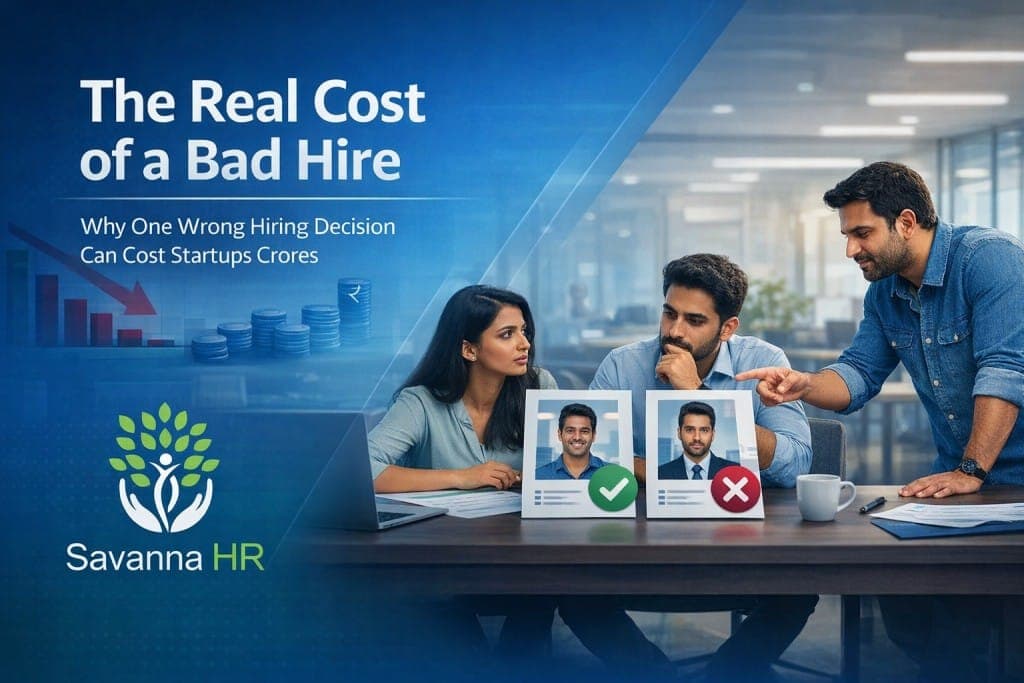
The Hire That Nearly Killed a Startup
In early 2024, a Bangalore-based SaaS startup raised its Series A round of 12 crore rupees with ambitious plans to triple its engineering team and launch in three new markets. The founding team, flush with capital and optimism, moved quickly to hire a VP of Engineering to lead the expansion. They found someone with an impressive resume, a stint at a well-known multinational, strong references, and the confident demeanor of a seasoned leader. Within six months, the company had lost four of its original eight engineers, the product roadmap was in disarray, and the founders were conducting an emergency search for a replacement. The total cost, including the salary paid, the lost productivity, the severance, the re-hiring expenses, and the delayed product launch, exceeded 85 lakh rupees, nearly seven percent of the total funding round.
This story is not unusual. It is, in fact, depressingly common in India's startup ecosystem. According to a 2025 survey by the Confederation of Indian Industry, 74 percent of Indian employers admit to having made at least one significant hiring mistake in the past year, and the average cost of a bad hire at the mid-to-senior level ranges from three to five times the person's annual salary when all direct and indirect costs are accounted for. For a startup operating with limited runway, a single bad hire can be an existential threat, not merely an inconvenience.
Yet despite the staggering financial and organizational toll, most startups continue to hire reactively, relying on gut instinct, network referrals, and compressed timelines that leave little room for the kind of rigorous evaluation that could prevent costly mistakes. This article examines the true cost of a bad hire in the Indian startup context, explores the root causes of hiring failures, and provides a research-backed framework for reducing the risk.
74%
Indian employers made a bad hire last year
3-5x
Annual salary: true cost of a bad hire
85L+
Avg. senior-level bad hire cost
Quantifying the Damage: Direct Financial Costs
The most visible cost of a bad hire is the direct financial outlay: the salary, benefits, and bonuses paid to someone who ultimately did not work out. But this is only the tip of the iceberg. According to the Society for Human Resource Management, the average cost-per-hire in India for a mid-level role is approximately 3.5 lakh rupees when you factor in job advertising, recruiter fees, assessment tools, interview time, and onboarding expenses. For senior roles that require executive search firms, this figure can easily reach 8 to 12 lakh rupees.
When a bad hire is terminated or resigns, these costs are effectively written off. But the financial damage does not stop there. There is the cost of the replacement search, which starts the entire spending cycle again, often at a premium because the role now needs to be filled urgently. There is the cost of any projects that were delayed, derailed, or delivered poorly under the bad hire's tenure. And there are often legal and severance costs, particularly for senior hires with contractual notice periods and negotiated exit packages.
For an Indian startup with an annual payroll budget of 2 crore rupees, a single bad hire at the senior level can consume 10 to 15 percent of total people costs, a devastating blow to a company where every rupee of runway matters. When you consider that the average Indian startup makes its first profitable hire only
after 2.3 attempts at filling a given role, the cumulative cost of hiring mistakes across the organization can easily run into crores.
Financial Reality Check: A bad hire at a CTC of 25 LPA actually costs the startup between 75 LPA and 1.25 crore when you account for lost productivity, team disruption, rehiring costs, and delayed milestones.
The Hidden Costs Nobody Calculates
Team Morale and Attrition
Perhaps the most damaging consequence of a bad hire is its impact on the existing team. When a new hire is clearly not performing or is creating friction, the burden inevitably falls on colleagues who must compensate for the gaps. This leads to burnout, resentment, and ultimately attrition among the very people you most need to retain. Research from the Harvard Business School shows that a toxic hire,
defined as someone who engages in behavior harmful to the organization, increases the likelihood of nearby employees quitting by 54 percent. In the Indian startup context, where team sizes are small and relationships are close, the departure of even one trusted team member triggered by a bad hire can create a cascading exodus.
The morale impact extends beyond the immediate team. When employees see poor hiring decisions going uncorrected, or when they observe that the company's stated values are not reflected in its hiring choices, it erodes trust in leadership. In a startup, where the founder's judgment is the primary currency of organizational credibility, a pattern of bad hires can fatally undermine the culture that attracted the early team in the first place.
Customer Impact and Revenue Loss
Bad hires in customer-facing roles create damage that extends far beyond the organization. A poorly performing sales hire may promise features the product cannot deliver, damaging client relationships that took months to build. A struggling customer success manager may fail to catch early warning signs of
Financial Reality Check: A bad hire at a CTC of 25 LPA actually costs the startup between 75 LPA and 1.25 crore when you account for lost productivity, team disruption, rehiring costs, and delayed milestones. churn, leading to the loss of accounts that represent significant recurring revenue. In India's startup
ecosystem, where most companies are building in concentrated verticals like fintech, healthtech, or SaaS, reputation travels fast. A single bad experience with a poorly placed employee can close doors across an entire industry network.
For B2B startups, the numbers are particularly stark. Losing a single enterprise client due to poor service or missed commitments can represent 10 to 20 percent of annual revenue for a company at the 5 to 10 crore ARR stage. When traced back to a hiring decision, this makes the cost-of-bad-hire calculation almost inconceivably expensive.
Opportunity Cost and Competitive Disadvantage
Every month that a critical role is filled by the wrong person is a month of lost progress. While your company struggles with internal dysfunction, competitors are executing, shipping features, closing deals, and consolidating market positions. In India's hyperpetitive startup landscape, where multiple companies are often pursuing the same opportunity simultaneously, the opportunity cost of a bad hire can be the difference between market leadership and irrelevance.
Consider a product lead who spends six months taking the product in the wrong direction before being replaced. The company does not just lose six months of salary; it loses six months of market learning, six months of potential competitive advantage, and potentially the confidence of investors who were expecting specific milestones. In the worst cases, a bad hire in a leadership position can cause a startup to miss its window of opportunity entirely.
Why Startups Keep Making the Same Mistakes
Speed Over Rigor
The most common root cause of bad hires in startups is the prioritization of speed over rigor. Founders are under constant pressure from investors, from the market, from their own ambitions to scale quickly. When a critical role is open, the temptation to fill it with the first plausible candidate is overwhelming. Structured interview processes, work sample assessments, and reference checks feel like luxuries that a fast-moving startup cannot afford. But the data tells us the opposite: companies that invest an extra two to three weeks in a rigorous evaluation process have 40 percent fewer early-stage departures, according
to research from Leadership IQ.
The Halo Effect
Another pervasive problem is the halo effect, the cognitive bias that causes interviewers to assume that someone who excels in one area must be equally strong in others. A candidate with a prestigious employer on their resume, a degree from an elite institution, or a charismatic interview presence may be
assumed to possess skills and qualities that have never been verified. In India, where brand affinity is particularly strong, the halo effect associated with names like Google, McKinsey, or IIT can be almost irresistible. But a great pedigree does not guarantee a great fit, particularly in the fundamentally differentenvironment of an early-stage startup.
Unclear Role Definition
Many bad hires are not actually bad employees; they are good employees placed in poorly defined roles. When a startup does not have a clear understanding of what it needs, the resulting ambiguity creates a situation where almost anyone will fail. The job description may be vague, the success metrics undefined, and the reporting relationships confused. The new hire arrives to discover that the role they were sold bears little resemblance to the role as it actually exists, leading to disillusionment, underperformance, and eventual separation. The responsibility for this failure lies with the organization, not the individual.
Founder Overconfidence
Many first-time founders overestimate their ability to evaluate talent, particularly for roles outside their area of expertise. A technical founder hiring their first head of sales, or a sales-oriented founder hiring their first CTO, is operating in largely unfamiliar territory. Without the domain knowledge to ask the right questions, assess the quality of answers, or calibrate against a meaningful benchmark, these hiring decisions become educated guesses at best. The result is a disproportionate number of misfires in exactly the roles that matter most for the company's growth.
Building a Hiring Process That Reduces Risk
The good news is that bad hires are largely preventable. Research consistently shows that structured, evidence-based hiring processes dramatically reduce the rate of hiring failures. Here is a framework designed specifically for the constraints and realities of Indian startups.
| Step 1: Define the Role Before You Post It
Before writing a single line of the job description, conduct a role definition exercise with all stakeholders. What are the three to five most critical outcomes this person must deliver in their first year? What skills and experiences are genuinely non-negotiable versus merely preferred? What does the role look like in six months, twelve months, and two years? What organizational context will this person be operating in, and what support systems will be available? This exercise typically takes two to three hours but can save months of wasted time and lakhs of rupees in avoided mistakes.
| Step 2: Use Structured Interviews
Unstructured interviews, the free-flowing conversations that most hiring managers default to, are among the worst predictors of job performance, with a validity coefficient of just 0.20. Structured interviews, where every candidate is asked the same predetermined questions and evaluated against a consistent scoring rubric, have a validity of 0.51, making them more than twice as effective. Implement a structured interview framework that includes behavioral questions tied to your critical outcomes, a consistent rating scale, and independent scoring by each interviewer before any group discussion. This removes much of the subjectivity and bias that leads to bad hiring decisions.
| Step 3: Incorporate Work Sample Tests
The single best predictor of future job performance is a work sample test, a practical exercise that simulates the actual work the person will be doing. For engineers, this might be a take-home coding challenge or a pair programming session. For product managers, it could be a product teardown or a roadmap prioritization exercise. For sales roles, a mock customer presentation. Work samples have a validity coefficient of 0.54, the highest of any single assessment method. They also give candidates a realistic preview of the work, which helps them self-select and reduces early-stage attrition.
| Step 4: Reference Checks That Actually Work
Most reference checks are performative exercises that yield little useful information, largely because companies contact only the references the candidate provides and ask generic questions. To make reference checks genuinely informative, request specific references such as a former direct report, a peer
from a cross-functional team, or a previous manager from a particular company. Ask pointed questions: What was this person's biggest area for development? If you were building a team today and needed someone for this specific role, would this person be in your top three choices? Why or why not?' The answers to these questions are far more revealing than the standard 'Would you rehire this person?'
which almost always gets an affirmative answer.
| Step 5: Invest in Onboarding
Even excellent hires can become bad hires if the onboarding experience is poor. Research from the Brandon Hall Group shows that companies with a structured onboarding program achieve 82 percent higher new hire retention and 70 percent higher productivity. For startups, this does not require an elaborate corporate onboarding program. It means having a clear 30-60-90 day plan, an assigned
onboarding buddy, regular check-ins during the first quarter, and explicit conversations about expectations and cultural norms. The investment is minimal; the return is enormous.
The Rule of Three: Never make a senior hire based on fewer than three independent data points. A great interview, a strong work sample, AND positive backchannel references together give you confidence. Any one of these alone is
insufficient.
When to Cut Your Losses
Despite your best efforts, some hires will not work out. When that happens, the single most expensive mistake you can make is delaying the decision to part ways. Research from Leadership IQ shows that 46 percent of new hires fail within 18 months, and managers typically recognize the problem within the first three months but wait an average of seven months before taking action. In startup terms, those four additional months of inaction represent significant lost runway, accumulated team damage, and compounding opportunity cost.
The best practice is to establish a 90-day evaluation checkpoint for every new hire, with clear performance metrics defined before the person starts. If someone is not meeting expectations at the 90-day mark, have a direct conversation about the gaps and create a 30-day improvement plan with specific, measurable targets. If there is no meaningful improvement by day 120, it is time to make the difficult
decision. This is not about being ruthless; it is about being honest. Prolonging a situation that is not working serves neither the company nor the individual, who deserves the opportunity to find a role where they can succeed.
The Bottom Line
A bad hire is not a single event; it is a cascading failure that compounds over time. The salary paid, the productivity lost, the team members who leave, the customers who churn, the milestones missed, and the competitive ground conceded all add up to a cost that dwarfs the original hiring investment. For Indian startups, where the margin for error is razor-thin and the competition for talent has never been
more intense, getting hiring right is not just a human resources function. It is a survival imperative.
The path to better hiring outcomes is not mysterious. It requires investing time in role definition, implementing structured evaluation processes, incorporating objective assessment methods, and building a culture where hiring decisions are made with the same rigor applied to product decisions or investment decisions. The startup that treats every hire as a strategic decision, rather than an operational task, will build the kind of team that can not only survive but thrive in India's increasingly demanding market.
Every great company is ultimately a collection of great hires. The cost of getting that wrong is measured not just in rupees but in the potential that was never realized. Make the investment in hiring well. The returns are compounded and permanent.
Related reading: Savanna HR startup hiring services · 5 Skills Making CFOs More Valuable in 2026, and How Indian Startups Should Hire Them · What CEOs Look for When Hiring a COO in 2026, and Why Talent Building Now Tops the List


