
The New Rules of the Indian Talent Market
The Indian hiring landscape in 2026 bears little resemblance to the market that existed even three years ago. The seismic shifts of the pandemic era, the subsequent correction, and the emergence of new economic forces have fundamentally altered the dynamics between employers and candidates, the skills that command premium compensation, the channels through which talent is discovered and engaged, and the expectations that professionals bring to their career decisions. For employers navigating this landscape, the old playbook is not just insufficient; it is actively counterproductive.
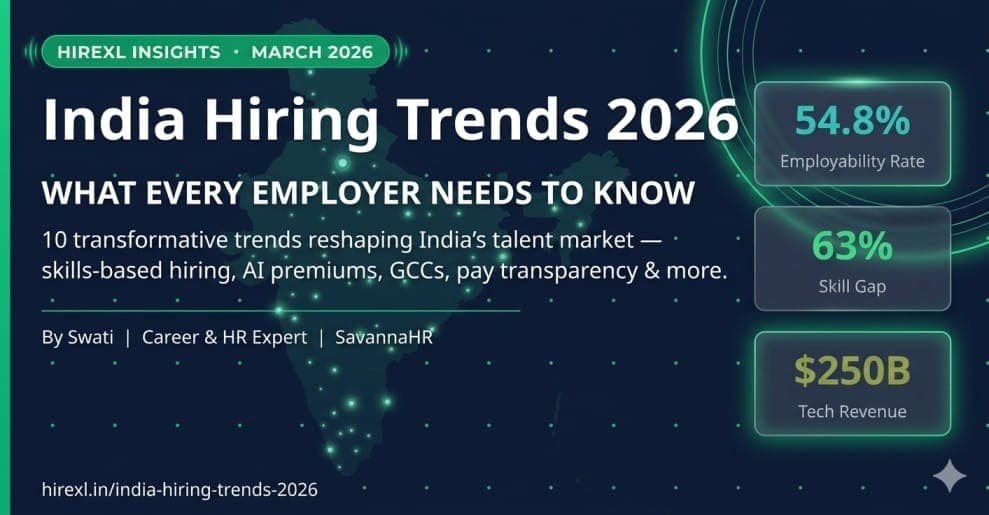
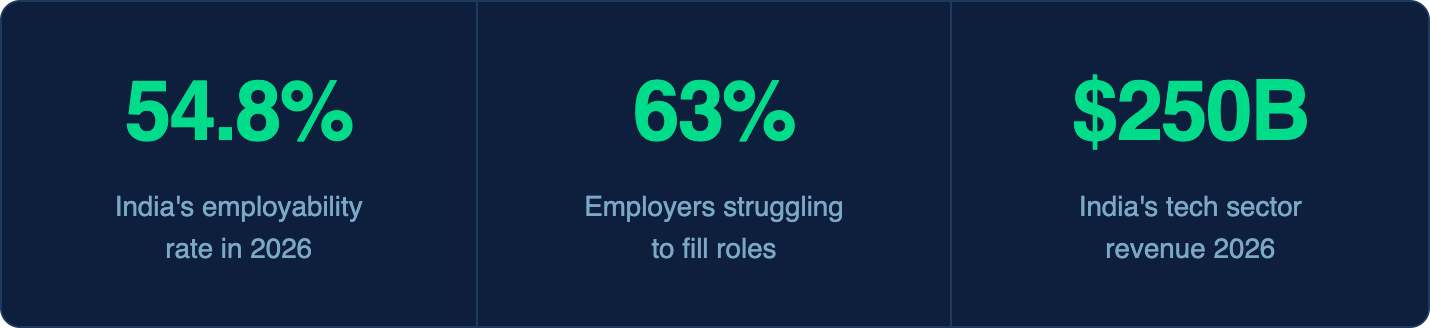
According to the India Skills Report 2026 published by Wheebox in partnership with CII and UNDP, India's overall employability rate has improved to 54.8 percent, the highest in five years, driven by improvements in digital literacy and the proliferation of skill-based certification programs. Yet paradoxically, 63 percent of Indian employers report difficulty filling critical roles, particularly in emerging technology domains. This coexistence of abundant talent supply and persistent skill shortages defines the central challenge of the 2026 hiring market: the problem is not a lack of people but a mismatch between the skills the market needs and the skills the workforce possesses.
This article examines the ten most significant hiring trends shaping the Indian market in 2026, providing employers with the insights they need to adapt their talent strategies to a landscape that is more competitive, more complex, and more candidate-driven than ever before. Each trend is grounded in data and accompanied by practical recommendations for how companies of different sizes and stages can respond.
Trend 1: The Skills-Based Hiring Revolution
The shift from credential-based to skills-based hiring has moved from theory to practice in 2026. A growing number of Indian employers, led by technology companies and progressive startups, are removing degree requirements from job postings, implementing skills assessments as the primary evaluation tool, and evaluating candidates based on demonstrated competencies rather than educational pedigree. According to LinkedIn India's hiring data, the number of job postings in India that do not require a specific degree increased by 36 percent between 2024 and 2026.
This shift is driven by both principle and pragmatism. The principle is that talent is distributed across the population in ways that do not correlate neatly with access to premium educational institutions. The pragmatism is that the demand for skills in areas like AI, cybersecurity, cloud computing, and data engineering far outstrips the supply from traditional degree programs, forcing employers to look beyond the usual talent pools. Companies like Zoho have pioneered this approach in India, building world-class products with teams drawn from their own training programs rather than from IITs and NITs, and their success is inspiring a broader rethinking of what qualifications actually matter.
Trend 2: AI Skills Premium and the Great Reskilling
The demand for AI and machine learning skills has created a two-tier labor market in Indian tech. Professionals with demonstrated expertise in large language models, generative AI, computer vision, and natural language processing command compensation premiums of 40 to 60 percent over comparably experienced engineers in traditional software development. Senior ML engineers with five or more years of experience are receiving offers of 40 to 60 lakh rupees at well-funded startups and GCCs, a level that would have been reserved for engineering directors just three years ago.
Simultaneously, a massive reskilling effort is underway across the industry. Companies are investing heavily in upskilling their existing workforce in AI and data skills, recognizing that hiring alone cannot close the gap. Infosys, TCS, and Wipro have each committed to reskilling over 100,000 employees in AI- related competencies by 2027. For employers, the implication is clear: a comprehensive talent strategy in 2026 must include both external hiring of AI specialists and internal development of AI capabilities within the existing workforce.
Trend 3: The GCC Talent Magnet
Global Capability Centers continue their dramatic expansion in India, with over 1,580 GCCs now operating across the country and new centers being established at a rate of approximately 50 per year. The combined GCC workforce exceeds 1.9 million professionals, and these centers have shifted from cost arbitrage operations to high-value innovation hubs that compete directly with India's best startups and product companies for top talent. The salary premiums offered by GCCs, particularly those of major technology, financial services, and consulting firms, have reshaped compensation benchmarks across the market, forcing startups and domestic companies to rethink their value propositions.
Trend 4: Tier-2 Cities as Talent Hubs
The geographic distribution of India's tech talent is shifting dramatically. Cities like Pune, Ahmedabad, Jaipur, Kochi, Chandigarh, Indore, Coimbatore, and Thiruvananthapuram are emerging as significant technology hubs, driven by a combination of remote work enablement, improving digital infrastructure, lower cost of living, and quality-of-life considerations that are increasingly important to tech professionals. According to Nasscom, tier-2 cities accounted for 18 percent of new tech job creation in 2025, up from 8 percent in 2020, and the trajectory is accelerating.
For employers, this geographic diversification creates both opportunities and challenges. The opportunity is access to talented professionals who are available at lower compensation levels than their metro counterparts and who are often more loyal due to fewer competing options. The challenge is building the management practices, communication infrastructure, and cultural cohesion needed to effectively manage distributed teams across multiple cities. Companies that invest in building distributed work capabilities now will have a structural advantage as this trend continues to accelerate.
Trend 5: The Return-to-Work Talent Pool
One of the most underutilized talent pools in India is the cohort of experienced professionals, predominantly women, who have taken career breaks and are seeking to re-enter the workforce. Nasscom estimates that over 2 million skilled women professionals left the Indian tech workforce between 2020 and 2024 for reasons including caregiving, relocation, and health, and a significant majority are interested in returning to professional roles. Companies like Tata Group, HCL, and Thoughtworks have launched dedicated returnship programs that provide structured re-entry pathways, and the results have been consistently positive: returnees typically reach full productivity within three to six months and demonstrate above-average retention rates.
For startups and mid-size companies, tapping this talent pool can be a competitive advantage. Return-to- work professionals bring years of relevant experience, mature judgment, and strong work ethic, often at compensation levels that reflect their career gap rather than their actual capabilities. Building a returnship program does not require massive investment; it requires a willingness to evaluate candidates on skills rather than resume continuity, flexibility in work arrangements, and a supportive onboarding process that accounts for the unique needs of professionals who have been away from the workforce.
Trend 6: Employee Experience as Competitive Advantage
The concept of employee experience, the sum total of every interaction an employee has with their employer, has moved from an HR buzzword to a genuine strategic priority for Indian companies in 2026. This shift is driven by the tight correlation between employee experience and business outcomes: companies in the top quartile of employee experience metrics report 25 percent higher productivity, 40 percent lower absenteeism, and 50 percent lower attrition than those in the bottom quartile, according to research from Gallup adapted for the Indian market.
Practically, this means that companies are investing in every stage of the employee lifecycle with the same attention to user experience that they bring to their customer-facing products. This includes redesigned onboarding processes, continuous feedback systems, flexible benefit platforms that allow employees to customize their compensation mix, and digital tools that reduce administrative friction. For startups, where the employee experience is often an afterthought, investing in these fundamentals can be a surprisingly effective differentiator in the talent market.
Trend 7: Pay Transparency Goes Mainstream
Salary transparency, long the norm in Europe and increasingly common in the US, is gaining significant traction in India. A growing number of Indian job postings now include salary ranges, driven by a combination of candidate demand, platform requirements, and employer recognition that transparency improves application quality and reduces time-to-hire. Glassdoor India reports that job postings with salary information receive 30 percent more applications, and the candidates who apply are more likely to be within the company's target experience range, reducing the time spent on mismatched candidates.
Trend 8: Employer Branding Through Content
Content marketing as an employer branding tool has evolved from a nice-to-have to a competitive necessity. The most effective employers in India's talent market are those that produce a consistent stream of content that gives potential candidates an authentic view of the company culture, the technical challenges they would work on, and the career growth opportunities available. Engineering blogs, behind- the-scenes social media content, employee spotlight features, and thought leadership from company leaders all contribute to an employer brand that attracts talent passively, reducing dependence on expensive job advertising and recruiter outreach.
Trend 9: The Compliance Complexity
India's evolving labor regulatory landscape is adding complexity to hiring and employment practices. The implementation of new Labour Codes, changes to PF and ESI thresholds, evolving regulations around gig and platform workers, and increasing scrutiny of independent contractor classifications are all creating compliance challenges that require professional expertise. Companies that build compliance capability proactively, whether through internal expertise or external advisory relationships, will avoid the costly penalties and reputational damage that catch unprepared employers off guard.
Trend 10: Data-Driven Talent Decisions
The most sophisticated employers in India are treating talent acquisition as a data science discipline. They are tracking metrics like source effectiveness, stage-by-stage conversion rates, time-to-productivity, quality of hire, and cost-per-hire with the same rigor they apply to product metrics and marketing attribution. This data-driven approach enables continuous optimization of the hiring process, evidence- based investment decisions about where to allocate recruiting resources, and predictive capabilities that allow companies to anticipate talent needs before they become urgent vacancies.
For companies that have not yet built this capability, the starting point is simple: instrument your applicant tracking system to capture data at every stage of the funnel, establish baseline metrics, and begin the iterative process of testing and learning that will improve your hiring outcomes over time. The companies with the best hiring data make the best hiring decisions, and the gap between data-driven and intuition- driven employers is widening rapidly.
The Bottom Line
The Indian hiring market in 2026 rewards adaptability, authenticity, and strategic thinking. The companies that will win the talent wars are those that understand these trends not as abstract concepts but as practical imperatives that demand specific actions. Skills-based hiring, AI reskilling, geographic diversification, employee experience investment, pay transparency, and data-driven decision-making are not optional innovations; they are the table stakes for competing in a talent market that has permanently shifted in favor of candidates who know their worth and have the options to command it.
The good news is that these trends create opportunities for companies of every size. Startups that cannot compete on compensation can compete on flexibility, impact, and growth. Mid-size companies that cannot match GCC brand recognition can differentiate through culture and employee experience. And forward-thinking employers that embrace these trends ahead of their competitors will build the teams that define India's next decade of economic growth.
Sources & References
- India Skills Report 2026 - Wheebox, CII, UNDP
- Nasscom India Tech Sector Report 2026
- LinkedIn India Hiring Trends Data 2026
- Gallup India Employee Experience Research
- Glassdoor India Pay Transparency Impact Study
- EY India GCC Report 2025-2026
- NITI Aayog India Labour Market Report


