
The Founding Team Challenge
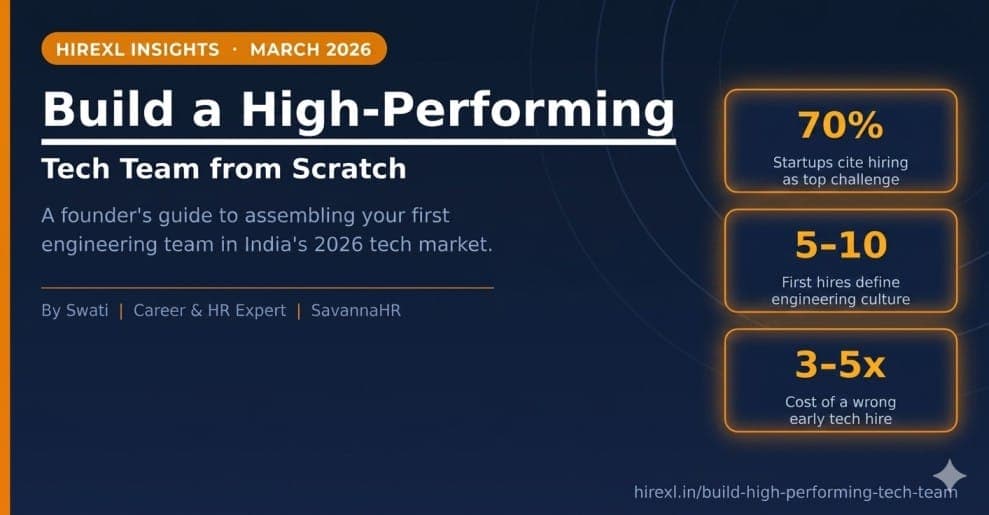
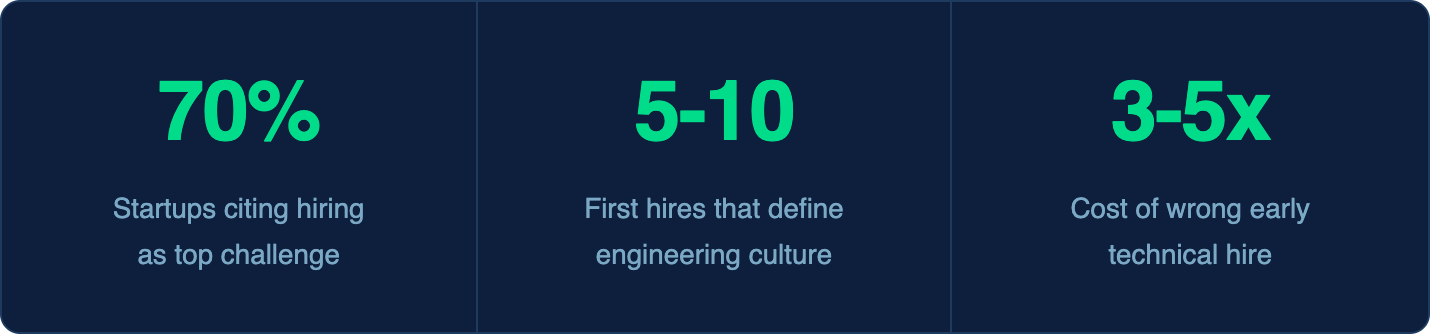
Every successful technology company begins with the same pivotal challenge: assembling the founding engineering team that will translate a vision into a product. This challenge is uniquely high-stakes because the first five to ten technical hires define not just what the company builds, but how it builds, the engineering culture it develops, the technical architecture it adopts, and the talent brand it projects to future candidates. According to data from Y Combinator, the quality of the founding engineering team is the single strongest predictor of startup success after product-market fit, more predictive than the business model, the market size, or even the founding team's prior experience.
In India's competitive 2026 tech market, building this team is both easier and harder than it has ever been. Easier because the talent pool is vast and growing: India produces over 1.5 million engineering graduates annually, has a mature ecosystem of experienced professionals across every technology domain, and benefits from a diaspora of globally experienced engineers who are increasingly returning to build companies at home. Harder because the competition for the best talent is fierce, with Global Capability Centers offering compensation packages that match or exceed Silicon Valley levels, established startups offering proven equity upside, and the sheer volume of new ventures competing for a finite pool of exceptional engineers.
This guide provides a comprehensive framework for founders and early-stage CTOs who are building their first engineering team in India. Drawing on research, interviews with successful founders, and data from HireXL and other platforms, we will cover everything from defining your technical hiring strategy and identifying the right profiles for your stage, to structuring compensation, building culture, and scaling from a founding team to a full engineering organization. Whether you are a technical founder hiring your first engineer or a non-technical founder building your entire technical capability from scratch, the principles and practices in this guide will help you make the decisions that determine your company's technical trajectory.
Defining Your Technical Hiring Strategy
| Start with Architecture, Not Job Descriptions
Before you write a single job description, you need to make fundamental decisions about your technical architecture, because these decisions determine what kinds of engineers you need. Are you building a monolithic application or a microservices architecture? Are you deploying on AWS, GCP, or Azure? Are you using React, Flutter, or native mobile development? Is your data infrastructure batch-oriented or real- time? Each of these choices implies different skill requirements, different team structures, and different hiring priorities.
For most early-stage Indian startups, the optimal approach is to start with a pragmatic, monolithic architecture using well-established technologies where the talent pool is deep and accessible. A Python or Node.js backend with a React frontend, deployed on AWS or GCP, gives you access to the largest possible pool of qualified engineers and avoids the operational complexity of microservices that is unnecessary before you have achieved product-market fit. You can always re-architect later; what you cannot recover from is spending your first six months searching for specialists in niche technologies when you should be shipping product.
| The Ideal Early-Stage Team Composition
Your first five engineering hires should collectively cover the full spectrum of capabilities needed to build, deploy, and maintain your product independently. The ideal composition varies by product type, but for a typical B2B SaaS startup in India, the following structure provides a strong foundation: one senior full- stack engineer who can serve as your technical anchor and make architectural decisions; one strong backend engineer with experience in your primary server-side technology and database design; one frontend engineer with deep expertise in your chosen UI framework and a strong sense of user experience; one engineer with DevOps and infrastructure capabilities who can set up CI/CD pipelines, monitoring, and deployment automation; and one versatile generalist who can move between frontend, backend, and data work as priorities shift.
Notice that this composition emphasizes versatility over specialization. At the early stage, the ability to wear multiple hats and move quickly across different parts of the stack is more valuable than deep expertise in any single domain. As the team grows beyond ten people, you will naturally move toward more specialized roles, but premature specialization in a five-person team creates bottlenecks and dependencies that slow you down. The exception is if your product has a genuinely specialized core, such as machine learning, computer vision, or blockchain, in which case you need at least one deep domain expert from the beginning.
Finding and Attracting Early-Stage Talent
| The Referral-First Approach
For your first five hires, your personal and professional network should be your primary sourcing channel. Referral hires at the early stage are not just faster and cheaper to make; they come with a level of trust and mutual knowledge that is critically important when you are building a team that will work in close collaboration under uncertain conditions. The people who join a startup in its first year are making a bet on the founders as much as on the product, and that bet is much easier to make when there is an existing relationship.
If your direct network does not include enough potential candidates, extend your reach through your investors, advisors, and existing team members. Most experienced VCs in India maintain extensive networks of engineers they have worked with across portfolio companies, and a warm introduction from a respected investor carries significant weight. Similarly, each person you hire expands your recruiting surface area: a single strong engineer with a broad professional network can generate three to five qualified referrals for subsequent positions. The compounding effect of referral networks is why the best founding teams often come together very quickly once the first two or three hires are made.
| Selling the Startup Opportunity
Convincing talented engineers to leave stable, well-paying positions at established companies to join an early-stage startup requires a compelling and honest pitch. The key is to understand what motivates engineers who are genuinely interested in the startup path and to speak directly to those motivations. For most engineers considering an early-stage move, the primary drivers are the opportunity to build something from scratch with significant ownership and autonomy, the accelerated learning that comes from working across the full stack in a small team, and the potential financial upside from equity in a company they are helping to build from the ground up.
Be specific and concrete in your pitch. Instead of generic promises about 'the ground floor of something big,' show candidates the actual technical challenges they will solve, the specific product decisions they will influence, and the career trajectory that is possible if the company succeeds. Share your fundraising status, your runway, your customer traction, and your go-to-market strategy with transparency. The best early-stage candidates are sophisticated enough to evaluate these factors, and they will respect honesty about both the opportunity and the risks far more than they will respect empty hype.
| Compensation Strategy for Early-Stage Hiring
Early-stage startups in India typically cannot match the base salary packages offered by established companies, particularly GCCs and well-funded late-stage startups. This does not mean you cannot attract top talent, but it does mean you need to construct compensation packages that are competitive on total value even if the cash component is below market. The standard approach combines a base salary that is 15 to 25 percent below the candidate's market rate with a meaningful equity grant that has the potential to significantly exceed the cash gap if the company succeeds.
For equity allocation, a common framework for Indian startups is to reserve 10 to 15 percent of the total equity pool for the employee stock option plan, with the first five engineering hires typically receiving 0.5 to 2 percent each depending on seniority and the stage of the company. These grants should vest over four years with a one-year cliff, which is now the standard structure in the Indian startup ecosystem. Be transparent about the current valuation, the total pool size, and the dilution implications of future funding rounds. Engineers who understand equity will evaluate your offer based on the potential value at exit scenarios, so provide realistic models that show what their grant could be worth at different outcomes. Beyond base salary and equity, consider offering benefits that have high perceived value relative to their cost: comprehensive health insurance covering the employee's family, a generous learning and development budget, modern equipment of their choice, flexible work arrangements, and a reasonable paid time off policy. These benefits signal that the company values its people and create a total package that is competitive even when the base salary is not at the top of the range.
Building Engineering Culture from Day One
| Technical Practices That Scale
The engineering practices you establish in your first six months will persist for years, so invest in getting the fundamentals right from the beginning. This means implementing code review processes from your very first pull request, writing automated tests from the first feature, setting up CI/CD pipelines before you have a production deployment, and establishing coding standards and documentation practices that will serve you as the team grows. It is dramatically easier to maintain good practices than to retrofit them into a codebase and culture that has grown without them.
The specific practices matter less than the principle of intentionality. Whether you use trunk-based development or feature branches, Scrum or Kanban, monorepo or polyrepo, the key is to make a conscious decision, document it, and apply it consistently. The worst outcome is an absence of shared practices where each engineer operates according to their own preferences, which creates a codebase that is inconsistent, difficult to maintain, and resistant to onboarding new team members. Your first engineers set the technical standard; make sure they set a high one.
| Communication and Decision-Making Norms
In a small team, communication norms emerge organically, but the patterns that emerge are not always healthy or scalable. Establish explicit norms around how technical decisions are made and documented, how disagreements are resolved, how work is prioritized and assigned, and how knowledge is shared across the team. A decision-making framework that works well for early-stage teams is to assign clear ownership for each technical domain to a specific engineer who has the authority to make decisions within that domain, while requiring consultation with the broader team for decisions that have cross- cutting implications.
Create a culture of written communication from the beginning. Design documents, architecture decision records, incident post-mortems, and sprint retrospective notes create an institutional memory that is invaluable as the team grows. When new engineers join, they can read the history of technical decisions and understand not just what was decided but why, which accelerates their onboarding and reduces the knowledge bottleneck that forms when context lives only in people's heads.
Scaling from Founding Team to Engineering Organization
| The First Engineering Manager
One of the most consequential decisions in a growing startup is when and how to introduce the first engineering management layer. Most startups reach this inflection point when the team grows to between eight and twelve engineers, at which point the founding CTO or technical lead can no longer effectively manage every individual while also contributing to architecture and technical direction. The decision of whether to promote from within or hire externally, and how to structure the management layer, will significantly impact team dynamics and culture.
Promoting a strong founding engineer into a management role has the advantage of continuity and credibility, but it requires ensuring that the individual genuinely wants to manage people, not just that they are the most senior engineer available. Many excellent engineers are poor managers and vice versa, and forcing someone into a management role they did not choose creates a frustrated manager and a team that is poorly served. If you promote from within, invest in management training and coaching, and create a clear path for the individual to return to an individual contributor role if they discover that management is not the right fit.
| Maintaining Culture Through Growth
The engineering culture you built with your founding team will be tested and potentially diluted with every batch of new hires. Protecting and evolving that culture as you scale requires intentional effort on several fronts. First, involve your founding engineers deeply in the hiring process for new team members: they are the best judges of cultural fit and technical standards because they embody the culture you are trying to preserve. Second, document your engineering values and practices explicitly, so that they can be communicated to new hires during onboarding rather than transmitted only through osmosis. Third, maintain the rituals and practices that define your culture, whether that is weekly architecture reviews, pair programming sessions, or team demo days, even as the logistics become more complex with a larger team.
Expect and embrace the evolution of your culture as new people bring new perspectives. The goal is not to preserve the founding team's culture in amber but to maintain the core values, such as technical excellence, collaboration, and ownership, while allowing the expression of those values to evolve as the team diversifies. The startups that successfully scale their engineering culture are those that distinguish between principles and practices: principles are non-negotiable, while practices can and should adapt to the needs and preferences of a growing, diverse team.
Common Mistakes and How to Avoid Them
The most common mistake founders make when building their first engineering team is hiring for skills rather than for learning ability and cultural alignment. At the early stage, the specific technical challenges your team will face are unpredictable, and the technologies you use today may not be the technologies you use in twelve months. An engineer who is deeply experienced in your current stack but resistant to change and learning is a worse hire than one who is slightly less experienced but demonstrates a pattern of rapidly mastering new technologies and thriving in ambiguous environments.
The second most common mistake is delaying the first hire while searching for the perfect candidate. The perfect candidate does not exist, and every week you spend searching is a week you are not building product. Define a clear 'good enough' threshold for each role, set a deadline for making a decision, and hire the best available candidate who meets your threshold. You can always upgrade talent as the company grows and your employer brand strengthens; what you cannot do is recover the time lost to indecision during the critical early months.
The third mistake is under-investing in onboarding. When you are moving fast and the team is small, it is tempting to expect new hires to figure things out on their own. But even experienced engineers need structured onboarding to understand your codebase, your product, your customers, and your team's way of working. A two-week onboarding program that includes pair programming with each team member, a walkthrough of the architecture and codebase, introductions to key stakeholders, and a small but complete first project will dramatically accelerate time-to-productivity and set the new hire up for success.
The Bottom Line
Building a high-performing tech team from scratch is one of the most challenging and consequential tasks a startup founder faces. The decisions you make about who to hire, how to compensate them, what culture to build, and how to scale will shape your company's trajectory for years to come. There are no shortcuts and no formulas, but there are principles that consistently produce strong outcomes: hire for learning ability and cultural alignment, invest in the practices and infrastructure that enable sustainable high performance, compensate fairly and transparently, and build a culture where talented people want to stay and grow.
The Indian tech ecosystem in 2026 offers an extraordinary opportunity for founders who approach team building with intentionality and rigor. The talent is there, the market conditions support startup careers, and the infrastructure for building distributed, high-performing teams has never been better. What separates the startups that build exceptional engineering teams from those that struggle with perpetual hiring challenges is not luck or resources; it is the strategic approach to every aspect of the team-building process, from the first hire to the hundredth. Start with a clear vision of the team you want to build, and make every decision in service of that vision.
Sources & References
- Y Combinator - Startup Success Factor Analysis
- NASSCOM India Tech Talent Report 2025
- HireXL - Early-Stage Startup Hiring Data
- First Round Capital - State of Startups Survey
- Stripe Atlas - Technical Hiring for Founders Guide
- ThoughtWorks India - Engineering Culture Research
- LinkedIn India - Tech Talent Migration Trends 2025


