How to Ace Your First 90 Days at a Startup: A Practical Roadmap
The Make-or-Break Window
Your first 90 days at a startup are the most consequential period of your entire tenure. They are the window in which you establish your credibility, build the relationships that will define your daily work experience, develop the organizational context needed to make good decisions, and create the momentum that will carry you through the months and years ahead. Get these 90 days right, and you set yourself up for accelerated growth, expanded responsibility, and the kind of outsized impact that drew you to startup life in the first place. Get them wrong, and you may find yourself struggling to recover from first impressions that are remarkably difficult to change.
The stakes are particularly high at a startup because the environment is unforgiving in ways that larger organizations are not. There is no established onboarding program to hold your hand. There are no redundant colleagues who can absorb your learning curve while you find your footing. And the expectation, whether stated or implied, is that you will be contributing meaningfully from very early on. According to data from LinkedIn's Workforce Learning Report, 22 percent of startup employees who leave within the first year cite 'unclear expectations and insufficient onboarding' as the primary reason. This is not a reflection of the employees' capabilities; it is a consequence of the unstructured environment that most startups provide to new hires.
This guide provides a structured 90-day framework for startup employees at all levels, from individual contributors to senior leaders. It draws on research from organizational psychology, real-world experience from hundreds of startup transitions, and the specific dynamics of India's startup ecosystem. Following this framework will not guarantee success, but it will dramatically increase your odds of building the foundation for a rewarding and impactful startup career.
22%
Leave within year 1
due to poor onboarding
90 days
Window to establish
credibility
3x
Faster ramp with
structured approach
Before Day 1: The Preparation Phase
Your 90-day clock actually starts before your first day of work. The period between accepting the offer and your start date is valuable preparation time that most people waste on passive anticipation. Use it actively to build the context that will accelerate your first weeks.
Start by studying the company in depth. Read every available piece of content: the company blog, press coverage, founder interviews, product reviews, customer testimonials, and competitor analyses. Understand the company's position in the market, its key value propositions, and the challenges it faces. If the company has a public product, use it extensively. Sign up as a customer, go through the onboarding flow, test every feature, and note your impressions, both positive and critical. This firsthand product knowledge will give you immediate credibility and a foundation for meaningful contributions from day one.
Reach out to your future manager and ask for any pre-reading materials they would recommend: product documentation, technical architecture overviews, recent board decks, or team OKRs. Most managers will be impressed by the initiative and happy to share materials that will help you hit the ground running. If possible, also connect with one or two future colleagues for informal conversations about the team dynamic, current priorities, and the unwritten norms that every organization has but rarely documents. These conversations provide invaluable context that no amount of public research can replace.
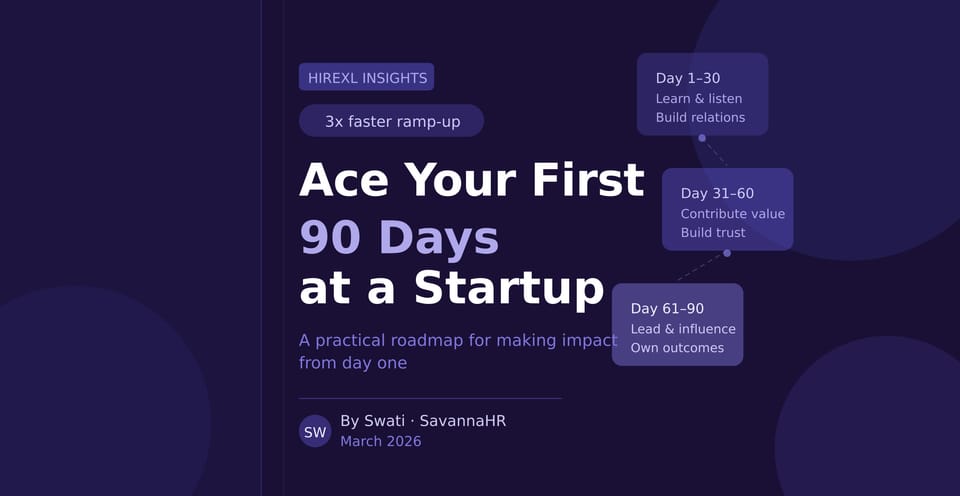
Days 1-30: Learn, Listen, and Build Relationships
| The Learning Imperative
Your primary objective during the first 30 days is learning, not contributing. This may feel counterintuitive in a startup environment where you are eager to prove your worth, but the research is clear: new hires who rush to make changes before understanding the context consistently underperform those who invest the first month in deep learning. The decisions you make in month one without adequate context are far more likely to be wrong than the decisions you make in month three with a thorough understanding of the organization, the product, and the people.
Create a personal learning plan organized around four dimensions: the product, meaning its features, its users, its strengths, and its weaknesses; the technology, meaning the architecture, the codebase, the infrastructure, and the technical debt; the people, meaning who does what, who makes decisions, who has influence, and how teams interact; and the business, meaning the revenue model, the unit economics, the growth metrics, and the competitive landscape. Schedule learning conversations with people across all these dimensions, not just within your immediate team. A 30-minute conversation with the head of customer success will teach you more about what customers actually need than a week of reading product documentation.
| The Relationship Foundation
The relationships you build in your first 30 days will shape your entire experience at the company. Prioritize one-on-one conversations with everyone you will work with closely: your direct manager, your teammates, your cross-functional counterparts, and key stakeholders for your role. These initial conversations should be primarily about listening, not selling yourself. Ask about their priorities, their challenges, their expectations for your role, and how they think you can be most helpful. Take notes and follow up on what you learn.
Pay particular attention to your relationship with your manager. Schedule a structured conversation in the first week to align on expectations: what does success look like at 30, 60, and 90 days? What are the most important priorities? How does your manager prefer to communicate, and how often do they want updates? What are the potential landmines or political sensitivities you should be aware of? Establishing this clarity early prevents the misaligned expectations that are the primary cause of early-stage frustration for both new hires and their managers.
| The First Win
While learning is the priority, you should also look for a small, tangible contribution you can make within the first two weeks. This is not about solving a major problem; it is about demonstrating initiative, capability, and a bias toward action. Fix a bug that has been lingering in the backlog. Write documentation for a process that exists in people's heads but nowhere else. Analyze a dataset that the team has been meaning to look at but hasn't found time for. The specific contribution matters less than the signal it sends: you are here, you are capable, and you are already adding value.
First 30 Days Mantra: 'Learn the system before you try to change it.' The changes you propose after deep understanding will be far more effective and far better received than those you propose from a position of ignorance, however well- intentioned.
Days 31-60: Contribute and Establish Your Value
| Moving from Observer to Contributor
By the end of your first month, you should have a solid understanding of the organizational context and be ready to shift from primarily learning to actively contributing. This transition should be gradual and deliberate. Begin by taking ownership of clearly defined tasks or projects that align with your role and that your manager has identified as priorities. Execute them with diligence, quality, and a bias toward asking for feedback rather than assuming you have gotten it right.
The key to this phase is demonstrating reliability. In a startup, where resources are stretched thin and everyone is counting on everyone else, the most valued quality in a new hire is not brilliance; it is dependability. Do what you say you will do, when you say you will do it. If something is going to be late, communicate proactively. If you encounter a blocker, escalate immediately rather than struggling in silence. If you make a mistake, own it openly and fix it quickly. These behaviors build trust faster than any technical achievement.
| Navigating the Startup Operating System
Every startup has an informal operating system, a set of unwritten rules about how decisions are made, how information flows, how conflicts are resolved, and how priorities are set. Understanding this operating system is essential to being effective, and it is almost never documented. By your second month, you should be developing a clear picture of how the organization actually works, as opposed to how the org chart says it works.
Pay attention to who is in the room when important decisions are made. Notice which communication channels are used for what, whether the real conversations happen in Slack, in meetings, or in informal sidebar discussions. Observe how disagreements are handled: does the loudest voice win, or does the best argument prevail? Understanding these dynamics allows you to navigate the organization effectively, influence decisions, and avoid the political missteps that can derail even the most capable new hire.
| Building Cross-Functional Relationships
In a startup, cross-functional collaboration is not a nice-to-have; it is how work gets done. By your second month, actively build relationships with people outside your immediate team. If you are an engineer, spend time with the product, design, and customer success teams. If you are in marketing, connect with sales, product, and engineering. These relationships serve a dual purpose: they give you a broader perspective on the business, which makes you a better decision-maker within your role, and they create the informal networks that you will rely on when you need to get things done across organizational boundaries.
Days 61-90: Lead, Influence, and Set Your Trajectory
| Taking Ownership of Meaningful Outcomes
By your third month, you should be transitioning from executing assigned tasks to owning meaningful outcomes. This means not just completing projects but identifying the projects that matter most, proposing solutions to problems you have observed, and taking initiative beyond your defined role. The shift from 'tell me what to do' to 'here is what I think we should do' is the defining transition of a successful 90-day period, and it is the signal that managers look for when evaluating whether a new hire is ready for expanded responsibility.
This does not mean unilaterally launching initiatives without alignment. It means bringing well-considered proposals to your manager and the broader team, informed by the organizational context you have built over the first two months. A proposal that says 'I have noticed that our deployment process takes three hours and involves six manual steps. Based on my experience with CI/CD automation, I believe we can reduce this to 30 minutes. Here is a plan' demonstrates initiative, expertise, and organizational awareness in a way that is impossible to ignore.
| The 90-Day Review Conversation
Schedule a structured review conversation with your manager at the 90-day mark. This conversation serves multiple purposes: it provides an opportunity to receive feedback on your performance during the onboarding period, it allows you to share your observations and recommendations now that you have sufficient context, and it establishes a forward-looking agenda for the next quarter that aligns your efforts with the team's highest priorities.
Come to this conversation prepared with a self-assessment: what have you accomplished, what have you learned, what do you wish had gone differently, and what do you see as the most important priorities for the next 90 days? Also bring any concerns or requests: do you need additional resources, clearer direction, different communication patterns, or specific development opportunities? The 90-day review is your best opportunity to shape the trajectory of your role going forward, so treat it with the same preparation and seriousness you would bring to an important client meeting or investor pitch.
| Setting Yourself Up for Long-Term Success
The habits and patterns you establish in your first 90 days tend to persist. If you establish a habit of regular one-on-ones with your manager, proactive communication about progress and blockers, and intentional relationship building across the organization, these practices will continue to serve you throughout your tenure. Conversely, if you establish patterns of isolation, reactive communication, and narrow focus, these too will become entrenched and increasingly difficult to change.
Use the end of your 90-day period as a reflection point. What is working well in your daily operating rhythm? What needs to change? Are you spending your time on the highest-impact activities, or have you drifted into comfortable but lower-value patterns? Are your key relationships healthy and productive, or are there tensions that need to be addressed? This reflective practice, repeated quarterly, is one of the most powerful tools for sustained career growth in any environment.
Special Considerations for Different Roles
| For Engineers
Ship code in your first two weeks, even if it is a small fix. Nothing builds engineering credibility faster than demonstrating that you can navigate the codebase, follow the development workflow, and deliver working code. Use your learning period to understand not just the codebase but the technical decision-making culture: how are architectural choices made, how is technical debt prioritized, and how are production incidents handled? These cultural elements will shape your effectiveness as much as your technical skills.
| For Product Managers
Immerse yourself in customer feedback from day one. Read every support ticket, listen to recorded sales calls, and schedule direct conversations with customers within your first two weeks. Your value as a product manager comes from your understanding of customer needs, and no amount of internal learning can substitute for direct customer exposure. By day 30, you should be able to articulate the top five customer pain points from memory.
| For Leaders and Managers
Resist the urge to make organizational changes in your first 60 days. Even if problems are obvious, changes made before you understand the full context are likely to create unintended consequences and resentment. Use the first two months to listen, learn, and build trust. By day 60, you will have a much more nuanced understanding of what needs to change, why previous attempts to change it may have failed, and how to approach the transformation in a way that brings people along rather than alienating them.
The Bottom Line
Your first 90 days at a startup are not just an onboarding period; they are the foundation of your entire career at the company. The learning you do, the relationships you build, the credibility you establish, and the momentum you create during this window will compound over months and years, shaping the opportunities available to you, the influence you wield, and the impact you ultimately have. Approach these 90 days with the same intentionality and strategic thinking you would apply to building a product or launching a business. Have a plan, execute it with discipline, and adapt based on what you learn. The startup world rewards those who are prepared, proactive, and resilient, and your first 90 days are your opportunity to demonstrate all three.
Sources & References
- LinkedIn Workforce Learning Report 2025
- Harvard Business Review - The First 90 Days Framework
- McKinsey - New Leader Transition Research
- Gallup - Manager Impact on Employee Engagement
- SHRM India - Onboarding Effectiveness Study
- First Round Review - Startup Onboarding Best Practices
- HireXL India - New Hire Retention Analytics