The Future of Work in India: Trends Shaping 2027 and Beyond
A Workforce in Transformation
India stands at an inflection point in its economic and workforce history. With over 500 million people in the working-age population and one of the youngest demographic profiles of any major economy, the country has the raw human capital to become the world's largest and most dynamic labor market. But raw numbers alone do not determine outcomes; what matters is how effectively that human capital is developed, deployed, and managed in an era of rapid technological change, evolving work models, and shifting global economic dynamics. The decisions that Indian companies, policymakers, and professionals make in the next two to three years will determine whether India captures its demographic dividend or squanders it.
The forces reshaping work in India are multiple and intersecting. Artificial intelligence is automating routine tasks while creating demand for entirely new categories of skills. The hybrid work revolution has permanently altered expectations about where and how work happens. The gig economy is expanding from blue-collar and logistics work into professional services and knowledge work. Demographic shifts are bringing Gen Z into the workforce in large numbers while experienced professionals are demanding new forms of flexibility and purpose. And India's growing role in global technology, through both its startup ecosystem and the explosive growth of Global Capability Centers, is creating new opportunities and new competitive pressures simultaneously.
This article examines the most significant trends that will shape work in India through 2027 and beyond, drawing on research from McKinsey, the World Economic Forum, NASSCOM, and proprietary data from HireXL. For each trend, we provide not just analysis but practical implications for employers, employees, and the ecosystem as a whole. Whether you are a CEO planning your workforce strategy, an HR leader designing programs for a changing world, or a professional navigating your own career, understanding these trends is essential for making informed decisions in the years ahead.
500M+
India's working-age
population
65%
Jobs requiring reskilling
by 2027
$5T
India's GDP target driving
workforce needs
Trend 1: The AI-Augmented Workforce
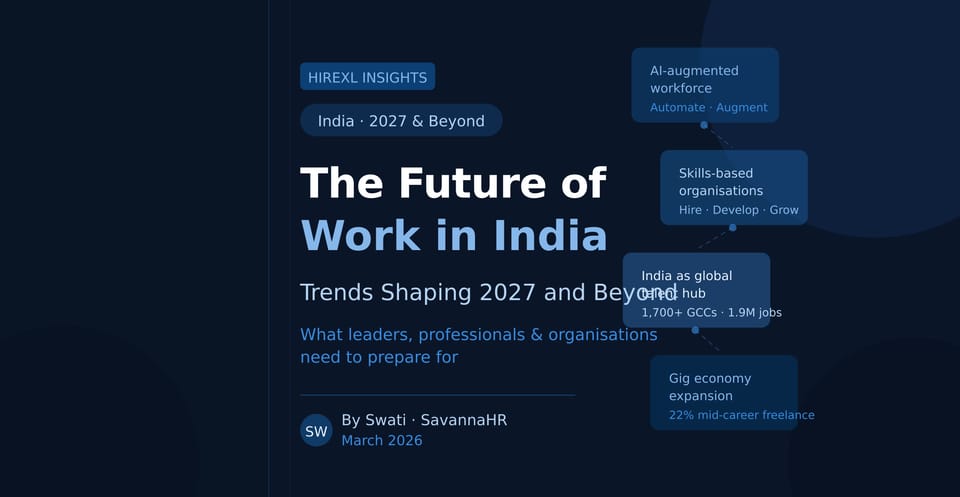
The integration of artificial intelligence into everyday work is the single most transformative trend affecting the Indian workforce. Unlike previous waves of automation that primarily displaced manual and routine cognitive work, the current generation of AI tools, powered by large language models and generative AI, is augmenting and in some cases replacing tasks that were previously considered the exclusive domain of skilled professionals. Software engineers are using AI coding assistants to write, debug, and review code. Content creators are using generative AI to draft, edit, and optimize written content. Data analysts are using AI to generate insights and build dashboards from natural language queries. Customer support teams are deploying AI agents that handle complex queries with near-human capability.
The World Economic Forum's Future of Jobs Report 2025 estimates that 65 percent of jobs globally will require significant reskilling by 2027, and the figure for India's technology sector is likely higher given the country's deep integration into global technology value chains. But the narrative that AI will eliminate jobs is overly simplistic and largely incorrect. What AI is eliminating is tasks, not jobs. The professionals who will thrive are those who learn to leverage AI as a multiplier of their own capabilities, using it to handle routine aspects of their work while focusing their human intelligence on creativity, judgment, relationship building, and strategic thinking that AI cannot replicate.
For Indian companies, the implication is clear: invest in AI literacy and AI tool adoption across your workforce, not just in your technology teams. The competitive advantage will accrue to organizations where every employee, from marketing managers to finance analysts to HR professionals, can effectively use AI tools to augment their work. This requires both training investment and cultural change, particularly in organizations where there is resistance to AI adoption driven by fear of displacement or unfamiliarity with the technology. The companies that create cultures of AI curiosity and experimentation will dramatically outperform those that treat AI as a specialized capability restricted to the data science team.
Trend 2: The Rise of Skills-Based Organizations
The traditional model of organizing work around jobs, with fixed job descriptions, rigid hierarchies, and career ladders defined by titles and tenure, is giving way to a more fluid model organized around skills. In a skills-based organization, work is decomposed into projects and tasks that are matched to individuals based on their demonstrated capabilities rather than their job title or position in the hierarchy. This shift is driven by the accelerating pace of change, which makes traditional job descriptions obsolete faster than they can be rewritten, and by the recognition that many of the most valuable capabilities cut across functional boundaries.
For Indian companies, the transition to skills-based models has profound implications for hiring, development, and career management. In hiring, it means shifting from degree-based and pedigree- based filtering to skills-based assessment, evaluating what candidates can actually do rather than where they studied or what titles they have held. This opens the talent pool dramatically, particularly in India where the quality of education varies enormously and where many highly capable professionals have non-traditional backgrounds. Companies like Tata Communications, HCL, and several leading Indian startups have already begun implementing skills-based hiring with measurable improvements in both diversity and quality of hire.
In talent development, the skills-based model means investing in continuous learning infrastructure that allows employees to acquire new capabilities in response to evolving business needs. The traditional model of annual training programs and static learning catalogs is inadequate for a world where the most valuable skills change every 18 to 24 months. Instead, companies need dynamic learning ecosystems that combine on-the-job learning, peer mentorship, external courses, and AI-powered personalized learning recommendations to keep their workforce's skill profile aligned with strategic needs. The organizations that build this capability will have a decisive competitive advantage in agility and innovation.
Trend 3: The Expansion of the Professional Gig Economy
India's gig economy has traditionally been associated with ride-sharing, food delivery, and other platform- based blue-collar work. But a significant and underreported shift is underway: the expansion of gig work into professional and knowledge-worker categories. Platforms like Toptal, Upwork, and India-specific platforms like Flexiple and SkillBridge are enabling experienced professionals, including software engineers, designers, product managers, data scientists, and marketing strategists, to work on a project basis for multiple clients rather than committing to a single full-time employer.
This shift is being driven from both the supply and demand sides. On the supply side, experienced professionals are increasingly choosing flexibility and autonomy over the stability and benefits of traditional employment, particularly those who have accumulated enough financial cushion and professional reputation to sustain themselves through project-based work. A 2025 survey by Nasscom found that 22 percent of mid-career tech professionals in India had done at least one freelance or contract engagement in the preceding twelve months, up from 12 percent in 2022. On the demand side, companies are discovering that project-based engagement of senior specialists is often more cost- effective and higher-quality than maintaining full-time headcount for capabilities that are needed intermittently.
For companies, the strategic implication is the need to develop the capability to effectively blend full-time employees with gig workers, fractional executives, and project-based specialists into cohesive, high- performing teams. This requires new approaches to team management, knowledge transfer, and intellectual property protection. For professionals, the gig economy expansion creates both opportunity and risk: the opportunity to earn more, learn faster, and maintain greater control over their work lives, but also the risk of income volatility, benefit gaps, and the isolation that comes with working outside of a stable team. The professionals who will thrive in this model are those who invest in building their personal brand, maintaining a strong professional network, and continuously updating their skills to remain in demand.
Trend 4: The Redefinition of Employee Experience
The concept of employee experience, once limited to office amenities, team outings, and the annual Diwali celebration, has expanded into a comprehensive framework that encompasses every touchpoint of the employee's relationship with their employer. In 2027, leading Indian companies will compete on the quality of the total employee experience, which includes meaningful work, psychological safety, career development opportunities, flexibility, wellness support, and a sense of belonging and purpose that connects individual contributions to broader organizational and societal impact.
This shift is driven by generational change. Gen Z professionals, who will constitute approximately 30 percent of India's tech workforce by 2027, have fundamentally different expectations from their employers compared to previous generations. They prioritize purpose over paycheck, flexibility over stability, and growth over comfort. They expect transparency about company performance, inclusion in decision- making, and authentic commitment to social and environmental responsibility. Companies that fail to adapt their employee experience to these evolving expectations will struggle to attract and retain the next generation of talent, while those that authentically deliver on these expectations will build employer brands that become self-reinforcing talent magnets.
Technology is enabling this redefinition. Employee experience platforms that integrate HR systems, communication tools, learning platforms, and wellness resources into unified digital environments are making it possible to personalize and optimize the employee experience at scale. AI-powered tools can identify employees at risk of disengagement or burnout before they reach crisis point, recommend personalized development opportunities based on individual career aspirations and organizational needs, and automate administrative processes that consume time and create friction. The companies that leverage these technologies effectively will deliver employee experiences that are qualitatively different from what most Indian workplaces offer today.
Trend 5: India as a Global Talent Hub
India's role in the global economy is shifting from a provider of outsourced services to a hub of innovation, product development, and strategic capability. This shift is most visible in the explosive growth of Global Capability Centers, which have evolved from cost-arbitrage operations performing routine tasks into sophisticated R&D and innovation centers that drive global product strategy for multinational corporations. By 2026, India hosts over 1,700 GCCs employing more than 1.9 million professionals, with the most advanced centers operating at capability levels that rival or exceed their parent company's headquarters.
This transformation has profound implications for the Indian workforce. The demand for high-skill, globally competitive talent is growing faster than the supply, which is driving up compensation for top-tier professionals and creating a bifurcated labor market where the best talent earns global-competitive packages while the broader workforce sees more modest growth. For Indian startups, this creates both a challenge and an opportunity: the challenge of competing with GCC compensation packages for top talent, and the opportunity to offer something GCCs cannot, namely ownership, impact, and the chance to build something from scratch.
Looking ahead, India's demographic advantage, combined with its maturing technology ecosystem and growing reputation for innovation, positions the country to become the world's largest source of technology talent and a primary destination for global companies seeking to build their innovation capabilities. The professionals who invest in developing globally competitive skills, building international networks, and maintaining the adaptability to work across cultures and contexts will be the primary beneficiaries of this trend. The companies that create environments where these globally competitive professionals want to work will capture a disproportionate share of the value that India's talent ecosystem generates.
Trend 6: Regulation and Compliance in the New World of Work
India's labor law framework, which has historically been complex, fragmented, and inconsistently enforced, is undergoing significant modernization through the implementation of the four Labor Codes that consolidate 29 existing laws into a more coherent framework covering wages, social security, industrial relations, and occupational safety. While implementation has been gradual and uneven across states, the direction of travel is clear: toward greater formalization of employment relationships, expanded social security coverage, and increased compliance obligations for employers.
For companies, particularly startups that have operated with informal HR practices, the evolving regulatory landscape requires proactive investment in compliance infrastructure. This includes proper employment contracts for all workers, accurate classification of employees versus contractors, compliance with state-specific registration and contribution requirements, and adherence to the new provisions around fixed-term employment, gig worker benefits, and workplace safety. The cost of non- compliance is increasing, both in terms of financial penalties and reputational risk, as employees become more aware of their rights and as enforcement agencies become more active.
Data privacy is another critical area of regulatory evolution. India's Digital Personal Data Protection Act creates new obligations around the collection, processing, and storage of employee data, with implications for everything from recruitment processes that involve automated decision-making to employee monitoring practices in remote work environments. Companies that proactively build privacy- compliant HR practices will be better positioned than those that treat compliance as a reactive, check- the-box exercise.
Preparing for the Future: A Framework for Action
For organizations, preparing for the future of work requires action across four dimensions. First, invest in workforce planning that anticipates the skills your organization will need in two to three years, not just the roles you need to fill today. Second, build learning and development infrastructure that enables continuous skill acquisition and career mobility across your organization. Third, modernize your employee experience to meet the evolving expectations of a multigenerational, increasingly distributed workforce. And fourth, develop the organizational agility to adapt your work models, team structures, and management practices as conditions change, without the disruption and cost of periodic restructuring.
For professionals, the future rewards those who take ownership of their own development, who invest in skills that complement rather than compete with AI, who build diverse professional networks, and who maintain the adaptability to navigate career transitions that may be more frequent and more dramatic than those of previous generations. The most valuable professional capabilities in 2027 will be those that are hardest to automate: complex problem-solving, creative thinking, emotional intelligence, cross- cultural communication, and the ability to integrate insights across disciplines to generate novel solutions.
The Bottom Line
The future of work in India is not something that happens to us; it is something we create through the choices we make today. Every hiring decision, every technology investment, every policy change, and every career choice is a vote for the kind of work world we want to inhabit. The trends described in this article are not inevitable forces; they are directions that can be shaped by intentional action from leaders, organizations, and individuals who understand what is coming and prepare accordingly.
India's opportunity is immense: the combination of demographic advantage, technological capability, entrepreneurial energy, and growing global integration creates the conditions for a workforce transformation that could drive unprecedented economic growth and social mobility. Realizing that opportunity requires us to be honest about the challenges, strategic about the investments, and committed to building workplaces and careers that are not just productive and profitable but also sustainable, inclusive, and fulfilling. The future of work in India belongs to those who prepare for it today.
Sources & References
- World Economic Forum - Future of Jobs Report 2025
- McKinsey Global Institute - India's Turning Point
- NASSCOM - India Technology Industry Report 2025
- Deloitte India - Future of Work Survey 2025
- LinkedIn India - Workforce Trends Report 2025
- HireXL - India Hiring & Talent Analytics 2026
- India Digital Personal Data Protection Act 2023