
India's Startup Attrition Crisis
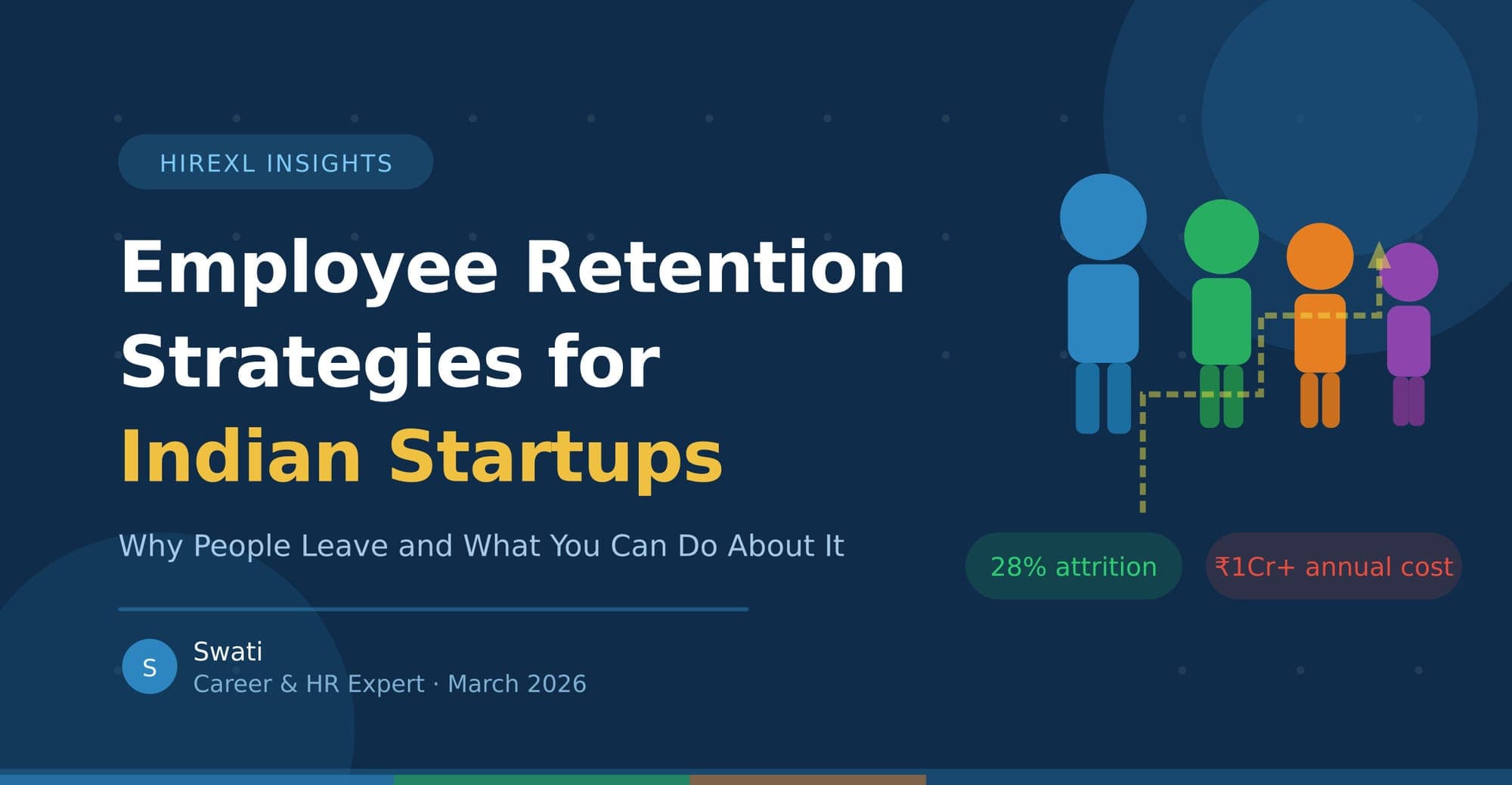
ndia's startup ecosystem is bleeding talent at an alarming rate. According to data from the Nasscom-Zinnov report on India's startup workforce, the average annual attrition rate for Indian tech startups in 2025 was 28 percent, nearly double the 15 percent average for established IT companies and significantly higher than the 12 to 18 percent range that most organizations consider manageable. For early-stage startups at the seed and Series A stage, the numbers are even more sobering: some companies report annual turnover rates exceeding 40 percent, effectively replacing nearly half their workforce every year.
The financial implications are staggering. For a 50-person startup with an average employee cost of 15 lakh rupees per annum, a 28 percent attrition rate means losing 14 people per year. At a replacement cost of three to five times annual salary, the total annual cost of attrition ranges from 63 lakh to 1.05 crore rupees, a sum that for many startups represents a significant percentage of their annual operating budget. And this calculation only captures the direct costs. The indirect costs, including the knowledge that walks out the door, the relationships that are disrupted, the projects that are delayed, and the morale impact on remaining team members, are even larger but harder to quantify.
The most troubling aspect of startup attrition is not its volume but its selectivity. Attrition does not affect all employees equally; it disproportionately hits your best performers, the people with the most options, the strongest networks, and the lowest tolerance for dysfunction. When a high performer leaves, they take with them not just their individual productivity but the institutional knowledge, the team dynamics, and the cultural influence that made them valuable. The resulting vacuum creates a negative spiral: remaining team members are overloaded with additional responsibilities, morale declines, and more people start looking for the exit. Understanding why people leave and building systems that give them compelling reasons to stay is not a luxury for Indian startups. It is a survival imperative.
Why People Actually Leave: The Real Reasons Behind the Exit Interview Clichés
Exit interviews consistently produce the same polite, non-confrontational reasons for departure: 'better opportunity,' 'career growth,' 'personal reasons,' 'relocation.' These explanations are rarely the full truth. Research from the Work Institute's 2025 Retention Report, combined with anonymous survey data from Indian tech professionals, reveals a more nuanced and actionable picture of why people actually leave.
| Reason 1: The Manager, Not the Company
The old adage that people don't leave companies, they leave managers, is backed by robust data. Gallup's State of the Global Workplace report consistently finds that the quality of the manager-employee relationship accounts for at least 70 percent of the variance in employee engagement scores, which are the strongest predictor of retention. In the startup context, this problem is amplified because many managers are first-time leaders, often individual contributors who were promoted based on technical excellence rather than leadership capability. They receive little or no management training and are expected to figure out people leadership while simultaneously delivering on aggressive technical or business goals.
The most common management failures that drive attrition include: inconsistent or absent feedback, where employees feel they are operating in a void without clear guidance on their performance; micromanagement, where capable professionals feel their autonomy and judgment are not trusted; favoritism, where perceived unfairness in opportunities, recognition, or treatment poisons the team dynamic; and emotional volatility, where a manager's mood swings create an environment of anxiety and walking on eggshells. These behaviors are not malicious; they are the natural consequences of putting untrained leaders in high-pressure situations without adequate support.
| Reason 2: Broken Growth Promises
Startups often sell candidates on the promise of rapid career growth, and this is frequently the deciding factor that persuades someone to accept a startup offer over a more secure, better-paying corporate position. When that promise goes unfulfilled, the sense of betrayal drives attrition more powerfully than almost any other factor. Growth disappointment takes several forms: the promised promotion that never materializes, the lateral scope expansion that was supposed to happen but didn't, the learning opportunities that were described in the interview but never created, and the general sense of stagnation that creeps in when a company's growth slows or when leadership positions are filled by external hires rather than internal promotions.
For early employees who joined before the company had established career frameworks, the problem is particularly acute. They were told 'we'll figure it out as we grow,' and two years later, they are still in the same role with the same title, watching new hires come in at higher levels with more formal structures. The implicit contract, 'join us early, grow with us, and benefit from the upside' has been violated, and no amount of equity promises can compensate for the daily experience of feeling stuck.
| Reason 3: Compensation Drift
India's tech salary market has been extraordinarily dynamic over the past five years, with significant spikes during the 2021-2022 hiring boom, a correction in 2023-2024, and a gradual recovery in 2025-2026. During periods of rapid market movement, companies that do not actively adjust compensation for existing employees find themselves in a situation where new hires are being paid significantly more than equally or more experienced incumbents. This 'compensation drift' or 'salary compression' is one of the most corrosive forces in employee retention.
When an engineer who has been with the company for two years and has deep institutional knowledge discovers that a newly hired engineer with comparable skills is earning 20 to 30 percent more, thepsychological impact is devastating. It signals that the company values acquisition over retention, that loyalty is not rewarded, and that the only way to get a market-rate salary is to leave and come back. Many companies are unaware of the extent of their compensation drift until they start losing their best people and discover the reason in exit interviews that are too late to be useful.
| Reason 4: Burnout and Unsustainable Pace
Startup culture in India often glorifies overwork, with founders wearing their 80-hour weeks as a badge of honor and implicitly or explicitly expecting the same from their teams. While bursts of intense effort are sometimes necessary and can even be energizing when they are tied to meaningful milestones, a sustained culture of overwork is a retention killer. Burnout does not make people less productive before they leave; it makes them less productive for months before they even realize they are burned out, and by the time they acknowledge it, their decision to leave is already made.
The research on burnout and attrition is clear: employees who report high levels of burnout are 2.6 times more likely to be actively seeking new employment and 63 percent more likely to take a sick day. In India, where cultural norms around work ethic make it difficult for employees to push back on unreasonable demands, burnout often goes unrecognized until it manifests as sudden resignation. The startup that loses a talented engineer to burnout did not lose them on the day they resigned; they lost them months earlier, when the accumulated exhaustion crossed an invisible threshold from which recovery was no longer possible within that environment.
The Retention Playbook: Evidence-Based Strategies
| Strategy 1: Invest in Manager Development
If managers are the primary driver of attrition, then manager development is the primary lever for retention. This means providing first-time managers with structured training before they take on people leadership responsibilities, not after problems have already emerged. The training should cover the practical skills of management: giving effective feedback, conducting one-on-ones, setting clear expectations, having difficult conversations, and creating an environment where people feel psychologically safe to take risks and make mistakes.
Beyond initial training, create ongoing support structures for managers: peer learning groups where they can discuss challenges and share approaches, coaching or mentoring from experienced leaders, and regular skip-level meetings where their direct reports have a channel to provide feedback about the management experience. The goal is not to produce perfect managers but to establish a minimum quality bar for people leadership that prevents the most common management failures from driving attrition.
| Strategy 2: Build Transparent Career Frameworks
Create and publish clear career frameworks that define the expectations, competencies, and compensation ranges for each level in your organization. This includes technical individual contributor tracks, management tracks, and ideally specialist tracks for roles like architecture, data science, or design. The framework should be specific enough that any employee can understand exactly what theyneed to demonstrate to reach the next level, and it should be applied consistently across the organization.
The absence of career frameworks is one of the most common reasons why high performers leave startups. They do not necessarily need to be promoted immediately; they need to see a credible path to growth and understand what they need to do to progress. A framework that shows a clear progression from senior engineer to staff engineer to principal engineer, with defined competencies and compensation at each level, gives people a reason to invest in their long-term growth at the company rather than looking for advancement elsewhere.
| Strategy 3: Conduct Stay Interviews
Most companies invest heavily in exit interviews, which by definition come too late to retain the person leaving. A far more effective practice is the stay interview: a regular, structured conversation between a manager and each direct report specifically focused on what is keeping them at the company, what might cause them to consider leaving, and what changes would make their experience better. Stay interviews should happen quarterly and should follow a consistent format to track trends over time.
The questions are simple but powerful: What do you look forward to when you come to work? What are you learning here? What might tempt you to leave? What can I do as your manager to make your experience better? Is there anything about the company, the team, or the role that frustrates you? These conversations serve a dual purpose: they provide early warning signals about attrition risk, and the act of conducting them signals to employees that their experience and opinions matter, which itself is a retention driver.
| Strategy 4: Proactive Compensation Management
Adopt a practice of annual market-rate adjustments for all employees, not just those who negotiate or threaten to leave. This means conducting an annual salary benchmarking exercise against current market data, identifying employees whose compensation has drifted below market, and proactively adjusting their pay before they become dissatisfied. The cost of these proactive adjustments is almost always less than the cost of losing and replacing the employees who would have left due to compensation dissatisfaction.
Make ESOP grants part of the ongoing retention toolkit, not just a one-time hiring incentive. Annual refresher grants for strong performers reinforce the long-term value of staying with the company and ensure that early employees who received small initial grants continue to benefit from the company's growth. Communicate the value of equity clearly and regularly, including the company's progress toward milestones that increase equity value.
| Strategy 5: Protect Against Burnout
Create structural guardrails against burnout rather than relying on individual resilience. This includes enforcing reasonable working hours, limiting after-hours communication, mandating minimum vacation usage, and building enough capacity in teams that the departure of any single person does not create a crisis.
Leaders should model sustainable work practices themselves; a founder who sends emails at midnight while encouraging work-life balance sends a message that actions contradict the stated values.Institute regular wellness check-ins as part of the management rhythm. Train managers to recognize early signs of burnout, including declining quality of work, withdrawal from team interactions, increased cynicism, and reduced initiative. When these signals appear, the response should be supportive intervention, not increased pressure. Sometimes the most powerful retention tool is giving a burned-out high performer permission and encouragement to take a two-week break, with the explicit assurance that their position and standing are secure.
Retention ROI: Reducing attrition from 28% to 20% for a 100-person startup saves approximately 50 lakh to 1 crore rupees annually in direct replacement costs alone, not counting the productivity and morale benefits of a more stable team.
The Bottom Line
Employee retention is not a separate initiative from building a great company. It is the same initiative. The practices that retain talented people, great management, clear growth paths, fair compensation, sustainable work practices, and a culture of respect and purpose, are identical to the practices that build high-performing organizations. There is no trade-off between being a great place to work and being a successful business; they are the same thing.
The Indian startups that will build enduring companies are those that treat retention not as a human resources problem to be solved with perks and counter-offers but as a leadership discipline that requires the same strategic attention, investment, and accountability as product development or customer acquisition. Start with the data: understand your attrition patterns, their root causes, and their true cost. Then build systems that address the causes, not the symptoms. The talent you retain is the foundation upon which everything else is built.
Sources & References
- Nasscom-Zinnov India Startup Workforce Report 2025
- Gallup State of the Global Workplace 2025
- Work Institute Annual Retention Report 2025
- McKinsey - The Great Attrition and What to Do About It
- Harvard Business Review - Stay Interview Research
- SHRM India - Employee Burnout and Retention Study
- AmbitionBox India Attrition Data 2025
Related reading: Savanna HR hiring solutions · EdTech Recruitment in Gurgaon (2026) · How to Choose the Best Recruitment Agency in Gurgaon (2026): 7 Standards That Matter


