The Complete Guide to Tech Interviews in India: What Top Companies Actually Test
Cracking the Indian Tech Interview in 2026
The technology interview landscape in India has undergone a dramatic transformation over the past three years. The era of whiteboard coding challenges and algorithm puzzles as the sole determinant of hiring outcomes is finally giving way to more practical, competency-based evaluation methods that attempt to assess how candidates will actually perform on the job. Yet the transition is uneven and the landscape confusing: different companies, even within the same industry, use radically different interview formats, evaluation criteria, and decision-making processes. A candidate preparing for interviews at an Indian startup, a Global Capability Center, and a product company like Google or Microsoft might face three entirely different assessment paradigms.
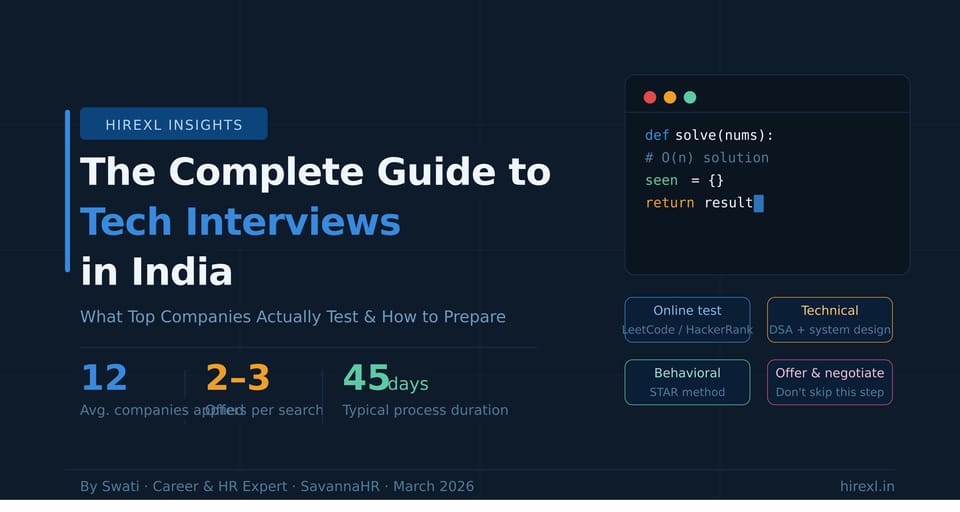
According to data from InterviewBit and Pramp, Indian tech candidates apply to an average of 12 companies during a job search and receive offers from approximately 2 to 3. The gap between applications and offers represents not just a selectivity issue but an information asymmetry: many candidates fail not because they lack the technical skills but because they do not understand what each company is actually testing or how to present their capabilities in the format the company expects. Understanding the structure, expectations, and unwritten rules of the Indian tech interview is a prerequisite for success, and it is an area where preparation yields enormous returns.
This guide provides a comprehensive overview of the current interview landscape in India across different company types, breaks down each stage of the typical process, and offers practical, evidence-based preparation strategies. Whether you are a fresh graduate preparing for your first tech interview or a senior professional evaluating leadership roles, the principles and tactics in this guide will help you perform at your best.
The Interview Landscape: Understanding Different Formats
| Product Companies (Google, Microsoft, Amazon, Flipkart)
Major product companies continue to place heavy emphasis on algorithmic problem-solving and system design, though the balance has shifted significantly toward practical application over theoretical complexity. A typical interview process consists of 4 to 6 rounds: an online coding assessment, one or two algorithmic problem-solving interviews, one system design interview for candidates with three or more years of experience, one behavioral interview, and sometimes a hiring manager round. The key shift in 2026 is that even algorithmic rounds increasingly present problems in the context of real products and systems, rather than abstract mathematical puzzles.
The system design round has become the most heavily weighted interview for mid-to-senior candidates at product companies. Interviewers expect candidates to design scalable systems from scratch, making trade-off decisions about consistency, availability, partition tolerance, technology choices, and operational considerations. The ability to think through a system holistically, from user requirements through to deployment and monitoring, is far more valued than the ability to recall specific design patterns or name- drop technologies.
| Indian Startups (Razorpay, CRED, Meesho, Zerodha)
Indian startups have increasingly adopted interview processes that prioritize practical skill demonstration over algorithmic prowess. The typical process includes a take-home coding assignment or live pair programming session, a system design or architecture discussion, a culture fit and values assessment interview, and a conversation with the founder or CTO. The take-home assignment is designed to evaluate how you approach a real-world problem: the quality of your code, your testing practices, your documentation, and your ability to make pragmatic design decisions under realistic constraints.
Startups also place significant weight on communication and collaboration skills, recognizing that in a small team, the ability to work effectively with colleagues across functions is as important as technical proficiency. Expect questions about how you have handled disagreements, how you prioritize competing demands, and how you approach problems where the requirements are ambiguous. The best preparation for startup interviews is to have a portfolio of real projects that demonstrate your end-to-end capabilities, not just your ability to solve algorithmic puzzles.
| Global Capability Centers (GCCs)
GCCs of multinational companies have developed hybrid interview processes that combine elements of their global parent's methodology with India-specific adaptations. The process typically includes an online assessment, technical interviews focused on the specific technology stack used by the team, a design or architecture round, and one or two behavioral rounds that assess cultural alignment and leadership potential. GCC interviews tend to be more structured and consistent than startup interviews, with detailed rubrics and calibrated scoring that reduce individual interviewer bias.
One distinctive feature of GCC interviews is their emphasis on behavioral competencies as evaluated through the STAR method: Situation, Task, Action, Result. GCC interviewers are typically trained to probe for specific examples of past behavior as predictors of future performance, and they expect candidates to articulate their contributions clearly and precisely. Vague responses like 'we delivered the project on time' are insufficient; interviewers want to hear about your specific role, the decisions you made, and the measurable impact of your actions.
Stage-by-Stage Preparation Guide
| The Online Assessment
Most companies begin with an automated online assessment that serves as a volume filter. These assessments typically include coding problems of varying difficulty, sometimes supplemented with multiple-choice questions on computer science fundamentals. The key to success is not just solving the problems but solving them efficiently within the time constraint. Practice regularly on platforms like LeetCode, HackerRank, and CodeForces, focusing not just on getting the correct answer but on optimizing your solution's time and space complexity.
A common mistake is over-preparing for the hardest problems while neglecting the fundamentals. Most online assessments include a mix of easy, medium, and hard problems, and the scoring often weights completion across difficulties. Solving all easy and medium problems perfectly is typically more valuable than partially solving a hard problem. Budget your time accordingly: spend no more than 20 percent of the time on the hardest problem, and ensure that your solutions for easier problems are clean, well- tested, and handle edge cases.
| The Technical Interview
Live technical interviews, whether conducted via video call or in person, assess not just your ability to write correct code but your problem-solving process, communication skills, and ability to think under pressure. The most effective approach is to think aloud, sharing your reasoning with the interviewer as you work through the problem. Start by clarifying the requirements and constraints, discuss potential approaches and their trade-offs before coding, implement your chosen solution while explaining your decisions, and test your solution with examples including edge cases.
Interviewers are evaluating you on multiple dimensions simultaneously: technical correctness, code quality, communication clarity, and how you handle hints or redirections. A candidate who writes perfect code in silence is often rated lower than one who writes slightly less optimal code but demonstrates clear thinking, receptiveness to feedback, and the ability to articulate trade-offs. Practice mock interviews with peers or through platforms like Pramp and Interviewing.io to build comfort with the live interview format.
| The System Design Interview
System design interviews require a fundamentally different preparation approach than coding interviews. You cannot cram for them; they test the accumulated understanding that comes from building and operating real systems. Start by studying the architecture of major internet-scale systems: how does a URL shortener work? How would you design a news feed? How does a chat application handle millions of concurrent users? For each system, understand the key components, the data flow, the scaling challenges, and the trade-offs involved in design decisions.
During the interview, structure your response using a consistent framework: begin with requirements clarification, both functional and non-functional; estimate the scale, including users, data volume, and query patterns; propose a high-level architecture; dive deep into the most critical components; and discuss trade-offs, failure modes, and scaling strategies. The interviewer is less interested in the specific technologies you choose than in your ability to reason about the problem systematically, identify the right abstractions, and make justified trade-off decisions.
| The Behavioral Interview
Behavioral interviews are often the most underestimated and under-prepared stage of the process, particularly among Indian tech candidates who focus disproportionately on technical preparation. Yet behavioral performance is frequently the deciding factor when technical assessments are comparable across candidates. Prepare a bank of six to eight detailed stories from your professional experience that cover common behavioral themes: leadership, conflict resolution, failure and recovery, innovation, collaboration, and decision-making under uncertainty.
Each story should follow the STAR format but with enough specificity and depth to withstand probing follow-up questions. When you say you led a project, be prepared to explain how you made decisions, how you handled disagreements within the team, what trade-offs you navigated, and what you would do differently in hindsight. Authenticity matters: interviewers are experienced enough to detect rehearsed, superficial answers, and they value candidates who demonstrate genuine self-awareness and a growth mindset over those who present a polished but unconvincing narrative of unbroken success.
Preparation Framework: Invest 50% of your interview prep time on the format you find most challenging, not the format you are most comfortable with. Comfort creates complacency; challenge creates growth.
Common Mistakes Indian Candidates Make
- Over-indexing on algorithms:at the expense of system design: Senior roles weight system design heavily, and candidates who neglect this area are at a significant disadvantage.
- Failing to ask clarifying questions: Jumping into a solution without understanding the requirements signals impulsiveness and lack of thoroughness.
- Neglecting communication: Technical skills matter, but so does the ability to explain your thinking clearly and concisely.
- Not researching the company: Generic answers signal lack of genuine interest. Understand the company's products, technology, and challenges before the interview.
- Ignoring the offer negotiation: Many candidates accept the first offer without negotiating, leaving significant compensation on the table.
The Interviewer's Perspective: What They Are Really Looking For
Having conducted hundreds of interviews myself and spoken with dozens of hiring managers across Indian tech companies, I can share what the evaluation really comes down to beyond the official rubrics. Interviewers are looking for three fundamental qualities: signal strength, meaning the candidate demonstrates clear evidence of the skills needed for the role; intellectual honesty, meaning the candidate is transparent about what they know and do not know; and cultural compatibility, meaning the candidate will work effectively within the team's operating style.
The most common reason candidates fail is not lack of skill but lack of clarity. Interviewers who cannot discern what a candidate knows and can do will default to a no-hire decision, even if the candidate might be perfectly capable. Your job in an interview is not just to have the right answers but to make your competence visible and unambiguous. This is why thinking aloud, structuring your responses, and being specific about your contributions and their impact matters so much.
Conversely, the candidates who receive the strongest yes votes are those who demonstrate that they can not only do the job but will make the team better. This might be through a creative approach to a problem, through insightful questions about the team's challenges, or through a genuine enthusiasm for the work that is contagious. The bar for technical competence is the minimum; the differentiator is everything else.
The Bottom Line
Tech interviews in India are imperfect instruments, and everyone involved in the process knows it. No interview format can perfectly predict how someone will perform in a real job over months and years. But within the constraints of the current system, there is an enormous amount you can do to improve your outcomes through preparation, practice, and a strategic approach to the process. The candidates who succeed are not always the most technically brilliant; they are the ones who understand the game they are playing and prepare accordingly.
Invest in preparation with the same discipline you would apply to building a product or studying for an exam. Practice coding under timed conditions, study system design through first principles rather than memorization, build a library of behavioral stories that showcase your strengths, and seek feedback through mock interviews with people who can give you honest, specific criticism. The interview process is a skill, and like all skills, it improves with deliberate practice. The effort you invest now will pay dividends not just in your next job search but in every career transition that follows.
Sources & References
- InterviewBit India Tech Hiring Data 2025
- LeetCode India - User Practice Analytics
- Glassdoor India - Interview Process Reviews
- LinkedIn India - Tech Interview Trends Report
- Harvard Business Review - Structured Interview Effectiveness
- Google re:Work - Interview Best Practices
- HireXL India - Interview Format Benchmarking Study