How to Build a Winning Campus Hiring Strategy for Indian Startups
The Campus Hiring Challenge for Startups
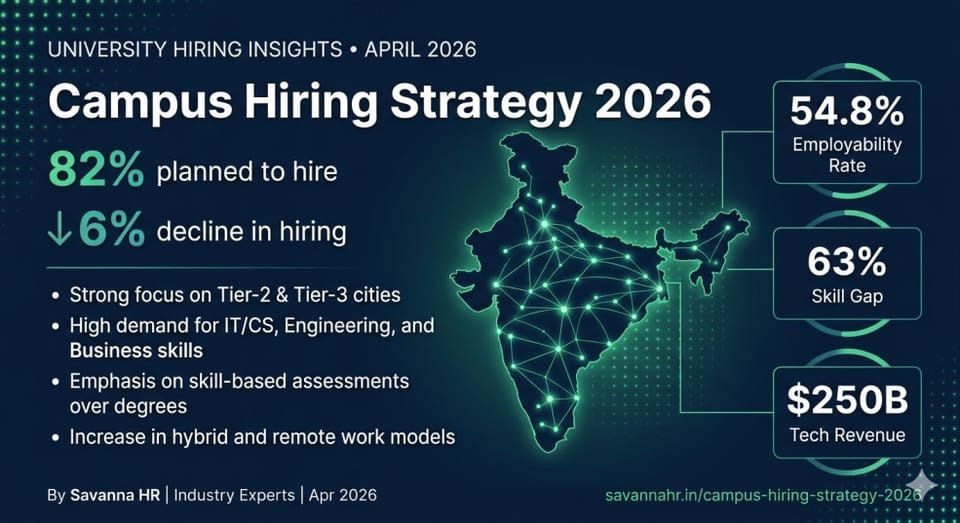
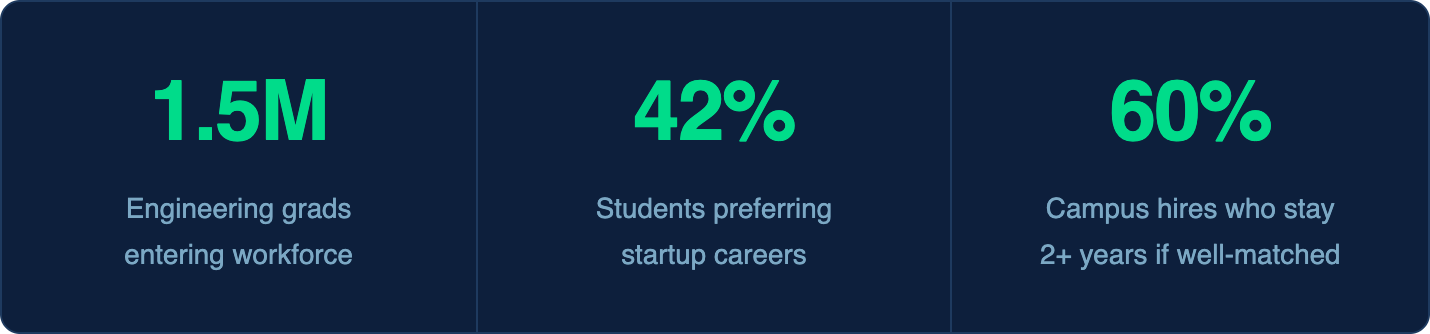
Every year between September and March, India's engineering and management campuses transform into intense battlegrounds where companies compete for the attention, interest, and commitment of the country's brightest emerging talent. Over 1.5 million engineering graduates enter the workforce annually in India, representing the world's largest pipeline of technically educated young professionals. For established companies like Google, Microsoft, Amazon, TCS, and Infosys, campus hiring is a well-oiled machine with dedicated teams, established relationships with placement cells, and brand recognition that does much of the heavy lifting. For startups, the picture is dramatically different.
Most startups approach campus hiring as an afterthought, if they approach it at all. They lack the brand recognition to attract top students' attention, the structured processes to evaluate large numbers of candidates efficiently, and the on-campus relationships that give established companies privileged access to the best talent before the general hiring season even begins. The result is that startups often end up with campus hires from the bottom half of the talent pool, which reinforces the perception that startups are fallback options rather than aspirational destinations. This creates a vicious cycle that perpetuates itself unless deliberately disrupted.
But the startups that do invest in building genuine campus hiring strategies are discovering a remarkable competitive advantage. The top students at India's premier and second-tier engineering colleges are increasingly interested in startup careers, drawn by the promise of meaningful work, rapid learning, and the chance to make an impact from day one. According to a 2025 survey by Unstop, formerly D2C, 42 percent of final-year engineering students ranked startups as their preferred employer type, up from 28 percent in 2022. The demand is there; the question is whether your startup can capture it effectively.
Rethinking Campus Hiring: Year-Round Engagement
The biggest mistake startups make is treating campus hiring as a seasonal activity: show up during placement season, give a presentation, conduct interviews, and leave. This approach fails because it puts you in direct, same-day competition with dozens of companies, many of which have brand advantages that you cannot overcome in a 30-minute presentation. The alternative is year-round engagement that builds your brand on campus well before the hiring season begins.
Start by identifying five to ten target campuses based on the quality of their programs, the geographic relevance to your company, and the cultural fit with your organization. You do not need to target IITs and IIMs to find excellent talent; many of the best campus hires come from strong tier-two institutions like BITS Pilani, NIT Trichy, IIIT Hyderabad, VIT, Manipal, and others where the talent is strong but the competition for students is less intense. Once you have identified your target campuses, begin building relationships with faculty, student organizations, and placement cells through a structured program of engagement activities.
These engagement activities might include hosting workshops or guest lectures on topics relevant to your technology or domain, sponsoring hackathons or coding competitions, offering summer and winter internships, providing capstone project mentorship, or creating campus ambassador programs where current student advocates promote your company to their peers. Each of these activities builds awareness, creates positive associations with your brand, and gives you direct access to motivated students who have self-selected into events related to your company's work.
The Internship Pipeline: Your Most Effective Campus Hiring Tool
If you do only one thing to improve your campus hiring, make it a structured internship program. Internships are by far the most effective mechanism for evaluating campus talent, because they provide something that no interview process can: the opportunity to observe how someone actually works over an extended period. An eight to twelve week internship gives you a comprehensive view of a student's technical skills, work ethic, learning speed, collaboration ability, and cultural fit, all of which are nearly impossible to assess accurately in a few hours of interviews.
The data supports this emphatically. According to NACE, the National Association of Colleges and Employers, companies that convert interns to full-time hires see 20 percent higher first-year retention rates and faster time-to-productivity compared to hires made through traditional campus recruitment. In the Indian context, where the quality signal from campus interviews is particularly noisy due to standardized coaching and preparation, the internship advantage is even more pronounced.
Design your internship program to be genuinely valuable for the student, not just a source of cheap labor. Assign interns to real projects with meaningful deliverables, provide them with a dedicated mentor, include them in team activities and social events, and conduct a structured mid-point review and final evaluation. The students who have a great internship experience become your most effective campus ambassadors, telling their classmates about the company and creating organic demand that no placement presentation can match. And the 60 to 70 percent of interns who convert to full-time hires arrive already onboarded, reducing your effective time-to-productivity from months to days.
Winning the Placement Presentation
When placement season arrives, you will likely be one of many companies presenting to students on the same day. You have 20 to 30 minutes to convince the best students in the room that your startup is where they should begin their career, competing against companies with household-name brands and significantly higher starting salaries. This is a high-stakes pitch, and it deserves the same preparation and polish that you would give to an investor presentation.
Lead with impact, not with company description. Students have heard dozens of companies describe themselves as innovative, fast-growing, and dynamic. What they have not heard is a specific, compelling story about the work they would actually do. Show a demo of your product and explain the technical challenges involved in building it. Present a specific problem that a recent campus hire helped solve, with their name and their contribution highlighted. Show the career trajectory of previous campus hires who are now leading teams or products. Make the opportunity tangible and personal, not abstract and corporate.
Be transparent about compensation, but frame it within the total value proposition. If your base salary is lower than corporate competitors, explain the equity component, the learning acceleration, and the career trajectory with specific examples. Students are not purely salary-driven; a significant proportion will accept a lower base for the right combination of learning, impact, and growth potential. But they need to understand the trade-off clearly, and they need to trust that the non-monetary benefits are real rather than aspirational.
End with a clear call to action and an element of urgency. Provide specific next steps for interested students, whether that is signing up for a coding challenge, scheduling a one-on-one conversation, or attending a hands-on workshop later that day. The more specific and immediate the next step, the more likely students are to take it. And if you can offer on-the-spot internship opportunities or fast-track interview processes for interested candidates, you will create a sense of momentum that compounds throughout the hiring season.
Presentation Hack: Bring a recent campus hire to your placement presentation. Nothing is more compelling to a student than hearing from someone who was in their exact position one or two years ago and can speak authentically about the experience of joining your startup.
Evaluating Campus Talent Effectively
Traditional campus hiring processes, which typically involve an aptitude test followed by a technical interview and an HR round, are poor predictors of on-the-job performance. They reward test-taking ability and interview preparation over the practical skills and learning orientation that actually determine success in a startup environment. Redesign your evaluation process to emphasize demonstrated capability and potential over test performance. Start with a practical coding challenge that reflects the actual work your engineers do, not an algorithm puzzle from a textbook. Candidates who can build a small but functional feature, debug a real codebase, or design a solution to a practical problem demonstrate skills that are directly transferable to the job. Follow the coding challenge with a technical discussion where the candidate walks through their approach, explains their design decisions, and responds to questions about how they would extend or improve their solution. This discussion assesses communication skills, problem-solving process, and depth of understanding in ways that a pass/fail test cannot.
For the cultural and motivational assessment, focus on questions that reveal the candidate's self- awareness, learning orientation, and alignment with the startup environment. Why are they interested in a startup rather than a corporate role? How do they handle ambiguity and setback? What have they built outside of their coursework that demonstrates initiative and passion? The answers to these questions are far more predictive of startup success than the answers to standard behavioral interview questions that every candidate has rehearsed.
Onboarding Campus Hires for Success
Campus hires require a qualitatively different onboarding experience than experienced professionals. They are entering the workforce for the first time, and many of their expectations about professional life are shaped by college experiences that bear little resemblance to startup reality. A structured onboarding program that bridges this gap is essential for converting promising graduates into productive team members.
The onboarding program should include a technical orientation that introduces the company's technology stack, development practices, and codebase; a business orientation that covers the product, the market, the customers, and the company strategy; professional skills training covering communication, collaboration, time management, and workplace norms; and an extended mentorship relationship with a senior team member who can provide guidance, feedback, and support throughout the first year.
Set clear 30-60-90 day expectations for campus hires, with appropriately calibrated milestones that build confidence through early wins while gradually increasing complexity and autonomy. New graduates who are thrown into the deep end without support often struggle and lose confidence, while those who are given a structured ramp that challenges them progressively develop faster and stay longer. The investment in structured onboarding pays for itself many times over through improved performance, higher retention, and the reputation benefits that come when campus hires have positive experiences and share them with their networks.
Building Your Campus Brand Long-Term
The most effective campus hiring strategies are built over years, not months. Each cohort of successful campus hires becomes an ambassador who refers their talented classmates and juniors. Each positive internship experience generates word-of-mouth that reaches the next year's students. Each contribution to the campus community, whether through workshops, hackathons, or mentorship, builds your reputation as a company that invests in young talent. Over three to five years of consistent engagement, a startup can build a campus brand that rivals companies ten times its size.
Track your campus hiring metrics rigorously: the number and quality of applications per campus, the conversion rate at each stage, the acceptance rate of offers, the performance of campus hires relative to experienced hires, and the retention rate over one, two, and three years. Use this data to refine your campus selection, improve your evaluation process, and optimize your value proposition. The startups that treat campus hiring as a strategic investment rather than a seasonal transaction will build a sustainable pipeline of young talent that fuels their growth for years to come.
The Bottom Line
Campus hiring is not just about filling entry-level positions; it is about building the next generation of your company's leaders, innovators, and culture carriers. The startup that attracts, develops, and retains the best campus talent today is building a competitive advantage that compounds over time, as those hires grow into the senior engineers, product leaders, and people managers who will drive the company's success for years to come. The investment required is modest relative to the returns: a thoughtful engagement strategy, a structured internship program, an effective evaluation process, and a supportive onboarding experience. Start building your campus strategy now, and by next placement season, you will be competing from a position of strength rather than anonymity.
Sources & References
- NASSCOM Emerging Technology Graduate Report 2025
- Unstop (D2C) Campus Hiring Preferences Survey 2025
- NACE Internship-to-Hire Conversion Research
- India Skills Report 2026 - Wheebox/CII
- LinkedIn India - Campus to Career Transitions Data
- AICTE India Engineering Education Statistics 2025
- HireXL Campus Hiring Best Practices Guide