Building a Diverse Tech Team in India: A Practical Framework for Meaningful Inclusion
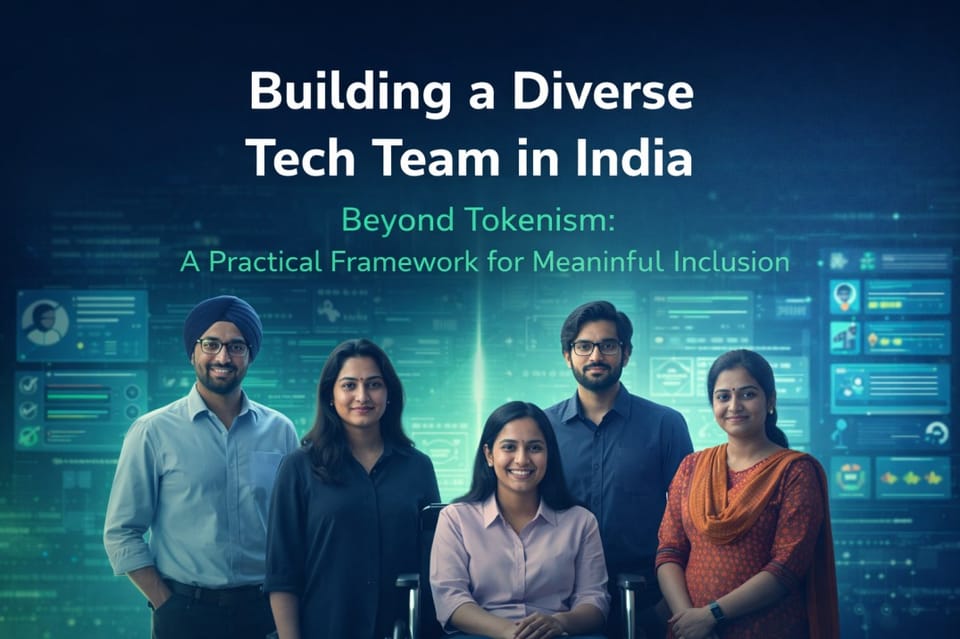
The Diversity Imperative for Indian Tech
India's technology sector has a diversity problem, and it is one that the industry has been remarkably slow to acknowledge, let alone address. According to Nasscom's 2025 workforce report, women represent only 36 percent of India's total tech workforce, a figure that drops to 26 percent for mid-level roles and below 10 percent for senior technical and leadership positions. The representation of people from Scheduled Castes and Scheduled Tribes in the organized technology sector remains in the low single digits. Professionals with disabilities are virtually invisible in most tech companies, despite India having one of the world's largest populations of people with disabilities. And the geographic concentration
of opportunities in a handful of metro cities creates systematic exclusion of talent from smaller towns and less developed regions.
These numbers are not just a social justice concern, though they are certainly that. They represent a massive inefficiency in how India's technology industry allocates its most valuable resource, human talent. When you systematically exclude or underrepresent more than half of the potential talent pool, you are not building the best possible teams. You are building the best possible teams from an artificially
constrained subset, which is a fundamentally different and inferior outcome. The research on this point is unambiguous: diverse teams produce better decisions, more innovative products, and stronger financial results than homogeneous ones.
McKinsey's Diversity Wins report, which analyzed over 1,000 companies across 15 countries, found that companies in the top quartile for gender diversity were 25 percent more likely to achieve above-average profitability, and those in the top quartile for ethnic and cultural diversity were 36 percent more likely. Boston Consulting Group found that companies with above-average diversity on their management teams reported innovation revenue 19 percentage points higher than companies with below-average diversity. In India's increasingly competitive tech landscape, these are not margins that any company can afford to leave on the table.
tech workforce
tech leadership
with gender diversity
Understanding the Barriers
| The Pipeline Problem Is Real, But It Is Not the Whole Story
The most common explanation for the lack of diversity in Indian tech is the pipeline argument: there are simply not enough qualified candidates from underrepresented groups. There is some truth to this. Women represent only about 30 percent of engineering graduates in India, and the representation ofmarginalized communities in premier technical institutions remains disproportionately low. But the pipeline argument, while partially valid, is also frequently used as an excuse for inaction, and it ignores the fact that the pipeline is not a natural phenomenon. It is the result of systemic decisions about who has access to quality education, who is encouraged to pursue technical careers, and who is supported in developing the skills and confidence needed to compete.
More importantly, the pipeline argument does not explain the dramatic drop-off in representation that occurs between entry-level and senior positions. If 36 percent of the tech workforce is female, why is the representation at the senior level below 10 percent? The answer lies not in the pipeline but in the retention and progression barriers that disproportionately affect women and other underrepresented groups after they enter the industry. These include biased performance evaluations, unequal access to high-visibility projects and mentorship, inflexible work policies that conflict with caregiving responsibilities, and cultures that reward behaviors more commonly associated with dominant groups.
| Unconscious Bias in Hiring and Promotion
Unconscious biases pervade every stage of the talent lifecycle, from resume screening to interviews to performance reviews to promotion decisions. Research shows that identical resumes with different names receive systematically different callback rates, with male-sounding and upper-caste-sounding names receiving preferential treatment. In interviews, affinity bias leads interviewers to favor candidates who remind them of themselves, which in a predominantly male, upper-caste leadership structure perpetuates the existing demographic composition. And in promotion decisions, 'potential' is often assessed based on characteristics that are more readily attributed to members of dominant groups, such as assertiveness, visibility, and self-promotion.
In the Indian context, these biases are compounded by deeply ingrained social hierarchies around caste, class, gender, and regional identity that manifest in subtle but powerful ways in professional settings. A candidate from a small town who speaks English with a regional accent may be unconsciously perceived as less competent than an otherwise identical candidate from a metropolitan background with a neutralaccent.
A woman who is less assertive in meetings may be evaluated as lacking leadership potential, while the same behavior in a man might be interpreted as thoughtful and collaborative. These biases are not intentional, but their cumulative effect is devastating to diversity outcomes.
| The Culture Gap
Many tech companies in India have cultures that are unwelcoming or hostile to people who do not fit the dominant demographic profile. This manifests in ways both overt and subtle: casual sexism in team conversations, social bonding rituals that exclude people with different lifestyles, an assumption that everyone shares the same cultural and socioeconomic background, and a tolerance for behavior that makes underrepresented employees feel like outsiders. When talented people from diverse backgrounds join these environments, they often leave within two years, not because they lack the skills to succeed but because the emotional tax of constantly navigating an exclusionary culture becomes unsustainable.
A Practical Framework for Building Diverse Teams
| Phase 1: Fix the Hiring Process
Diversity starts at the top of the funnel, and fixing the hiring process is the highest-leverage intervention available. Begin by auditing your job descriptions for language that may discourage diverse applicants. Use tools like Textio or Gender Decoder to identify gendered or exclusionary language and replace it with inclusive alternatives. Remove unnecessary requirements that function as proxies for privilege, such as degrees from specific institutions, fluency in English over domain expertise, or relocation requirements that disadvantage people with family obligations in other cities.
Implement structured interviews with standardized questions and evaluation rubrics for every role. Structure reduces the space for unconscious bias to influence decisions by ensuring that every candidate is assessed on the same criteria with the same evidence. Require diverse interview panels for every role: no candidate should be evaluated exclusively by people who look like each other and share the same background. This does not mean tokenistic inclusion of a single diverse panelist; it means building interview teams that represent the diversity of perspectives you want in your organization.
Set explicit sourcing goals for diverse candidates. If your applicant pool for engineering roles is 85 percent male, you have a sourcing problem that will not be solved by making the evaluation process fairer. Proactively source candidates from women-in-tech communities like WomenWhoCode, SheThePeople, and Lean In India. Partner with organizations that support professionals from marginalized backgrounds. Post roles on platforms that reach beyond the traditional channels. Require that every shortlist include at least one candidate from an underrepresented group, a practice sometimes called the Rooney Rule, which research shows increases diverse hiring without compromising quality.
| Phase 2: Create an Inclusive Culture
Hiring diverse people into a culture that is not ready for them is worse than not hiring them at all. Every diverse hire who joins and leaves within a year because the culture was unwelcoming sends a powerful negative signal to the market and makes future diversity efforts harder. Before scaling your diversity hiring, invest in creating the cultural conditions that will allow diverse employees to thrive.
This starts with leadership commitment that goes beyond aspirational statements. Leaders must model inclusive behavior, hold themselves and others accountable for bias, and make diversity a genuine strategic priority rather than an HR initiative. This means allocating budget to diversity programs, including diversity metrics in leadership evaluations, and making visible investments in employee resource groups, mentorship programs, and professional development for underrepresented employees.
Train all managers in inclusive leadership practices, not a one-time unconscious bias workshop but an ongoing development program that builds the specific skills needed to lead diverse teams effectively. This includes recognizing and interrupting bias in real time, facilitating meetings where everyone's voice is heard, providing equitable feedback and growth opportunities, and navigating the cultural differences that arise in diverse teams. The quality of the direct manager experience is the single biggest factor in whether diverse employees stay or leave, so investing in managerial capability is the highest-return diversity intervention available.
| Phase 3: Build Equitable Progression Systems
The most critical gap in diversity efforts is not at the entry level; it is in the progression from mid-level to senior roles. Closing this gap requires examining every aspect of your talent management system for equity: how performance is evaluated, how high-potential employees are identified, how stretch assignments and visible projects are distributed, and how promotion decisions are made.
Implement transparent promotion criteria that are published and accessible to all employees, not hidden in managers' heads. Audit promotion decisions quarterly for demographic patterns: are women and underrepresented employees being promoted at the same rate as their peers with comparable performance? If not, investigate why and address the systemic factors. Create formal sponsorship programs that pair high-potential employees from underrepresented groups with senior leaders who can advocate for their advancement, not just mentorship programs that offer advice but lack organizational power.
Pay equity is another essential element. Conduct annual compensation audits to identify and correct pay gaps across gender, caste, and other demographic dimensions. In India, where salary negotiation norms vary by social group and where historical compensation often serves as the basis for future offers, pay inequities compound rapidly unless actively monitored and corrected. The companies that achieve genuine pay equity are those that audit proactively and correct immediately, rather than waiting for complaints or market pressure.
Measurement Matters: Track diversity metrics at every stage of the employee lifecycle: applications, interviews, offers, acceptance, retention at 1 and 2 years, performance ratings, promotions, and exits. Aggregate numbers hide the specific stages where diverse talent is being lost.
The Business Case for Indian Companies
Beyond the global research on diversity and performance, there are India-specific reasons why building diverse teams is a competitive imperative. India is one of the world's most demographically diverse countries, and the customers, users, and stakeholders that Indian tech companies serve reflect that diversity. A product team that represents only a narrow slice of India's population will inevitably build products that serve only a narrow slice of India's market. The insights that come from having team members who understand the lived experiences of different communities, gender identities, economic backgrounds, and geographic contexts translate directly into better product decisions and broader market relevance.
Additionally, as India's tech ecosystem matures and internationalizes, the companies that will succeed in global markets are those with diverse, multicultural teams that can navigate different business contexts and cultural norms. A homogeneous team from a single Indian metro may build excellent products for the Indian market but will struggle to understand and serve customers in Southeast Asia, Africa, LatinAmerica, or the Middle East, all regions where Indian tech companies are increasingly competing. Diversity is not just a domestic advantage; it is a prerequisite for global competitiveness.
Finally, the war for talent itself demands diversity. With the best candidates increasingly choosing employers based on values and culture, companies that demonstrate genuine commitment to diversity and inclusion have a significant advantage in attracting top talent from every demographic group. A LinkedIn survey found that 76 percent of job seekers consider diversity important when evaluating companies, and this figure rises to 86 percent among Gen Z professionals who are entering the workforce in growing numbers.
The Bottom Line
Building a genuinely diverse tech team is not easy, and anyone who tells you it is has not tried to do it seriously. It requires sustained commitment, deliberate process changes, cultural transformation, and the willingness to confront uncomfortable truths about how your organization has historically operated. It requires investing time and resources in activities whose returns are measured in years, not quarters. And it requires leaders who are willing to be held accountable for diversity outcomes with the same rigor they apply to revenue and product targets.
But the returns, in innovation, in market understanding, in talent access, and in financial performance, are compelling and well-documented. The Indian tech companies that build the most diverse and inclusive teams will be the ones that build the best products, attract the best talent, and ultimately create the most lasting value. The path is difficult, but the destination is worth the journey. Start where you are, with the next hire, the next promotion decision, the next team meeting. Every inclusive action, however small, moves the needle in the right direction.
Sources & References
• Nasscom India Tech Workforce Diversity Report 2025
• McKinsey - Diversity Wins: How Inclusion Matters
• Boston Consulting Group - Innovation & Diversity Study
• LinkedIn Diversity & Inclusion Survey 2025
• Textio - Inclusive Language Research
• Harvard Business Review - Structured Hiring & Bias Reduction
• WomenWhoCode India - Tech Workforce Gender Analysis