
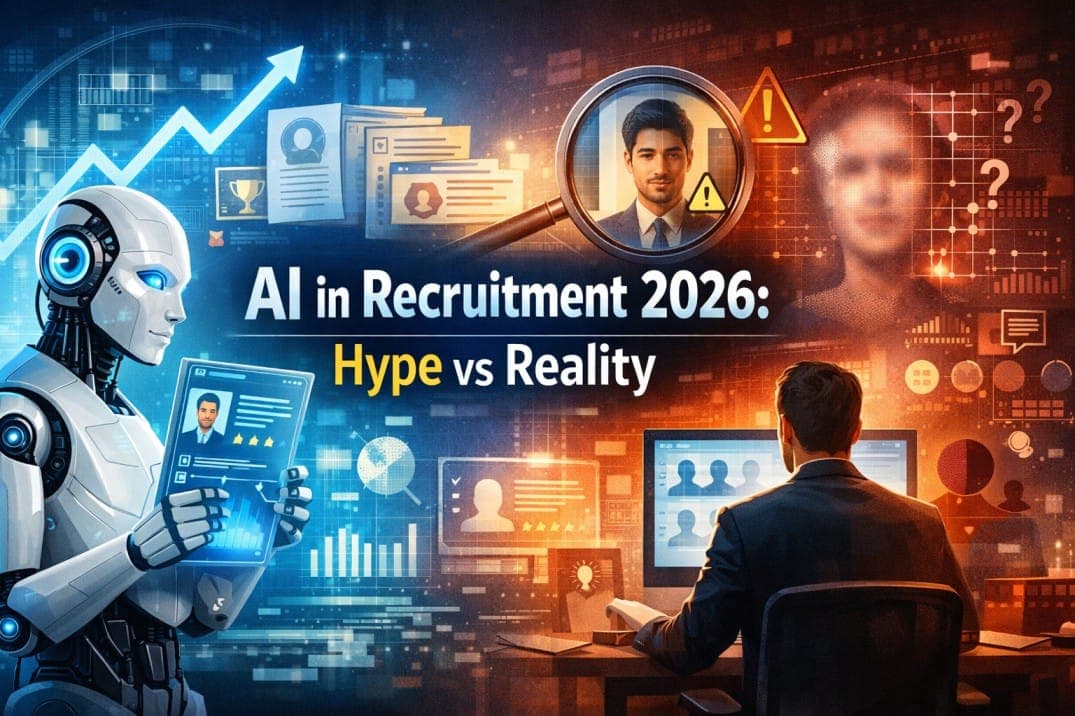
The AI Recruitment Revolution: Promise and Peril
If you have attended a single HR technology conference, read a talent acquisition blog, or spoken with a recruitment software vendor in the past two years, you have almost certainly been told that artificial intelligence is about to transform hiring forever. The promises are bold and sweeping: AI will screen thousands of resumes in seconds, eliminate human bias from hiring decisions, predict candidate success with unprecedented accuracy, and reduce time-to-hire from weeks to days. The pitch is compelling, the demos are slick, and the market is responding with enthusiasm. According to Gartner, global spending on AI-powered recruitment technology is expected to exceed 3.1 billion dollars in 2026, up from 1.8 billion in 2024.
But how much of this is reality, and how much is marketing hype? The honest answer is that AI in recruitment is simultaneously more powerful and more limited than most people realize. The technology has made genuine advances in specific, well-defined tasks like resume parsing, candidate matching, and
interview scheduling. But many of the grander claims, particularly around bias elimination, performance prediction, and fully automated hiring, are either premature, misleading, or fundamentally flawed. For HR leaders and startup founders in India, where the adoption of AI recruitment tools is accelerating rapidly, separating the genuine capabilities from the inflated promises is essential to making smart technology investments.
This article provides a clear-eyed assessment of where AI in recruitment actually delivers value in 2026, where it falls short, and how Indian companies can adopt these tools intelligently without falling into the
traps that have ensnared early adopters.
Where AI Actually Delivers: The Proven Use Cases
Resume Screening and Candidate Matching
The area where AI has delivered the most consistent, measurable value in recruitment is the initial screening of applications. Modern AI-powered applicant tracking systems can parse thousands of resumes in minutes, extracting structured data from unstructured documents with impressive accuracy. More importantly, matching algorithms can compare candidate profiles against role requirements using semantic understanding rather than simple keyword matching, which means they can identify relevant candidates even when the exact terminology differs. A candidate who describes their experience as 'building data pipelines for real-time analytics' can be matched to a role requiring 'streaming data infrastructure,' something that keyword-based systems consistently miss.
The impact is real and measurable. Companies using AI-powered screening report a 40 to 60 percent reduction in the time recruiters spend on initial resume review, freeing them to focus on higher-value activities like candidate engagement and interview preparation. For Indian startups that receive hundreds or thousands of applications for popular roles, this efficiency gain is significant. However, it is crucial to understand that AI screening works best as a filtering and ranking tool, not as a decision-making tool. The technology excels at narrowing a pool of 500 applicants to the most relevant 50, but the final evaluation still requires human judgment.
Interview Scheduling and Coordination
One of the most underappreciated applications of AI in recruitment is the automation of interview scheduling, a task that is purely administrative but consumes an extraordinary amount of recruiter time. AI scheduling assistants can coordinate across multiple calendars, manage time zone differences, handle rescheduling requests, and even send personalized reminders, all without human intervention. For companies hiring across India's multiple time zones or coordinating with global teams, this can save 5 to 10 hours per recruiter per week, which translates directly into faster hiring cycles and better candidate experience.
Candidate Sourcing and Outreach
AI-powered sourcing tools have become increasingly sophisticated at identifying potential candidates across platforms like LinkedIn, GitHub, and niche talent communities. These tools can analyze profiles, activity patterns, and career trajectories to predict which professionals might be open to new
opportunities, even if they are not actively job searching. More advanced systems can personalize outreach messages based on the candidate's background and interests, which significantly improves response rates compared to generic InMail templates. In India's competitive tech talent market, where the best candidates are almost always passive rather than active job seekers, this capability represents a genuine competitive advantage.
Chatbots and Candidate Experience
AI-powered chatbots have evolved from clunky, frustrating FAQ machines into genuinely useful assistants that can handle a surprising range of candidate interactions. Modern recruitment chatbots can answer questions about the role, the company, and the application process, pre-screen candidates against basic requirements, schedule interviews, and provide status updates throughout the hiring process. The best implementations achieve candidate satisfaction ratings comparable to human interactions while operating around the clock. For Indian companies hiring at scale, where the ratio of recruiters to open roles often makes personal attention impossible, chatbots represent a practical way to maintain a responsive,
professional candidate experience.
Where AI Falls Short: The Overpromised Capabilities
Bias Elimination: The Dangerous Myth
Perhaps the most troubling claim made by AI recruitment vendors is that their technology can eliminate or significantly reduce hiring bias. The reality is far more complex. AI systems learn from historical data, and if that data reflects existing biases in hiring patterns, which it almost certainly does, the AI will perpetuate and potentially amplify those biases at scale. Amazon's well-documented experience with its AI recruiting tool, which was found to systematically downgrade resumes from women, is not an outlier. It is a
predictable consequence of training algorithms on biased historical data.
In the Indian context, the risks are particularly acute. Training data from Indian companies may reflect systemic biases around educational institutions, regional backgrounds, gender, and even linguistic patterns. An AI system trained on a dataset where most successful hires attended IIT or IIM will learn to favor candidates from those institutions, not because they are inherently better but because the historical pattern reflects an existing bias. Similarly, AI systems that analyze language patterns may penalize
candidates who write in Indian English idioms rather than Western English conventions, disadvantaging candidates whose communication style is perfectly effective in the Indian business context.
The responsible approach is not to abandon AI screening but to treat it as a tool that requires careful monitoring and regular auditing. Any AI system used in hiring should be tested for disparate impact across demographic groups, and the results should be transparent and reviewable. Companies that
adopt AI screening should actively monitor whether the technology is narrowing or broadening their candidate pools, and they should maintain human oversight at every decision point.
Performance Prediction: Less Accurate Than You Think
Many AI recruitment platforms claim to predict candidate performance or job fit with high accuracy, often citing impressive-sounding metrics like 85 or 90 percent prediction accuracy. These claims deserve deep skepticism. Job performance is a complex, multi-dimensional outcome influenced by factors that extend far beyond the information available in a resume or even an interview, including team dynamics, managerial quality, organizational context, market conditions, and personal circumstances.
Academic research on the predictive validity of various hiring methods suggests that the best combination of assessments, structured interviews combined with work sample tests, achieves a validity coefficient of approximately 0.63. This is excellent by the standards of social science but still means that a significant portion of performance variance is unexplained. AI systems, regardless of how sophisticated their algorithms, are working with the same underlying data and are subject to the same fundamental
limitations. Any vendor claiming substantially higher predictive accuracy is either measuring something different from actual job performance or using a validation methodology that does not hold up to scrutiny.
Video Interview Analysis: Ethical Quicksand
One of the most controversial applications of AI in recruitment is the automated analysis of video interviews, where algorithms claim to assess candidates based on facial expressions, vocal patterns, body language, and word choice. Companies like HireVue have promoted this technology as a way to identify high-potential candidates objectively, but the scientific basis for these claims is increasingly questioned. A 2024 meta-analysis published in the Journal of Applied Psychology found no significant correlation between AI-assessed facial expressions during interviews and subsequent job performance.
Beyond the scientific concerns, video analysis raises serious ethical questions about consent, privacy, and discrimination. Algorithms trained on facial expressions may penalize candidates with certain disabilities, neurodivergent traits, or cultural communication styles that differ from the training data. In
India, where communication norms vary significantly across regions and cultural backgrounds, the risk of algorithmic discrimination through video analysis is particularly high. Several European countries have already moved to restrict or ban AI video analysis in hiring, and Indian companies would be wise to approach this technology with extreme caution.
Critical Question: Before adopting any AI recruitment tool, ask the vendor: 'What data was this system trained on? Has it been tested for disparate impact in the Indian market? Can you share the validation methodology and results?' If they cannot answer clearly, proceed with extreme caution.
The Indian Context: Unique Challenges and Opportunities
India's recruitment landscape presents both unique challenges and unique opportunities for AI adoption. On the challenge side, the sheer volume of applications that Indian companies receive, often hundreds or thousands per role, creates a genuine need for AI-assisted screening. The diversity of educational institutions, regional backgrounds, and career paths in India makes standardized evaluation difficult. And the rapid growth of the startup ecosystem means that many companies are building hiring processes from scratch, without the institutional knowledge that established companies have accumulated over decades.
On the opportunity side, India has several structural advantages for AI recruitment adoption. The country has one of the world's largest populations of AI and data science professionals, which means local expertise is available to customize and monitor AI tools. The digital-first nature of India's startup
ecosystem means that many companies are already generating the structured data that AI systems need to function effectively. And the scale of India's talent market, with over 5 million new graduates entering the workforce annually, means that the efficiency gains from AI screening are proportionally larger than in smaller markets.
The key to successful adoption in India is localization. AI recruitment tools developed for the US or European markets may not perform well in India without significant customization. Indian resumes follow different conventions, career paths are less standardized, educational credentials vary enormously in quality and relevance, and the cultural context of professional communication is distinct. Companies should prioritize tools that have been trained on Indian data or that can be fine-tuned to the local context, and they should invest in ongoing monitoring to ensure that the tools are delivering accurate and equitable results.
A Practical Framework for AI Adoption in Hiring
For Indian companies looking to adopt AI in their recruitment processes, here is a pragmatic framework that balances innovation with prudence.
Start with High-Volume, Low-Risk Applications
Begin your AI journey with use cases where the technology is proven and the risk of error is manageable. Resume screening, interview scheduling, and candidate communication are all areas where AI delivers consistent value with minimal downside. These applications also generate data that can help you evaluate the technology's effectiveness before expanding to more consequential use cases.
Maintain Human Decision Authority
Regardless of how sophisticated your AI tools become, keep humans in the decision loop for every hiring decision. AI should inform, prioritize, and augment human judgment, never replace it. This is not just an ethical imperative; it is a practical one. The complexity and stakes of hiring decisions, particularly for roles that significantly impact organizational outcomes, require the kind of contextual judgment, empathy, and adaptability that AI systems simply do not possess.
Audit Regularly for Bias and Accuracy
Establish a quarterly review process for any AI tools used in hiring. Analyze the demographic composition of candidates at each stage of the funnel. Compare AI screening decisions against human evaluations on a random sample. Track whether candidates identified as strong by AI actually perform well after hiring.
These audits are essential for catching algorithmic drift, the tendency of AI systems to become less accurate or more biased over time as the data environment changes.
Invest in Training Your Team
AI tools are only as good as the people who use them. Ensure that your recruiters and hiring managers understand both the capabilities and limitations of the technology. They should know how the AI makes its recommendations, what data it uses, and where it is likely to be wrong. This informed skepticism is the best defense against over-reliance on algorithmic outputs and ensures that human expertise remains the foundation of your hiring process.
The Future: What to Watch for 2027 and Beyond
Looking ahead, several emerging trends are worth monitoring. First, the integration of large language models into recruitment tools is creating new possibilities for personalized candidate engagement, intelligent job matching, and even real-time interview assistance for recruiters. However, these same
models introduce new risks around hallucination, data privacy, and the potential for generating plausible but inaccurate candidate assessments.
Second, the regulatory landscape is evolving rapidly. The European Union's AI Act, which came into force in 2025, classifies AI systems used in employment decisions as high-risk, imposing strict requirements around transparency, human oversight, and bias testing. India's own regulatory framework for AI is still developing, but companies that adopt strong governance practices now will be better positioned for whatever regulations emerge. Proactive compliance is not just risk management; it is a competitive
advantage in attracting talent that cares about ethical technology use.
Third, the skills-based hiring movement is creating new opportunities for AI tools that can assess competencies rather than credentials. As more Indian companies shift from pedigree-based to skills-based evaluation, AI systems that can accurately assess demonstrated abilities through portfolio analysis, coding challenges, and project evaluation will become increasingly valuable. This is an area where the technology is genuinely promising and where India's large, diverse talent pool stands to benefit significantly.
The Bottom Line
AI in recruitment is neither the silver bullet that vendors promise nor the existential threat that skeptics fear. It is a powerful set of tools that, when applied thoughtfully, can make hiring faster, more efficient, and in some cases more equitable. But it is also a technology that comes with real risks, particularly around bias amplification, false precision, and the erosion of human judgment in decisions that profoundly affect people's lives.
For Indian companies navigating this landscape, the winning strategy is informed pragmatism: adopt AI where it has proven value, maintain rigorous human oversight, invest in ongoing monitoring and auditing, and resist the temptation to outsource consequential decisions to algorithms that are less capable than their marketing suggests. The companies that get this balance right will hire better, faster, and more fairly. The ones that don't will discover that AI is only as good as the humans guiding it.
The future of recruitment is not artificial intelligence or human intelligence. It is artificial intelligence amplifying human intelligence, each compensating for the other's limitations. Build your hiring process on that foundation, and you will be well-positioned for whatever the next wave of technology brings.
Related reading: Savanna HR hiring solutions · EdTech Recruitment in Gurgaon (2026) · How to Choose the Best Recruitment Agency in Gurgaon (2026): 7 Standards That Matter
Frequently asked questions
Where does AI actually help in recruitment?
AI delivers the most value in well-defined tasks: parsing and screening resumes, matching candidates to roles by meaning rather than keywords, scheduling interviews, sourcing passive candidates and answering routine candidate questions. Companies using AI screening report spending 40 to 60 percent less recruiter time on initial resume review.
Can AI replace recruiters or make hiring decisions?
No. AI works best as a filtering and ranking tool, not a decision maker. It can narrow 500 applicants to the most relevant 50, but judging fit, motivation, culture and leadership still needs human recruiters and hiring managers. Claims of fully automated hiring or bias-free AI are premature.
How should Indian companies adopt AI recruitment tools?
Start with one clear problem such as screening time or scheduling, measure results before and after, keep a human in every hiring decision, check the tool for bias against your own candidate data, and ask vendors how their models work. Avoid buying on demos and broad promises alone.


