How AI Is Transforming Recruitment in 2026: 5 Shifts Employers & Job Seekers Must Know
In January 2026, McKinsey & Company did something that startled the consulting world. During final-round interviews for junior hires, the firm asked candidates to use Lilli — McKinsey’s proprietary AI assistant — in real time, evaluating them not on whether they could solve the case alone, but on how effectively they could collaborate with a machine. Interviewers scored candidates on how they prompted the system, assessed its outputs, and applied conclusions to a client scenario.
That single decision tells you more about where recruitment is heading than any market forecast ever could. The question is no longer “Will AI change hiring?” It already has. The question now is: Are you adapting fast enough — as an employer, as an HR leader, or as a candidate?
After analyzing the latest data from LinkedIn, Gartner, the World Economic Forum, and dozens of enterprise hiring platforms, five structural shifts emerge that are fundamentally rewriting the rules of talent acquisition in 2026. Here’s what they are — and what they demand from you.
Shift 1: From Tool to Teammate - The Rise of Agentic AI in Hiring
For years, AI in recruitment meant keyword-matching algorithms and chatbots that could schedule interviews. That era is over. In 2026, the dominant paradigm is “Agentic AI” — systems that don’t wait for a prompt but autonomously execute multi-step hiring workflows: sourcing candidates, screening resumes, conducting initial video assessments, and even negotiating interview slots.
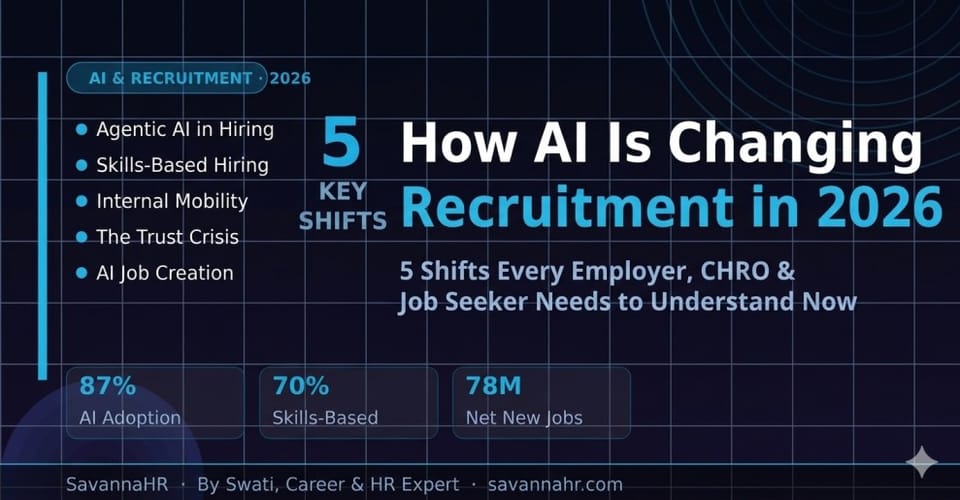
The numbers reflect this leap. Over 87% of companies now integrate AI into their hiring tech stack, with 93% of recruiters planning to increase AI usage this year. AI-powered chatbots and voice assistants handle approximately 75% of all candidate communications, and nearly one in three organizations now relies on AI to conduct initial screening interviews. The global AI-in-HR market has reached $6.25 billion and is projected to grow at a 24.8% compound annual rate through 2030.
But here’s what the adoption curve obscures: most organizations are still using AI as a faster version of their old process, not as a catalyst for rethinking the process itself. That’s the equivalent of using a smartphone only to make phone calls. The organizations pulling ahead are the ones redesigning their entire talent workflow around what AI makes possible — collapsing a 45-day hiring cycle into 12 days, matching internal talent to open roles before posting externally, and using predictive analytics to identify retention risks before an employee even updates their LinkedIn.
The strategic question for CHROs: Are you bolting AI onto a broken process, or rebuilding the process around AI’s actual capabilities?
Shift 2: The Death of the Degree -Skills-Based Hiring Goes Mainstream
If there’s one trend that AI has turbocharged beyond recognition, it’s the move from credential-based to skills-based hiring. The National Association of Colleges and Employers reports that 70% of employers in its 2026 Job Outlook survey now use skills-based hiring practices. McKinsey itself signalled the shift when it announced it would start “looking more at liberal arts majors, whom we had deprioritized,” seeking candidates who can make “discontinuous leaps” in thinking — something AI can’t do.
Why is this happening now? Because AI has made technical knowledge a commodity. When a junior analyst can prompt an AI to build a financial model in minutes, the differentiating skill isn’t Excel proficiency — it’s judgment, creative reasoning, and the ability to ask the right question in the first place. Employers are waking up to the reality that a four-year degree from a prestigious university is a proxy, not a predictor, of performance.
For job seekers, this is both liberating and terrifying. Liberating, because your non-traditional background may suddenly be an asset. Terrifying, because the goalposts have moved — and nobody sent a memo. If you’re relying on your credentials to get you through the door, you’re competing in yesterday’s game. The new currency is demonstrable skill, and AI tools are now sophisticated enough to assess it at scale.
For CHROs, the implication is structural: your job architecture, compensation bands, and promotion criteria were likely built around roles and titles. Skills-based hiring requires you to rebuild them around capabilities. That’s not an HR project. It’s an organizational redesign.
Shift 3: The Great Rebalance -Internal Mobility Over External Acquisition
The war for talent is shifting battlefields. Nearly 70% of organizations surveyed say they’ve prioritized internal mobility over the past year — and AI is the enabler that makes it work at enterprise scale.
Traditional internal mobility was a polite fiction. Managers hoarded talent. Employees discovered opportunities through word of mouth. HR had no visibility into adjacent skills. AI-powered talent marketplaces have changed all of that. These systems continuously map employee skills, identify adjacencies, surface stretch assignments, and recommend career paths that align individual aspirations with organizational needs. They turn static org charts into dynamic, self-optimizing talent ecosystems.
The economics are compelling. External hires cost 1.5 to 3 times more than internal moves, take longer to reach full productivity, and carry higher attrition risk. When AI can identify that your marketing analyst has 80% of the skills needed for a product management role — and recommend the exact training to close the gap — the ROI case for internal mobility becomes almost impossible to ignore.
For employees, this shift means your relationship with your employer is no longer a transaction (“skills for salary”) but a partnership (“growth for loyalty”). For job seekers evaluating potential employers, the question to ask in interviews is no longer just “What does the role look like?” but “How does your AI-powered talent marketplace support my long-term career development?”
Shift 4: The Trust Crisis- And Why It’s Your Biggest Competitive Risk
Here is the paradox at the heart of AI recruitment in 2026: adoption is soaring, but trust is collapsing.
87% of companies use AI in hiring.
Only 26% of applicants trust AI to evaluate them fairly.
66% of U.S. adults say they would avoid applying for jobs that use AI in hiring.
71% of Americans oppose AI making final hiring decisions.
Read those numbers again. You have a technology that nearly every employer has adopted — and that two-thirds of the talent pool actively distrusts. That isn’t a marketing problem. It’s a strategic vulnerability. In a tight labor market, the companies that lose candidates at the top of the funnel because of opaque AI screening are the ones that will struggle most to fill critical roles.
Harvard Business Review captured it bluntly in January 2026: “AI Has Made Hiring Worse — But It Can Still Help.” The article detailed how AI-generated applications have flooded employer pipelines (estimates suggest 40–80% of applicants now use AI to draft resumes and cover letters), while AI-powered screening on the employer side has created an arms race where both sides are automating against each other — and nobody is winning.
The companies solving this are doing three things: publishing their AI hiring practices transparently, maintaining meaningful human oversight at every decision point, and conducting regular third-party bias audits. These aren’t just ethical choices — they’re talent acquisition advantages. When candidates trust your process, they’re 18% more likely to accept an offer.
Shift 5: AI Creates More Jobs Than It Kills , But Different Ones
The headline-grabbing narrative is that AI is coming for everyone’s jobs. The data tells a more nuanced story. According to LinkedIn’s Economic Graph data, AI has already created 1.3 million new jobs globally between 2023 and 2025. McKinsey, far from cutting headcount, announced it will hire 12% more staff in 2026 than it did in 2025 — explicitly rejecting the narrative that AI replaces knowledge workers.
But — and this is the critical nuance — the jobs being created are fundamentally different from the ones being displaced. Companies are simultaneously laying off in recruiting, marketing, and experimental projects while aggressively hiring in AI, security, and core product development. The World Economic Forum’s latest projections estimate 170 million new jobs will be created by AI by 2030 — but 92 million existing roles will be displaced, for a net gain of 78 million that require entirely different capabilities.
For job seekers, the message is clear: AI literacy is no longer optional. Yet only 3% of U.S. LinkedIn members currently list AI skills on their profiles. That gap between demand and supply is where enormous career opportunity lives — for those willing to invest in building these skills now.
For CHROs, the challenge is workforce planning at a velocity that traditional annual planning cycles can’t support. You need rolling skills inventories, real-time labor market intelligence, and the organizational agility to redeploy talent as AI reshapes which roles matter and which ones don’t.
So What Do You Do With All of This?
Whether you’re a CHRO managing a transformation, an employer trying to hire the right people faster, or a job seeker navigating a market that feels increasingly automated and impersonal — the underlying imperative is the same: stop thinking of AI as a feature and start thinking of it as a fundamental shift in how talent and organizations find each other.
If you’re an employer: Audit your AI stack not for efficiency, but for trust. The 30% cost-per-hire savings mean nothing if you’re losing your best candidates because they don’t trust your process.
If you’re a CHRO: Redesign your talent architecture around skills, not roles. Invest in internal mobility infrastructure. And make AI governance a board-level conversation before regulators make it one for you.
If you’re a job seeker: Learn to work with AI, not against it. The candidates who thrive in 2026 are the ones who can demonstrate not just technical competence but creative judgment — the ability to ask the question the algorithm didn’t think to ask.
At Savanna HR, we sit at the intersection of AI capability and human judgment. We help organizations deploy AI-powered recruitment that is faster, fairer, and built on trust — because the future of hiring isn’t human or machine. It’s both, working together, at their best.
The companies that understand this will win the talent wars of 2026. The ones that don’t will wonder where all their best candidates went.